
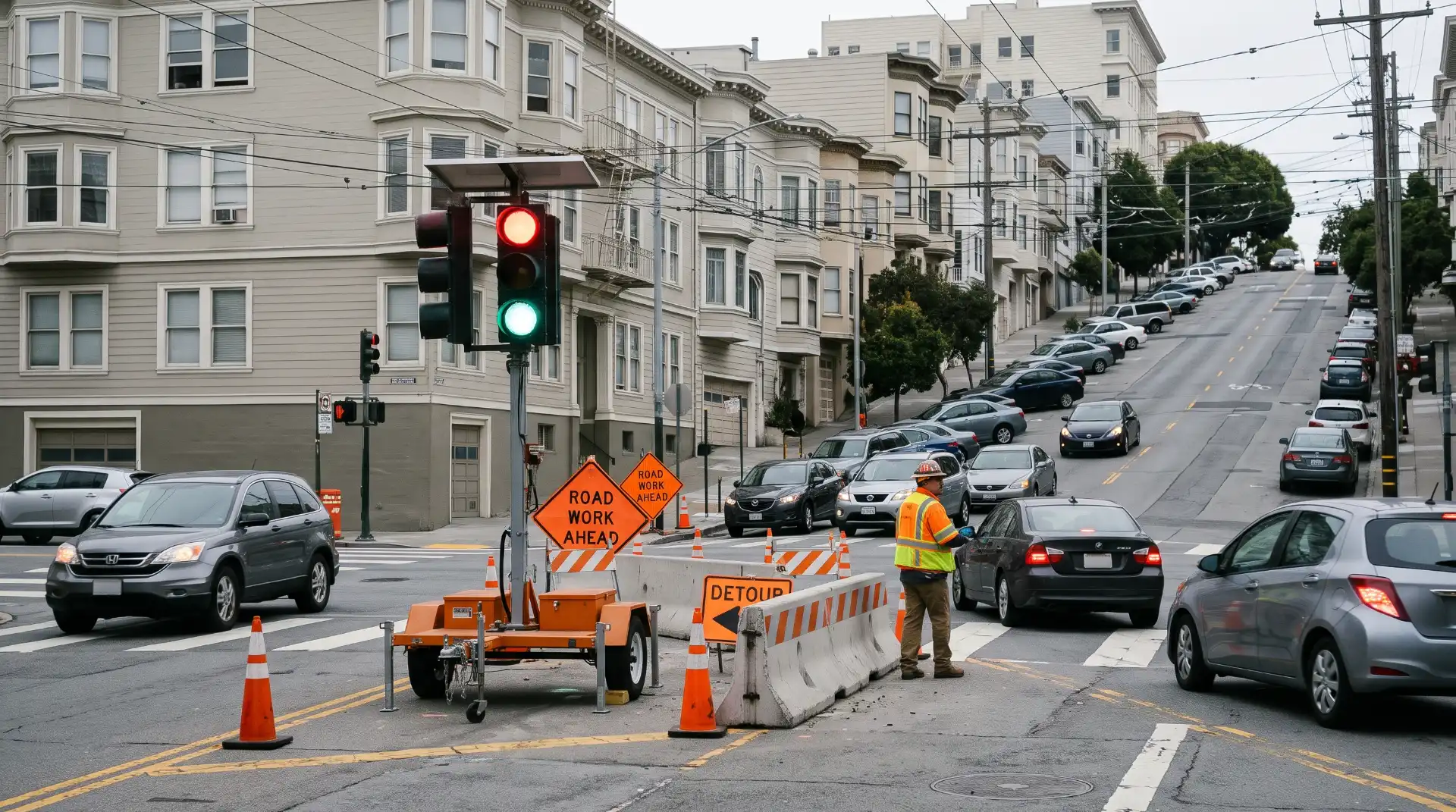
Temporary traffic signals are designed to keep drivers, pedestrians, cyclists, and road workers safe when ordinary traffic patterns change. They are commonly used during road construction, utility repairs, emergency road closures, and infrastructure improvement projects. In a busy city like San Francisco, these devices can be essential for managing traffic through narrow streets, construction zones, and intersections where normal traffic signals are temporarily unavailable.
However, a temporary traffic signal can create a serious hazard when it is improperly installed, incorrectly programmed, poorly maintained, difficult to see, or confusing to approaching drivers. A signal that displays conflicting instructions, changes at an unexpected time, or fails to coordinate traffic from opposite directions may contribute to a collision involving multiple vehicles or vulnerable road users.
When an accident occurs under these circumstances, determining who is legally responsible can be complicated. The driver involved in the collision may be partly responsible, but other parties could also bear liability depending on how the temporary signal was installed, operated, inspected, and maintained.
Potentially responsible parties may include a traffic-control contractor, a construction company, a signal equipment provider, a private utility company, the City and County of San Francisco, or another public agency responsible for the roadway. In some cases, several parties may share responsibility.
California law also imposes special requirements on claims against government entities. An injured person generally cannot establish public-agency liability merely by showing that a traffic signal was confusing or that a collision occurred near a construction site. The available evidence must support a legally recognized basis for liability.
This guide explains how unsafe temporary traffic signals can cause accidents in San Francisco, which parties may be held responsible, what evidence can help establish negligence, and what injured people should know about California personal injury claims.
Understanding Temporary Traffic Signals in San Francisco
Temporary traffic signals are used to manage vehicle and pedestrian movement when a roadway cannot operate under its normal conditions. Unlike permanent signals installed at established intersections, temporary devices may be moved, reprogrammed, or removed as construction and maintenance activities progress.
These signals are particularly useful when roadwork reduces a street to one usable lane, requiring vehicles traveling in opposite directions to take turns passing through a restricted area. They may also be used when a permanent traffic signal is temporarily disabled or when construction changes the normal arrangement of an intersection.
San Francisco presents distinctive challenges for temporary traffic control. Many streets are narrow, traffic volumes can be high, and motorists share road space with buses, delivery vehicles, cyclists, pedestrians, and commercial transportation services. A temporary signal that works adequately on a quiet road may require additional planning and safeguards when deployed on a crowded urban street.
For example, imagine a utility company repairing underground water infrastructure on a street with limited space for two-way traffic. Workers close one lane and install a portable signal at each end of the work zone. If both signals display green at the same time, vehicles traveling toward each other may enter the same restricted lane.
Another scenario involves a temporary signal that is positioned behind construction equipment or foliage. A driver approaching the intersection may not see the red indication until it is too late to stop safely. If the driver enters the intersection and collides with cross traffic, the investigation may need to examine both the driver’s actions and the visibility of the temporary signal.
Temporary traffic signals are not inherently unsafe. The central question is whether the equipment and traffic-control arrangement were reasonably designed, installed, operated, and maintained for the conditions in which they were used.
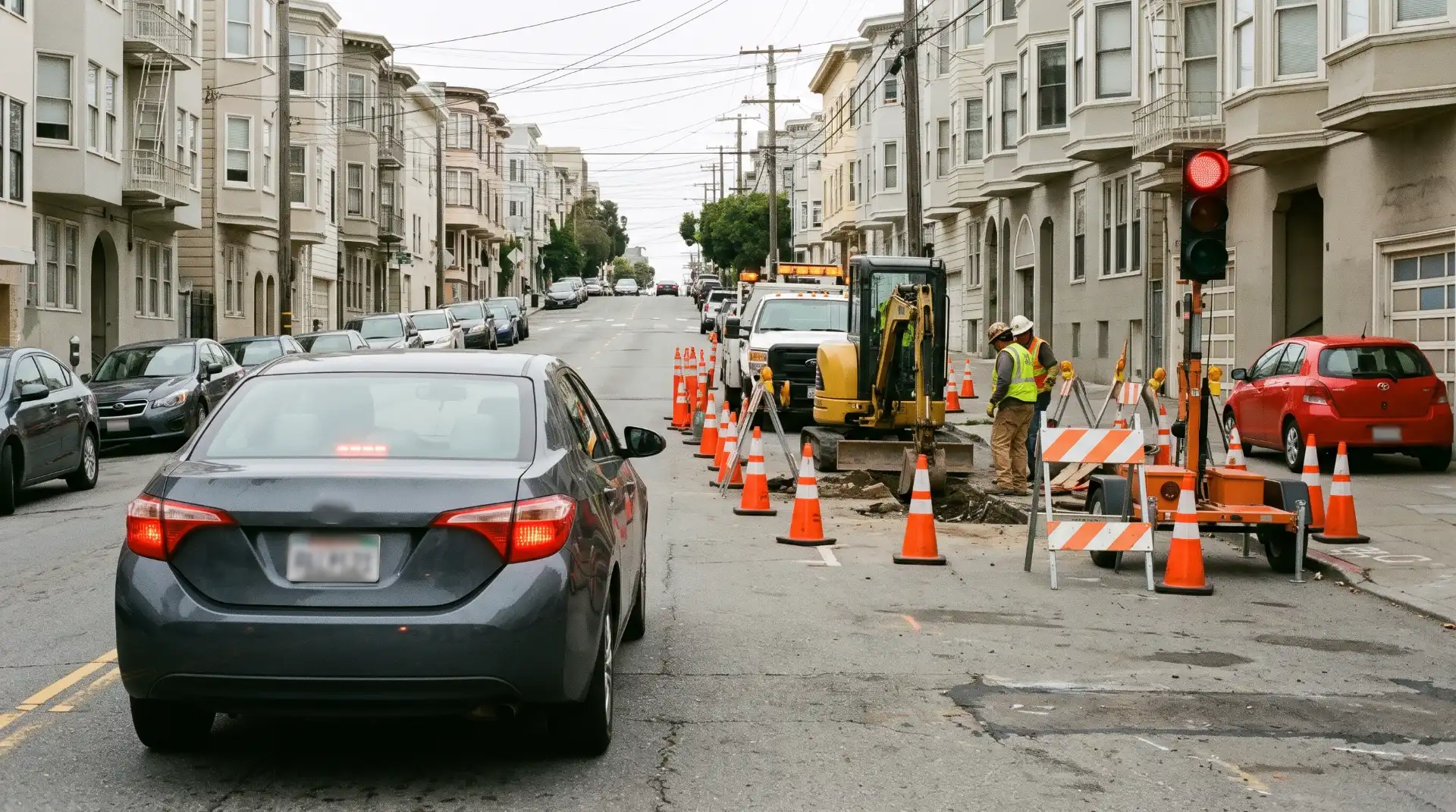
How Unsafe Temporary Traffic Signals Can Cause Accidents
A temporary signal can contribute to a collision in several different ways. Identifying the specific failure is important because different problems may point toward different responsible parties.
Conflicting Signal Indications
One of the most dangerous failures occurs when opposing traffic receives permission to proceed at the same time. A driver may reasonably rely on a green indication, only to encounter another vehicle entering the same space from a conflicting direction.
This situation can produce head-on collisions, side-impact crashes, and chain-reaction accidents involving vehicles that cannot stop before reaching the conflict point.
Investigators may need to examine the signal’s programming, timing records, controller settings, installation procedures, and maintenance history. They may also need to determine whether workers changed the signal configuration during construction without properly checking its operation.
Incorrect Signal Timing
Temporary signals must allow enough time for vehicles to travel through a controlled section of roadway and clear the area before opposing traffic is released. If the timing is too short, vehicles may still occupy the restricted lane when the opposing signal turns green.
This problem can be particularly serious where a work zone is long, traffic moves slowly, or large vehicles require additional time to pass through the area.
A collision involving a vehicle trapped in a one-lane work zone may raise questions about the signal timing, the distance between the signal heads, and whether the traffic-control plan accounted for actual roadway conditions.
Poor Visibility and Obstructed Signals
Drivers need a reasonable opportunity to see a signal and respond to its instructions. Temporary equipment may be obscured by parked vehicles, construction machinery, temporary signs, vegetation, or the geometry of the street.
Glare, darkness, fog, rain, and other weather conditions can also affect visibility. A signal placed around a sharp bend may be difficult to see even when its lights are functioning correctly.
The responsible party may depend on who selected the signal location, who controlled the work zone, and whether the obstruction was reported or should have been identified during inspections.
Equipment Failure and Power Interruptions
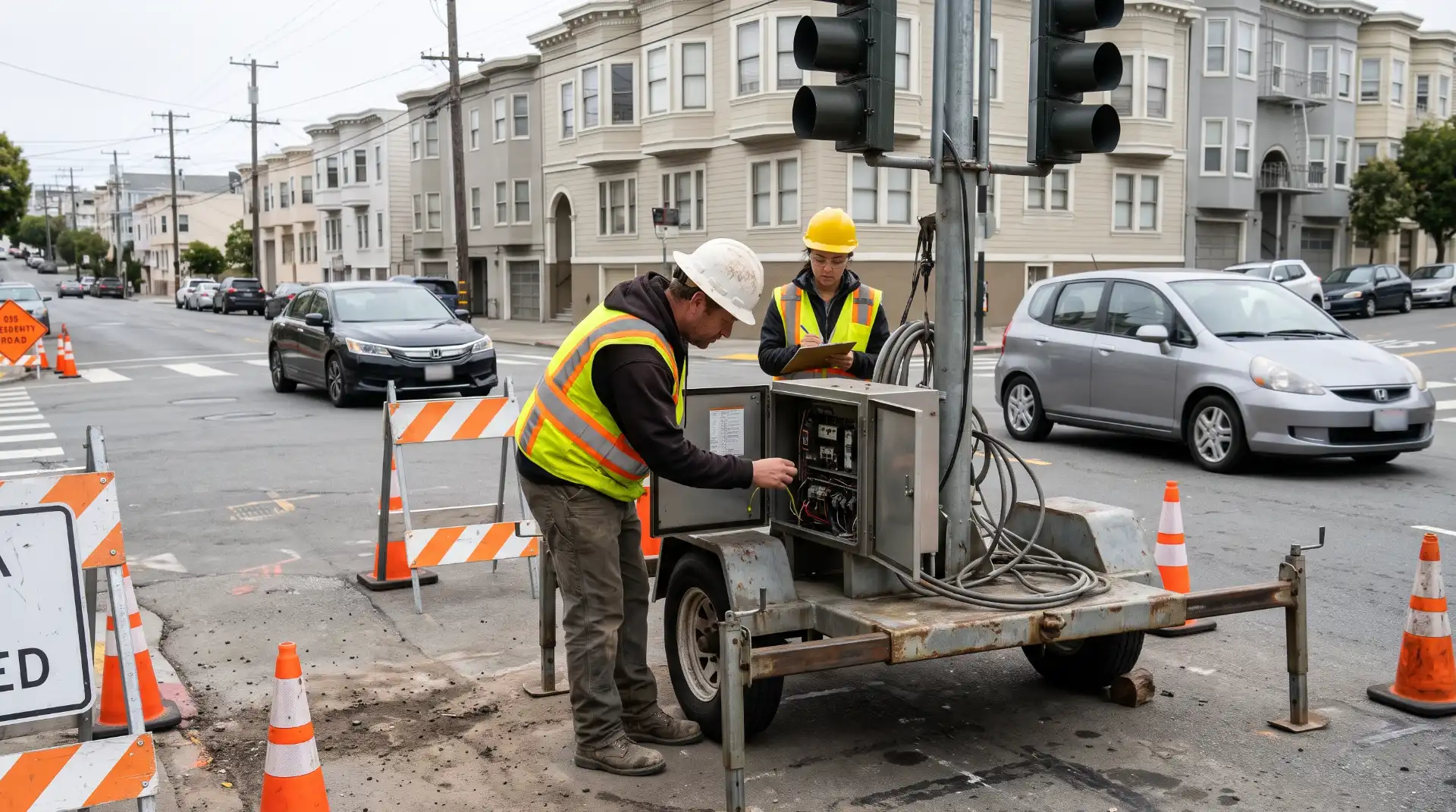
Portable traffic signals rely on electrical components, control systems, power supplies, and sometimes communication links between separate signal units. A malfunctioning controller, depleted battery, damaged connection, or interrupted communication may cause the system to operate unpredictably.
The equipment may display an incorrect indication, remain dark, or fail to coordinate with a signal at the opposite end of the work zone.
When a malfunction contributes to a crash, investigators should distinguish between an unexpected failure that could not reasonably have been prevented and a failure associated with inadequate maintenance, defective equipment, improper installation, or ignored warnings.
Confusing Signs and Inadequate Warnings
Even a functioning signal may be unsafe if drivers receive insufficient warning that traffic patterns have changed. A motorist may approach an unfamiliar intersection expecting normal traffic movement and encounter a temporary signal with little advance notice.
Missing warning signs, inconsistent instructions, poorly positioned cones, and unclear lane markings can make the signal more difficult to understand.
The investigation should consider the entire traffic-control arrangement rather than focusing exclusively on the signal head. A collision may result from a combination of equipment problems, inadequate warnings, and driver error.
Who May Be Liable for an Unsafe Temporary Traffic Signal Accident?
Liability depends on the circumstances of the collision, the duties assigned to each party, and the evidence connecting the alleged negligence to the injuries.
1. The City and County of San Francisco
A public agency may potentially be responsible when a dangerous condition of public property satisfies the requirements of California law.
For example, a public agency might be involved in planning a roadway project, approving a traffic-control arrangement, supervising public employees, or inspecting work performed on public streets. If a legally actionable dangerous condition exists and the necessary elements of public-entity liability are established, the agency may face a claim.
California Government Code Section 835 generally requires proof that the public property was in a dangerous condition when the injury occurred, that the condition caused the injury, and that the danger created a reasonably foreseeable risk of the type of harm suffered. The claimant must also establish either that a public employee’s negligent or wrongful conduct created the condition within the scope of employment or that the public entity had actual or constructive notice of the condition in sufficient time to take protective measures.
The statutory requirements are important. A public agency is not automatically liable whenever a temporary signal malfunctions on a city street.
The investigation must identify the specific dangerous condition, the agency’s relationship to the property, the applicable legal theory, and the evidence supporting each required element.
2. Private Traffic-Control Contractors
Public agencies and construction companies often hire specialized contractors to install, program, inspect, and maintain temporary traffic-control equipment.
A contractor may face liability if its negligent work contributes to an accident. Examples include incorrectly positioning a signal, failing to coordinate opposing signals, ignoring a known equipment problem, or leaving a dangerous arrangement in place after construction conditions change.
Consider a hypothetical project in which a contractor installs portable signals to manage traffic through a single open lane. The contractor incorrectly configures the controllers, allowing both ends of the work zone to display green simultaneously. A driver enters the lane and collides with an approaching vehicle.
If evidence establishes that the contractor’s negligent configuration caused the conflict, the contractor may be an appropriate defendant.
Relevant evidence may include installation records, programming instructions, inspection reports, work orders, maintenance logs, employee testimony, and communications concerning signal malfunctions.
The contractor’s exact responsibilities matter. Some agreements assign the contractor responsibility for the entire traffic-control system, while others divide responsibilities among multiple companies or agencies.
3. Construction Companies and Utility Contractors
A construction company or utility contractor may be responsible when its work creates an unsafe traffic-control arrangement or when it fails to address a known hazard within its control.
For example, a construction crew may move a temporary signal while adjusting the work zone but fail to restore it to a safe position. Alternatively, heavy equipment may block the signal’s visibility, or a lane closure may change the distance vehicles must travel through the controlled area without corresponding adjustments to the signal timing.
The company performing the physical work may not be the same business responsible for programming the equipment. Nevertheless, its conduct may still be relevant if it created the hazard, interfered with the traffic-control system, or failed to follow required safety procedures.
Investigators should identify which company performed each task and determine whether the work complied with the applicable contract, approved traffic-control plan, and safety requirements.
4. Temporary Signal Manufacturers and Equipment Suppliers
In some cases, the accident may involve a defective traffic-control device rather than negligent installation or maintenance.
A signal controller may contain a manufacturing defect, a component may fail prematurely, or the equipment may have a design characteristic that makes it unsafe under reasonably foreseeable operating conditions.
A product liability claim may be possible if the evidence supports a recognized theory of liability, such as a manufacturing defect, design defect, or failure to provide adequate warnings or instructions.
However, an equipment failure does not automatically prove that the manufacturer is responsible. Investigators must determine whether the product was defective, whether it was used and maintained appropriately, and whether the alleged defect caused the collision.
The equipment may also have been damaged after installation, modified by another party, or operated outside its intended specifications. Those circumstances may affect the analysis.
Preserving the physical equipment and its technical records can be especially important when a product defect is suspected.
5. Signal Maintenance Providers
Temporary signals may require repeated inspections during a construction project. Equipment can be displaced, damaged, exposed to weather, or affected by changing traffic patterns.
A maintenance provider may be liable if it fails to perform assigned inspections, disregards a reported malfunction, or does not repair a known problem within a reasonable period.
Suppose a portable signal repeatedly loses power, and a contractor receives reports that the lights are going dark during busy periods. If the contractor fails to investigate or implement appropriate precautions and a collision occurs during another outage, the prior reports may become important evidence.
The legal analysis will depend on the maintenance contract, the provider’s actual responsibilities, the timing of the reported problem, and whether the failure substantially contributed to the accident.
6. Negligent Drivers
Drivers must also be considered. A temporary signal can be defective or confusing without eliminating a driver’s responsibility to operate a vehicle reasonably.
A motorist who drives too fast for a construction zone, ignores a clearly visible red signal, follows another vehicle too closely, or fails to maintain a proper lookout may contribute to a collision.
California generally follows comparative negligence principles. Responsibility may be divided among parties when their conduct contributes to the same injury.
For example, a driver may enter a work zone against a clearly displayed red signal while a contractor has also installed an obstructed warning sign. If both failures contributed to the crash, the evidence may support allocating responsibility between them.
The driver’s conduct does not necessarily eliminate the liability of another party whose negligence created a dangerous condition. Likewise, a defective signal does not automatically excuse a driver who acted unreasonably.
7. Multiple Parties Sharing Responsibility
Some temporary traffic signal accidents result from a sequence of failures. A contractor may incorrectly program the signal, a maintenance provider may fail to identify the problem, and a driver may approach the work zone too quickly to respond to an unexpected hazard.
Each party’s potential responsibility must be evaluated separately.
Contracts, permits, work orders, insurance policies, and inspection records may help establish who controlled each part of the operation. Investigators should avoid assuming that the public agency, construction company, or driver is solely responsible before the evidence has been examined.
California’s comparative fault rules may allow responsibility to be apportioned among multiple parties, subject to the applicable legal requirements. The allocation can affect the amount an injured person ultimately recovers.
California’s Rules for Temporary Traffic Control
Temporary traffic-control arrangements are not supposed to be improvised without regard to safety. California has standards and guidance addressing how traffic should be directed through construction zones and other areas where normal road conditions have changed.
The California Department of Transportation publishes the California Manual on Uniform Traffic Control Devices, commonly called the California MUTCD. The 2026 edition became effective on January 18, 2026, and includes Part 6, which addresses temporary traffic control.
The manual provides standards and guidance for traffic-control devices, signs, signal operations, pedestrian safety, flagger control, and other work-zone considerations. Its provisions are relevant when examining whether a particular traffic-control arrangement complied with applicable requirements.
Readers can consult the official Caltrans California MUTCD 2026 resource for the current manual and its individual chapters.
The applicable requirements may depend on the road, the type of work, the responsible agency, the approved plans, and the contract specifications. A standard that applies to a state highway project may not resolve every question involving a city street.
Caltrans also publishes information about work-zone traffic-control resources, including traffic-control plans, temporary devices, and worker and road-user safety.
Why Compliance Matters
Evidence that a contractor or agency failed to follow an applicable traffic-control requirement may help explain how an unsafe condition developed. Investigators may compare the actual installation with the approved plan and examine whether the signal timing, placement, visibility, and warning signs were appropriate.
However, a departure from a guideline or technical standard does not automatically establish legal liability in every case. The legal significance of the requirement depends on the applicable law and the facts.
Similarly, compliance with a particular standard does not necessarily end the inquiry if other evidence suggests that the arrangement was unsafe under the actual conditions.
The important question is whether the evidence supports the elements of a legally recognized claim against the particular defendant.
How California Law Applies to Dangerous Public Property
Claims involving public roads and traffic-control systems require special attention because government agencies are subject to statutory rules governing liability.
Dangerous Condition of Public Property
Under California Government Code Section 835, a qualifying dangerous condition of public property may support liability when the statutory elements are established.
The condition must create a reasonably foreseeable risk of the type of injury that occurred, and the required connection to public-employee negligence or sufficient notice must be demonstrated.
For a temporary traffic signal accident, the alleged condition might involve a dangerous signal installation, a hazardous traffic-control configuration, or another qualifying feature of the public property.
The analysis is fact-specific. A claimant generally needs to identify the particular condition that made the property dangerous, rather than simply alleging that the intersection was unsafe because a crash occurred there.
Actual and Constructive Notice
Notice can be important when a public agency did not directly create the alleged dangerous condition.
Actual notice may exist when the agency knew about the problem and understood its dangerous character. Constructive notice may be established when the condition existed long enough and was sufficiently obvious that a reasonably adequate inspection system should have discovered it.
Suppose a temporary signal has repeatedly failed during a road project and the responsible agency receives documented complaints before a collision. Those complaints may help establish knowledge of the problem, depending on their content, timing, and the agency’s responsibilities.
In another situation, the signal may have malfunctioned only moments before the crash. If the agency had no reasonable opportunity to discover and correct the issue, the notice requirement may be more difficult to establish.
Maintenance records, complaint logs, inspection schedules, and communications between the agency and contractor can help clarify these issues.
Failure to Install a Signal Versus a Malfunctioning Signal
California law distinguishes between certain claims based solely on the absence of a traffic-control device and claims involving a dangerous condition created by an existing device or other roadway feature.
Government Code Section 830.4 generally provides that a condition is not a dangerous condition merely because specified regulatory traffic signals, stop signs, yield signs, or speed-restriction signs were not provided.
That limitation does not mean every claim involving a traffic signal must fail. A malfunctioning signal or a dangerous physical condition may raise different issues, depending on the facts and applicable statutory provisions.
For example, an allegation that an agency should have installed a new traffic signal is legally different from an allegation that an installed temporary signal displayed conflicting indications and created a foreseeable risk of collision.
Because public-entity liability can involve statutory exceptions and immunities, a claim should be evaluated under the specific legal provisions that apply to the alleged condition.
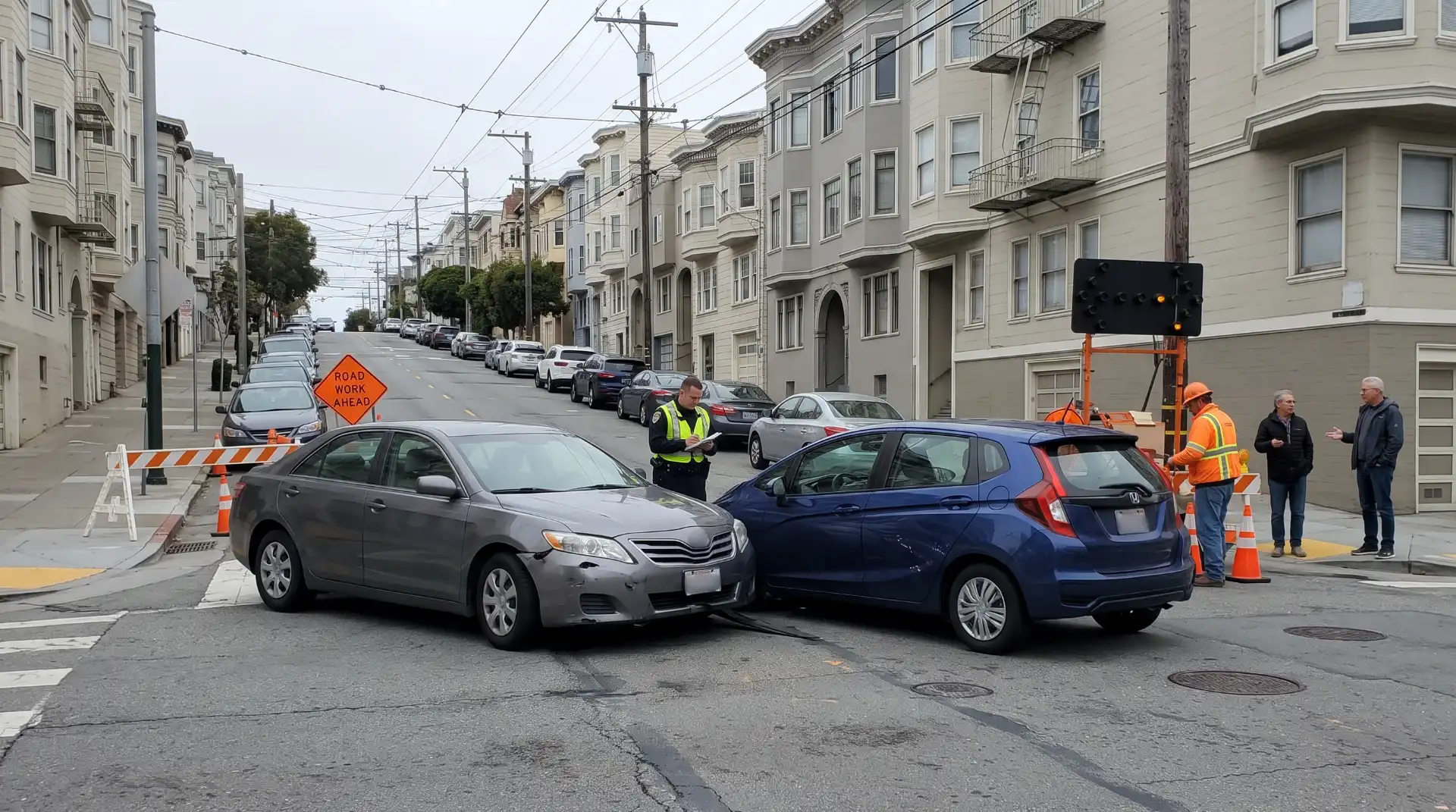
How to Prove That an Unsafe Temporary Signal Caused the Crash
A successful injury claim generally requires more than showing that a temporary signal was present when the collision occurred. Evidence must help establish what went wrong, who was responsible, and how the failure contributed to the injuries.
Photographs and Video Footage
Photographs of the intersection can document the signal’s position, visibility, surrounding signs, lane markings, cones, barriers, and roadway layout.
If possible, images should show the approach to the signal from the perspective of an approaching driver. A close-up photograph of the signal alone may not reveal whether a vehicle could see it in time to stop safely.
Dashcam footage, nearby business surveillance, residential cameras, and other recordings may show the sequence of events before the crash. Video can also help establish whether the signal displayed red, yellow, green, or no visible indication at a particular moment.
Because construction crews may move equipment or restore normal traffic patterns shortly after an incident, early documentation can be particularly valuable.
Witness Statements
Drivers, passengers, pedestrians, cyclists, construction workers, and nearby residents may have observed the signal before the collision.
Witnesses may be able to describe whether both directions received green indications, whether a signal was obscured, whether workers were manually directing traffic, or whether the equipment had malfunctioned previously.
Statements should be collected as accurately as possible. Investigators should distinguish between what a witness directly observed and what the witness inferred after seeing the crash.
Signal Controller and Maintenance Records
Technical records can help reconstruct how a temporary signal operated before and during an accident.
Relevant materials may include controller programming, timing configurations, fault logs, power records, maintenance reports, inspection checklists, and communications between the contractor and the project supervisor.
These records may show whether the equipment experienced a known fault, whether the signal had been reconfigured, or whether the installation differed from the approved traffic-control plan.
Because some electronic records may be overwritten or retained for limited periods, requests for preservation may need to be made promptly.
Construction Plans and Contracts
The approved traffic-control plan may show where signals were supposed to be placed, how traffic was expected to move, and which safety devices were required.
Contracts and work orders can help identify who was responsible for installation, programming, inspections, and repairs.
A comparison between the approved plan and the actual site conditions may reveal whether a contractor changed the setup without authorization or whether the planned arrangement failed to address a foreseeable hazard.
Vehicle Data and Accident Reconstruction
Modern vehicles may store data that helps investigators understand speed, braking, acceleration, or other aspects of a collision. The availability and detail of this information depend on the vehicle and its systems.
An accident reconstruction specialist may combine vehicle data with photographs, measurements, signal records, video footage, and witness statements to assess the sequence of events.
For related information, see the site’s article on Black Box Data After a Car Accident: How Vehicle Event Recorders Can Help Prove Fault in California.
Vehicle event data cannot necessarily establish what a temporary signal displayed. It is one potential source of evidence that may be useful when considered alongside the other available records.
What Injured People Should Do After a Temporary Signal Accident
The steps taken immediately after a collision can help protect health and preserve evidence. Safety should always come first.
Seek Medical Attention
Anyone who may have been injured should obtain appropriate medical evaluation. Some injuries, including certain head, neck, and internal injuries, may not produce obvious symptoms immediately.
Call 911 when emergency assistance is needed. Follow medical instructions and keep copies of records relating to examinations, treatment, prescriptions, rehabilitation, and follow-up appointments.
Medical documentation can help establish the nature and extent of the injuries, although the connection between an injury and a particular collision may require additional evidence.
Report the Collision
Report the accident to the appropriate law enforcement agency when required or appropriate. Provide a factual account of what happened and identify the temporary traffic signal as a possible contributing factor if that reflects what you observed.
Avoid guessing about the cause or accusing a particular contractor or agency without supporting information. Investigators can examine the evidence to determine whether the signal malfunctioned or whether another factor contributed to the crash.
Document the Scene When Safe
If it is safe to do so, photograph the temporary signal, nearby warning signs, traffic cones, barriers, lane markings, road conditions, and the general intersection layout.
Record the date, time, approximate location, direction of travel, and relevant weather or visibility conditions. If witnesses are willing to provide contact information, preserve it for follow-up.
Do not enter an active construction zone or approach moving traffic to obtain photographs. Never put yourself or another person at risk to collect evidence.
Preserve Relevant Documents
Keep the police report information, photographs, medical records, insurance correspondence, repair estimates, and receipts for accident-related expenses.
If you have dashcam footage, preserve the original file and create a backup. Avoid editing the original recording because the unaltered version may be more useful for investigation.
If the accident may involve a public agency or construction contractor, evidence preservation may require formal requests for records and communications.
Review the Appropriate Claim Process
For a general overview of the next steps after a collision, see What to Do After a Car Accident in San Francisco: A Step-by-Step Guide.
When you are considering compensation for injuries, the site’s guide on How to File a Personal Injury Claim After a San Francisco Car Accident provides additional background on the claim process.
An accident involving a public agency may require a different process from a claim against a private driver or contractor. Identifying the correct defendants and deadlines early can help prevent avoidable procedural problems.
Special Deadlines for Claims Against California Government Agencies
One of the most important issues in a potential claim against the City and County of San Francisco or another public entity is the filing deadline.
Under California’s Government Claims Act, a claim for personal injury or damage to personal property generally must be presented to the appropriate public entity within six months of the date the claim accrues, subject to statutory rules and exceptions.
This requirement is separate from the deadline that may apply to a later lawsuit. If a government claim is rejected, the deadline for filing suit may be as short as six months from the date the rejection notice is personally delivered or mailed, depending on the applicable provisions. Different rules may apply if the claim is not acted upon.
The details matter, and exceptions or other procedural requirements can affect the calculation.
The California Courts provide a practical explanation in their guide, Ask a Government Agency to Pay You by a Deadline.
A claim against a private contractor may be governed by different deadlines, but naming a contractor does not eliminate the need to consider potential public-entity claims. If both a government agency and private companies may be responsible, each claim must be evaluated separately.
Anyone who suspects that a public agency contributed to an accident should seek legal guidance promptly rather than assuming the ordinary personal injury lawsuit deadline applies to every defendant.
What Compensation May Be Available?
When negligence or another legally recognized basis for liability is established, an injured person may be able to pursue compensation for damages caused by the collision.
The available damages depend on the nature of the injuries, the evidence, applicable law, and the circumstances of the claim.
Medical Expenses
Potentially recoverable medical expenses may include reasonable costs associated with emergency treatment, hospital care, physician visits, diagnostic testing, medication, physical therapy, and other necessary treatment.
Future medical expenses may also be relevant when the evidence supports a need for continuing care.
Medical records, bills, treatment plans, and appropriate expert opinions can help establish the relationship between the collision and the claimed expenses.
Lost Income and Reduced Earning Capacity
An injured person may miss work during recovery. In more serious cases, injuries may affect the person’s ability to perform their usual job or earn income in the future.
Employment records, wage statements, tax documents, and medical evidence may help establish the financial impact.
The analysis should distinguish between income already lost and a potential reduction in future earning capacity.
Pain, Suffering, and Other Non-Economic Harm
Depending on the applicable law and evidence, damages may also include physical pain, emotional distress, and the effects of an injury on ordinary daily activities.
The value of these damages varies substantially with the facts. There is no single formula that reliably predicts the result of every temporary signal accident claim.
Property Damage
A vehicle damaged in the collision may require repairs or replacement. Documentation can include repair estimates, invoices, photographs, towing charges, and information about the vehicle’s value.
Property damage and personal injury claims may involve different evidence and insurance considerations, even when they arise from the same accident.
No particular recovery is guaranteed. The claimant must establish the applicable legal basis for liability and provide evidence supporting the damages sought.
How Comparative Fault Can Affect a Claim
California generally applies comparative negligence principles. This means that an injured person’s own negligence may reduce the damages recoverable rather than automatically preventing recovery.
For example, suppose a temporary signal is partially obscured by construction equipment, but a driver is also traveling too quickly for the work zone. If the evidence establishes that both the obstruction and the driver’s speed contributed to the crash, responsibility may be apportioned according to the applicable law.
A different result may follow if the driver had a clear view of the signal and ignored a red indication without a reasonable explanation.
Comparative fault analysis is fact-specific. It requires examination of what each party knew, what each party could reasonably have done, and how the relevant conduct contributed to the accident.
An injured person should not assume that a claim is automatically barred simply because an insurer alleges that the person was partly responsible. The evidence and the applicable law must be considered.
Common Challenges in Temporary Traffic Signal Accident Claims
These cases can be more complicated than ordinary vehicle collisions because the equipment, work zone, and responsibilities may change over time.
One challenge is identifying the correct defendant. A city may own the roadway, a utility company may have requested the work, a construction contractor may have hired a traffic-control company, and a separate vendor may have supplied the equipment. Each relationship must be examined.
Another challenge is obtaining records. Signal programming, inspection documents, construction plans, and communications may be held by different organizations. Some evidence may be maintained electronically or retained only for a limited period.
A third challenge is proving causation. A signal may have been defective, but the evidence must connect that defect to the particular collision and injuries. Conversely, a driver may have made a mistake while a separate unsafe condition also contributed to the outcome.
Finally, claims against public agencies require careful attention to statutory requirements and procedural deadlines. The legal analysis should not assume that the rules governing a private driver’s liability automatically apply to a government defendant.
These challenges make early evidence preservation and careful identification of the parties especially important.
Frequently Asked Questions
Can I sue San Francisco if a temporary traffic signal causes a crash?
Potentially, yes. A claim may be possible if the evidence establishes a legally actionable dangerous condition of public property and satisfies the applicable statutory requirements. The city is not automatically liable simply because an accident occurred on a public street or near roadwork.
Can a construction company be responsible for a malfunctioning temporary signal?
A construction company or traffic-control contractor may be liable if its negligent installation, programming, maintenance, or other work contributed to the collision. The specific contract, assigned duties, applicable standards, and evidence of causation will matter.
What if the temporary signal displayed green for both directions?
Conflicting green indications may be important evidence of a dangerous signal configuration. Investigators should preserve photographs, video footage, witness statements, controller records, and other evidence that can help establish what each signal displayed and why.
The exact cause still needs to be determined. A programming error, equipment defect, communication failure, or unauthorized change to the system may involve different parties.
How long do I have to file a claim against San Francisco?
A personal injury claim against a California public entity generally must be presented within six months of accrual, subject to applicable rules and exceptions. Other deadlines may govern a subsequent lawsuit. Because these requirements are strict, prompt legal review is advisable.
What if I was partly responsible for the accident?
California’s comparative negligence rules may allow an injured person to recover damages reduced by the person’s share of responsibility. The result depends on the evidence and the legal issues involved. Partial fault does not necessarily eliminate every possible claim.
What evidence is most useful in these cases?
Useful evidence may include photographs, dashcam recordings, witness accounts, police reports, signal controller logs, inspection records, maintenance reports, construction plans, contracts, and medical documentation. No single item is necessarily decisive; the evidence must be considered together.
Do temporary traffic signals have to follow California standards?
Temporary traffic-control arrangements must be evaluated under the applicable laws, standards, project specifications, and approved plans. The California MUTCD 2026 contains provisions addressing temporary traffic control. The precise requirements depend on the project and the circumstances.
Should I contact a lawyer after a crash involving a temporary signal?
Legal advice may be especially useful when the cause is uncertain, multiple parties may be responsible, serious injuries occurred, or a government agency may be involved. An attorney can help assess the available evidence, identify possible defendants, and evaluate applicable deadlines.
Conclusion: Identifying Liability After an Unsafe Temporary Signal Crash
An accident involving an unsafe temporary traffic signal in San Francisco may raise questions about driver negligence, construction practices, equipment failures, maintenance procedures, and government responsibility. The correct answer depends on the facts rather than the mere presence of a temporary signal.
A negligent driver may be responsible for ignoring a visible warning or driving unsafely through a work zone. A traffic-control contractor may be responsible for an improperly installed or programmed system. A construction company or maintenance provider may face liability if its work or failure to address a known hazard contributed to the collision. A public agency may also face a claim when the requirements for public-entity liability are satisfied.
The strongest investigations focus on identifying the specific failure, preserving evidence, determining who controlled the relevant equipment and roadway, and establishing how the alleged negligence caused the injuries. California’s special rules for government claims make early attention to deadlines particularly important.
If you have been injured in a collision involving a temporary traffic signal, consider obtaining medical care, preserving relevant evidence, and seeking advice about your legal options. A careful investigation can help clarify which parties may be responsible and what remedies may be available under California law.
This article is for general informational purposes only and is not legal advice. It does not create an attorney-client relationship. Laws, deadlines, and liability rules can depend on the specific facts of a case. Consult a qualified California attorney about your circumstances.