
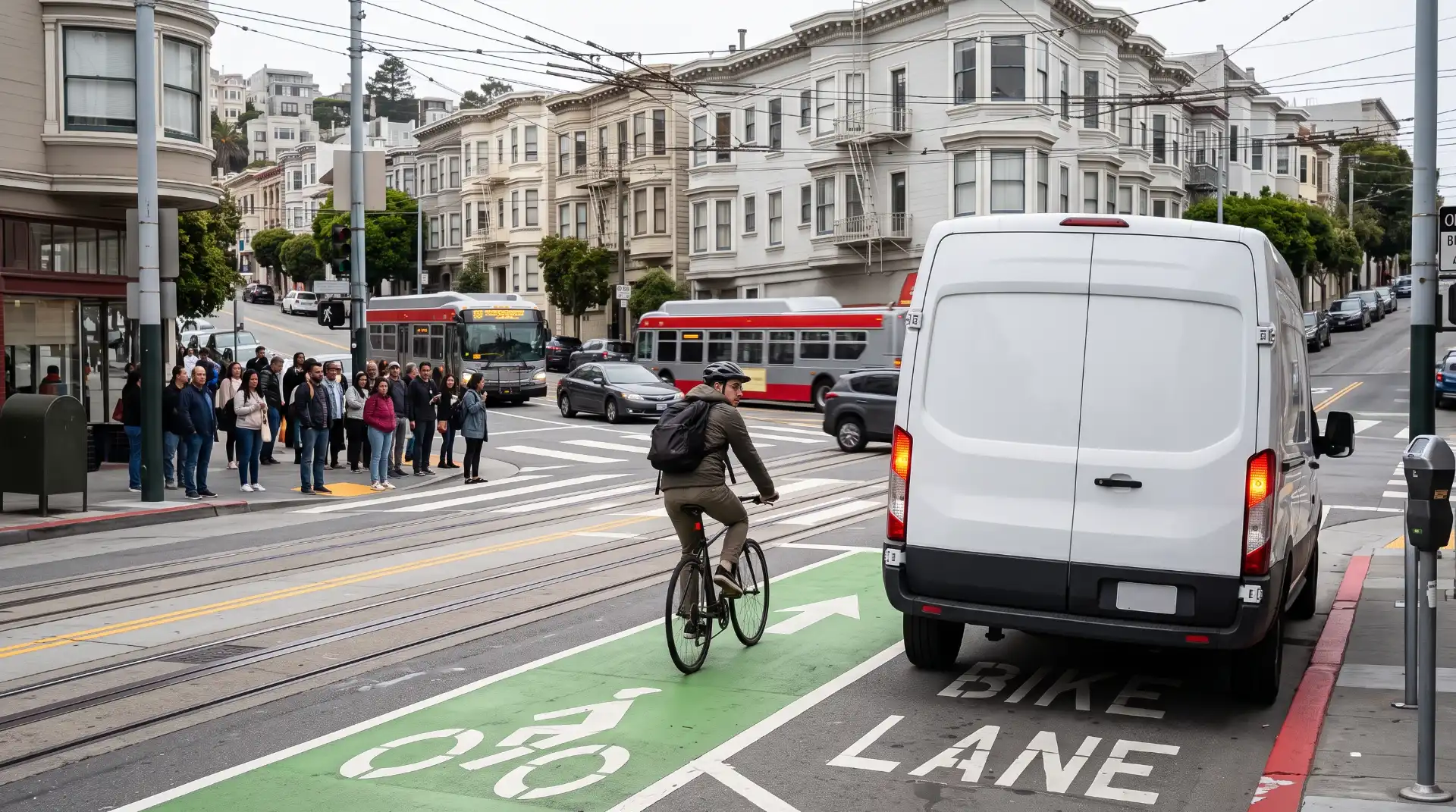
Delivery vans are an essential part of San Francisco’s economy, transporting packages, groceries, restaurant orders, business supplies, and other goods throughout the city. From downtown commercial districts to residential neighborhoods in the Mission, Richmond, Sunset, and SoMa areas, commercial vehicles regularly share limited road space with passenger cars, buses, cyclists, and pedestrians.
However, the growing demand for rapid deliveries has created additional traffic safety challenges. When drivers stop in bicycle lanes, park near crosswalks, or block intersections while unloading packages, they can create unexpected hazards for other road users. A delivery van may remain stationary for only a few minutes, but that brief obstruction can force a cyclist into moving traffic, conceal a pedestrian from an approaching driver, or cause a motorist to make a sudden maneuver.
When an accident occurs, determining who is legally responsible can be complicated. The delivery driver may have contributed to the crash, but the driver’s employer, a delivery contractor, a vehicle owner, or another party may also have potential liability depending on the circumstances. California traffic laws, insurance arrangements, employment relationships, and evidence from the scene can all influence the outcome.
Understanding liability after San Francisco delivery van accidents can help injured cyclists, pedestrians, motorists, and their families make informed decisions. It can also help delivery companies understand why safe loading procedures and lawful stopping locations are essential to protecting the public.
Why Delivery Van Accidents Are a Growing Concern in San Francisco
San Francisco’s streets present unique challenges for commercial delivery operations. Many neighborhoods have narrow roads, steep hills, closely spaced intersections, heavy pedestrian activity, and limited curbside loading space. In commercial areas, delivery vehicles must often operate near public transit stops, bicycle facilities, driveways, and busy pedestrian crossings.
Unlike suburban shopping centers with large parking lots and designated loading areas, many San Francisco destinations offer few convenient places for drivers to stop. A driver delivering packages to an apartment building may find that nearby curb space is occupied. A restaurant delivery driver may face a busy street with no immediately available loading zone.
These challenges can create pressure to stop wherever a small opening appears. Unfortunately, a location that looks convenient to the driver may obstruct a bicycle lane or interfere with the movement of other road users.
Delivery schedules can make the situation more difficult. Drivers may be expected to complete numerous stops within a limited period, and even short delays can affect their routes. However, pressure to deliver packages quickly does not automatically excuse unsafe driving or violations of applicable traffic regulations.
A driver who cannot find an appropriate stopping location must still consider the safety of cyclists, pedestrians, and motorists. Businesses should also establish realistic schedules and procedures that discourage dangerous stopping practices.
Why Bicycle Lanes Are Particularly Vulnerable
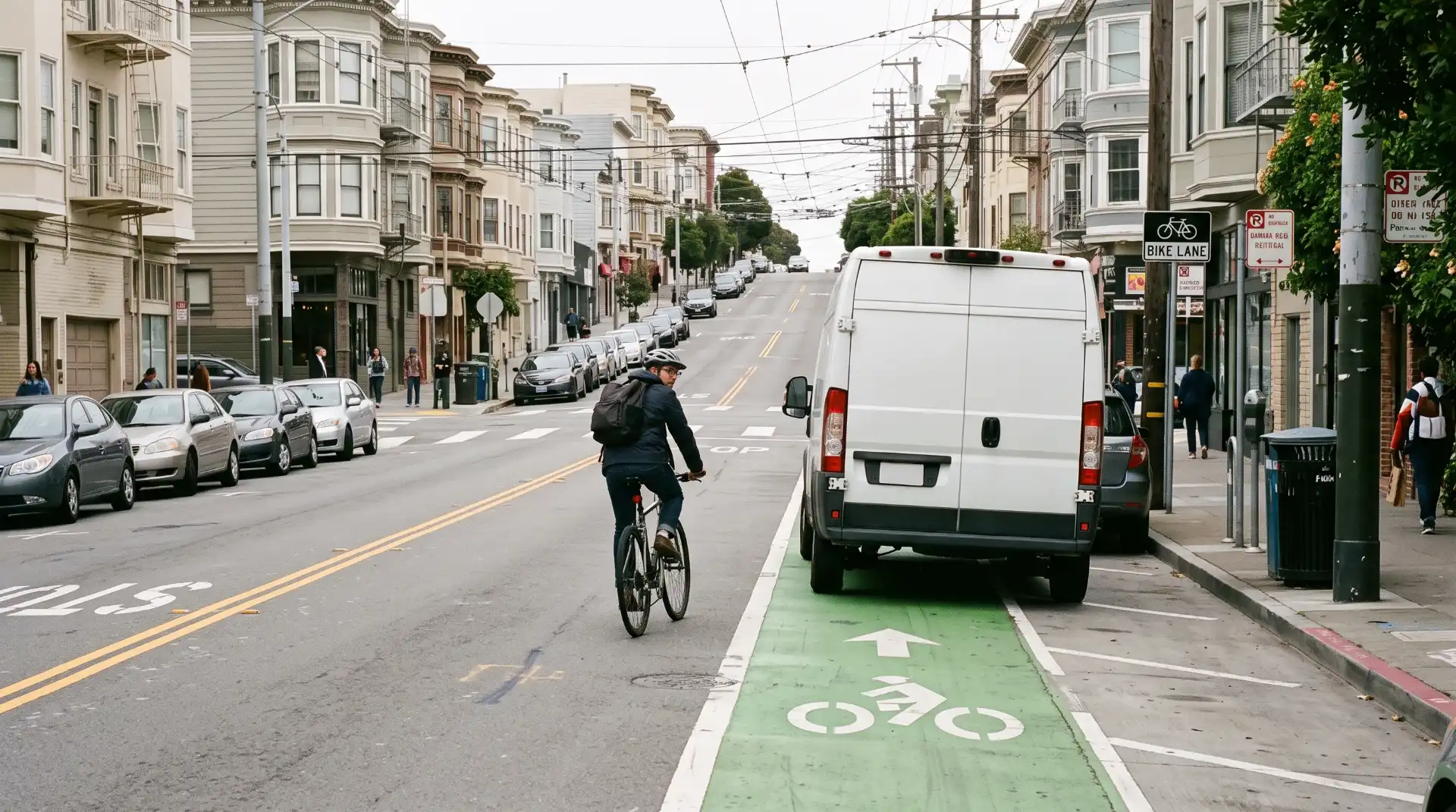
Bicycle lanes provide designated space for cyclists to travel through streets where motor vehicles may be moving at considerably higher speeds. Depending on the roadway, the bicycle facility may be painted directly on the pavement, separated by a buffer, or protected by physical barriers.
When a delivery van blocks that space, cyclists may have to stop suddenly or move into a neighboring traffic lane. They may also need to navigate around parked vehicles, open car doors, or other obstacles while checking for approaching traffic.
These movements can be especially dangerous on busy streets where drivers are not expecting cyclists to leave their designated travel paths. A cyclist may have only a few seconds to decide whether to brake, wait behind the van, or move around it.
The danger is not limited to the immediate obstruction. A van can also block sightlines, conceal cyclists from turning motorists, and make it harder for drivers to anticipate how traffic will move through an intersection.
How Blocked Intersections Increase Collision Risks
Intersections are locations where vehicles, pedestrians, and cyclists frequently cross one another’s paths. Traffic signals, crosswalk markings, and lane assignments help establish predictable movements, but those safeguards become less effective when a vehicle obstructs the roadway.
A delivery van that extends into an intersection may prevent another driver from completing a turn safely. A van stopped near a crosswalk may make it difficult for motorists to see pedestrians waiting to cross. A cyclist attempting to pass the vehicle may also enter a space where turning drivers are not expecting a bicycle.
These conditions can lead to rear-end collisions, sideswipes, pedestrian impacts, and crashes involving multiple vehicles.
The location of the van is therefore an important part of an accident investigation. Investigators must determine whether the vehicle merely happened to be nearby or whether its position contributed to the sequence of events that caused the collision.
What California Law Says About Delivery Vans Blocking Bicycle Lanes
California traffic laws regulate the use of bicycle facilities and certain locations where vehicles may stop or park. The specific rule that applies depends on the road design, the location of the vehicle, the circumstances of the stop, and any applicable statutory exceptions.
California Vehicle Code Section 21211 addresses obstructions of certain bikeways and bicycle paths. The statute generally prohibits stopping or placing a vehicle or other object where it impedes or blocks the normal and reasonable movement of bicyclists on covered facilities, subject to the language and exceptions of the law.
Drivers should not assume that a delivery stop is permitted simply because the vehicle is stationary for only a short time. Nor should they assume that turning on hazard lights automatically authorizes them to occupy a restricted bicycle facility.
For the relevant statutory language, see California Vehicle Code Section 21211.
The exact application of this statute depends on the facility involved and the circumstances of the incident. Other traffic and parking regulations may also apply to a particular street.
When a Blocked Bicycle Lane Leads to a Collision
Consider a cyclist traveling along a San Francisco street when a delivery van stops directly in the marked bicycle lane. The cyclist checks for traffic and begins moving left to pass the van. At the same moment, a passenger vehicle approaches from behind and strikes the bicycle.
The passenger vehicle’s driver may argue that the cyclist moved unexpectedly into traffic. The delivery driver may contend that the cyclist should have waited. The cyclist may argue that the van created an avoidable obstruction that made the maneuver necessary.
Each argument must be evaluated using the available evidence.
Investigators may examine whether the delivery driver had a reasonable alternative stopping location, how long the van remained in the lane, whether the cyclist had sufficient visibility, and whether the passing motorist maintained a safe lookout.
The van’s position could be a significant contributing factor even if the van never physically touched the cyclist. However, an unlawful stop does not automatically make the delivery driver responsible for every subsequent collision. The evidence must establish the necessary connection between the conduct and the injuries.
Can a Delivery Driver Stop in a Bicycle Lane to Unload Packages?
The answer depends on the specific location and applicable law, but drivers should not assume that unloading packages gives them permission to obstruct a bicycle facility.
A delivery business should train its drivers to identify authorized loading areas and understand restrictions that apply to bicycle lanes, crosswalks, intersections, and other designated spaces. If the intended destination does not have a convenient loading location, the driver may need to use an appropriate alternative rather than create a hazard.
A brief stop can still be dangerous if it forces cyclists into traffic or blocks a driver’s view of a pedestrian. The duration of the stop may be relevant to the investigation, but it does not independently determine whether the stop was lawful or whether negligence occurred.
Liability When a Delivery Van Blocks a San Francisco Intersection
California Vehicle Code Section 22500 addresses locations where stopping, parking, or leaving a vehicle standing is generally prohibited, including specified circumstances involving intersections and crosswalks. The statute contains exceptions and qualifications, so the facts and precise location must be considered.
Drivers making deliveries should review the applicable restrictions rather than assume that any available curb space is suitable for unloading. Posted signs, roadway markings, and local regulations may impose additional requirements.
A blocked intersection can create several different types of hazards. A vehicle may obstruct the path of a turning car, conceal a pedestrian, reduce visibility between cyclists and motorists, or force another driver to enter an adjacent lane unexpectedly.
Pedestrian Accidents Near Obstructed Crosswalks
Imagine a delivery van stopped close to a marked crosswalk on a busy San Francisco street. A pedestrian begins crossing while an approaching driver is unable to see the person because the van blocks the driver’s view.
If the driver strikes the pedestrian, the investigation may examine the van’s location, the pedestrian’s position, the traffic signal, the driver’s speed, and the distance available to react.
The delivery driver’s conduct may be relevant even if the van never made contact with the pedestrian. A vehicle can potentially contribute to an accident by creating an obstruction that prevents other road users from seeing one another.
However, the presence of a van near the accident scene is not enough by itself to establish liability. The injured person must establish the necessary connection between the obstruction and the collision.
San Francisco’s street design can also affect the analysis. Investigators may need to determine whether the crosswalk was marked, whether traffic controls were operating properly, and whether parked vehicles or other obstructions contributed to the lack of visibility.
Visibility Problems and Turning Vehicles
A delivery van positioned near an intersection can interfere with a driver’s ability to see traffic approaching from another direction. A motorist attempting to turn may move forward cautiously but still lack a clear view of a cyclist or pedestrian.
If a collision occurs, the positions of the vehicles before impact can become important evidence. Photographs showing the van’s location relative to the intersection, traffic lanes, and crosswalk may help explain what each road user could see.
Visibility issues can also arise when a delivery van is stopped near parked cars or a corner where cyclists and pedestrians routinely cross. The investigation should consider the complete street environment rather than focusing exclusively on the final point of impact.
For additional information about the relationship between obstructed sightlines and accident responsibility, readers can explore this related article on our website: Daylighting and Safety Zones: How Blocked Sightlines Affect Crash Fault.
Who May Be Legally Responsible for a Delivery Van Accident?
Liability depends on the facts of the collision and the legal relationship between the parties involved. In some cases, the driver may be the primary responsible party. In others, a delivery company, contractor, vehicle owner, or maintenance provider may also face a claim.
The Delivery Van Driver
A delivery driver may be liable when negligent driving or an unsafe stopping decision causes an injury. Examples include obstructing a bicycle lane, stopping in a prohibited location, blocking a crosswalk, failing to check traffic before reentering the roadway, or opening a vehicle door into a cyclist’s path.
Drivers are expected to exercise reasonable care under the circumstances. This includes considering the likely movements of cyclists and pedestrians when choosing where to stop or maneuver.
If a driver knows that the van is obstructing a bicycle lane but leaves it there without taking reasonable precautions, that decision may become relevant to a negligence claim.
The circumstances of the stop also matter. A mechanical emergency, an instruction from a police officer, or another unexpected event could affect the legal analysis. Not every stop in a restricted location establishes negligence, and not every negligent stop necessarily causes a compensable injury.
The Delivery Company or Employer
A company may be legally responsible for an employee’s negligent conduct when the employee was acting within the scope of employment. This principle, commonly known as respondeat superior, can apply when a delivery employee causes an accident while performing assigned work duties.
For example, an employee completing scheduled deliveries may stop in a bicycle lane and cause a cyclist to swerve into traffic. If the employee was acting within the scope of employment, the employer may also face liability.
The analysis can become more complicated if the driver was performing a personal errand, acting outside assigned duties, or operating under a different arrangement. The actual employment relationship and the driver’s activities at the time of the accident must be examined.
Company procedures may also become relevant. Investigators may review whether drivers received appropriate safety training, whether the business provided reasonable instructions for finding loading zones, and whether delivery quotas encouraged unsafe stopping practices.
A demanding schedule does not automatically make an employer liable. The evidence must establish a legally recognized basis for responsibility and a connection between the conduct and the injury.
Independent Contractors and Delivery Platforms
Many commercial deliveries involve independent contractors, subcontractors, or third-party delivery platforms. These arrangements can make it more difficult to determine which company may be responsible for a driver’s conduct.
A business may classify a driver as an independent contractor, but that label does not necessarily resolve every legal question. California law may require a closer examination of the working relationship, the degree of control exercised by the business, the contractual arrangements, and the type of claim being pursued.
Investigators may need to determine who assigned the delivery, who controlled the route, who owned the vehicle, who maintained it, and who established the driver’s safety procedures.
A delivery company is not automatically liable simply because its package was being transported when the crash occurred. Conversely, a contractor designation should not be treated as conclusive proof that the company has no responsibility.
Vehicle Owners and Fleet Operators
The owner of a delivery van may be different from the driver or the company arranging the delivery. Some businesses lease vehicles, use third-party fleet operators, or rely on contractors who supply their own vans.
Vehicle ownership may affect insurance coverage and can raise additional legal questions. If negligent maintenance or an unsafe vehicle condition contributed to the accident, the owner or maintenance provider may also warrant investigation.
However, ownership alone does not automatically establish liability for every accident. The applicable legal basis, the vehicle’s use, the owner’s role, and the evidence must be considered.
Maintenance Providers and Other Third Parties
A collision may involve more than an unsafe stopping decision. Defective brakes, damaged tires, malfunctioning lights, or a faulty vehicle door could contribute to the crash.
If negligent repairs or a defective component played a role, a maintenance provider or manufacturer may potentially be responsible under the applicable legal principles.
For example, a van might stop unexpectedly because of a mechanical failure. Investigators would need to determine whether the driver could have moved the vehicle safely, whether warning measures were reasonable, and whether a maintenance problem contributed to the incident.
The investigation should distinguish between a van intentionally parked in a dangerous location and a vehicle that became disabled unexpectedly.
How California Negligence Law Applies to Delivery Van Accidents
A personal injury claim generally requires evidence that the defendant owed a duty of care, breached that duty, and caused legally recognizable harm. The precise elements and defenses depend on the type of claim, but these principles provide a useful framework for evaluating delivery van accidents.
The central question is not simply whether the van was parked illegally. Investigators must determine whether the conduct fell below the applicable standard of care and whether it contributed to the collision and resulting injuries.
Traffic Violations and Negligence
A violation of an applicable traffic law may provide important evidence in a negligence case. California’s negligence-per-se doctrine may apply in qualifying circumstances, but it does not automatically establish liability whenever a traffic violation occurs.
The legal analysis can involve whether the statute was intended to protect the injured person, whether the injury was the type the statute was designed to prevent, and whether the violation caused the harm. Other legal requirements and defenses may also apply.
For instance, evidence that a delivery van obstructed a bicycle lane may support a negligence argument if a cyclist was forced into traffic and injured. Evidence that a van blocked a crosswalk may be relevant when a pedestrian was struck after being forced to move around it.
Nevertheless, a parking citation does not necessarily resolve the entire personal injury claim. The injured person must still establish the required connection between the conduct and the claimed losses.
Foreseeability and Causation
Foreseeability is an important consideration when evaluating whether a driver’s conduct may create liability. A driver should recognize that blocking a bicycle lane can force cyclists to merge into traffic and that obstructing a crosswalk can interfere with visibility.
If a cyclist is struck while maneuvering around an improperly stopped van, the evidence may support the argument that the resulting danger was foreseeable. Similar questions may arise when a pedestrian is hit because a van conceals the pedestrian from an approaching motorist.
Causation can still be disputed. Another driver may have been speeding, a cyclist may have made an unexpected maneuver, or the collision may have resulted from circumstances unrelated to the van’s position.
A careful investigation should establish the timing, positions, movements, and visibility conditions surrounding the crash. This helps distinguish between a vehicle that merely happened to be nearby and one that played a meaningful role in causing the injury.
What Evidence Can Help Establish Liability?
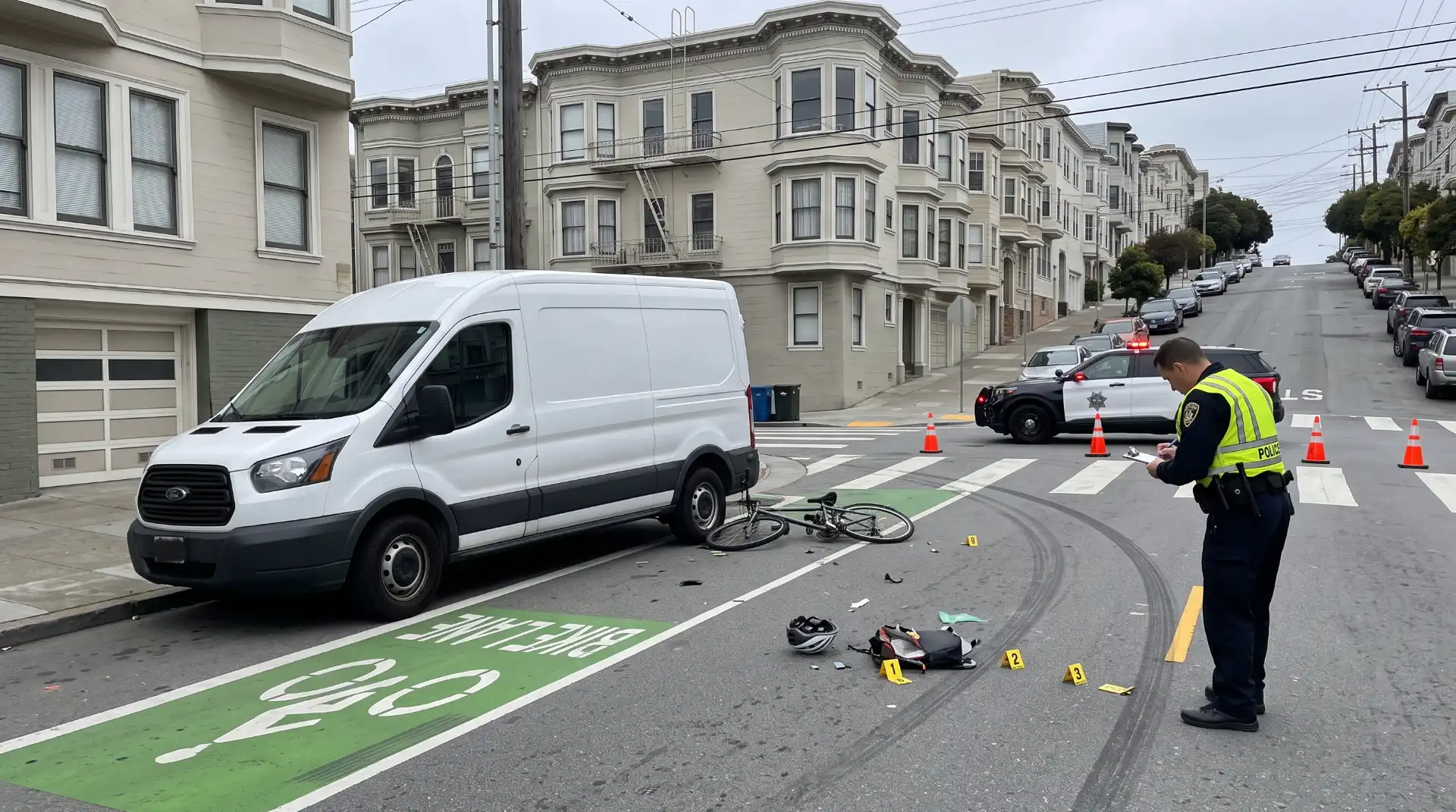
Evidence is often decisive in delivery van accident claims because the parties may offer different explanations for the same event. A van may move before investigators arrive, witnesses may leave, and surveillance footage may be erased.
A prompt investigation can help preserve information that might otherwise become unavailable.
Photographs and Video Footage
Photographs can document the van’s position relative to the bicycle lane, intersection, crosswalk, curb, and surrounding traffic. Images taken from multiple angles may help demonstrate whether the van obstructed visibility or left insufficient room for cyclists to pass.
Video footage can be particularly valuable. Nearby businesses, residential buildings, transit vehicles, traffic cameras, and vehicle-mounted cameras may have recorded part of the incident.
Footage may show how long the van remained stopped, whether the cyclist signaled before changing position, and how approaching motorists reacted. Recording availability varies, and some footage may be subject to privacy restrictions or limited retention periods.
Potential evidence should therefore be identified and preserved promptly through appropriate means.
Witness Statements and Police Reports
Witnesses may provide details that photographs cannot capture. A pedestrian may have seen the van enter the bicycle lane, while a nearby driver may have observed a cyclist forced to merge.
Statements are generally more useful when collected while memories remain fresh. Investigators should distinguish what each witness actually saw from assumptions about speed, distance, or fault.
A police report may document the vehicles involved, the location of the crash, statements from drivers, visible damage, road conditions, and any citations issued. It can provide a useful starting point, but it does not necessarily resolve every disputed issue.
The absence of a citation does not prove that a driver acted reasonably, just as a citation does not automatically establish every element of a personal injury claim.
Delivery Records and Company Documents
Commercial delivery records may help establish why the driver was in the area and whether the stop occurred during an assigned delivery. Depending on availability and applicable law, relevant materials may include route information, timestamps, dispatch messages, vehicle inspection records, and training documentation.
These records may clarify whether the driver was performing work duties and help identify the appropriate business or insurer. They may also reveal whether a vehicle had a known mechanical issue or whether a company had established procedures for finding legal loading locations.
Some business records may require formal legal procedures to obtain. An injured person should not assume that all relevant documents will be voluntarily provided.
Medical and Financial Records
Medical records help document the injuries attributed to the collision. They may include diagnoses, treatment recommendations, rehabilitation records, medication expenses, and information about continuing care.
Financial records can help establish lost wages, reduced earning capacity, medical expenses, and other measurable losses. Repair estimates and replacement receipts may support property damage claims.
Keeping these records organized can make it easier to evaluate the effects of the accident and respond to disputes about the nature or extent of the injuries.
What if the Cyclist or Pedestrian Shares Some Fault?
Delivery van accidents do not always involve one party whose conduct explains the entire collision. A cyclist may have changed lanes quickly, a motorist may have been traveling too fast, or a pedestrian’s movements may be disputed.
California generally follows a comparative negligence system. An injured person may still recover damages when partly responsible for an accident, although the amount recoverable can be reduced according to the applicable allocation of fault.
Suppose a cyclist is injured while going around a van that obstructs a bicycle lane. The delivery driver may have contributed by creating the obstruction, while a passing motorist may have contributed by failing to maintain a safe lookout. The cyclist’s own actions may also be examined.
An insurer might argue that the cyclist should have stopped rather than entering the traffic lane. That argument should be evaluated in context. A cyclist’s decision to maneuver around an obstruction does not automatically eliminate another driver’s potential responsibility for creating a hazardous condition.
The important distinction is between identifying a possible contribution to the accident and assuming that any mistake by the injured person prevents recovery. Under California’s comparative fault framework, responsibility may be apportioned according to the evidence and applicable law.
For more information about dangerous road conditions and accident responsibility, readers can also explore High-Injury Corridors in San Francisco: How Dangerous Streets Can Contribute to Car Accidents.
What Compensation May Be Available After a Delivery Van Accident?
When a person suffers injuries because of another party’s negligence, California law may allow recovery for certain economic and noneconomic losses. The damages available depend on the facts, the nature of the injuries, the evidence, and the legal basis for the claim.
Medical Expenses and Rehabilitation
Medical expenses may include emergency treatment, hospital care, diagnostic testing, physician visits, physical therapy, medication, and other reasonable treatment related to the accident.
Some injuries require continuing care long after the initial collision. A cyclist who suffers a fracture may need surgery and rehabilitation, while a pedestrian with a head injury may require specialist care and ongoing monitoring.
Future medical costs may also be relevant when supported by appropriate evidence. Claimants should preserve bills, treatment records, and documentation of medical recommendations.
Lost Wages and Reduced Earning Capacity
An injury can prevent someone from returning to work immediately or limit the tasks the person can perform. A worker in a physically demanding occupation, for example, may be unable to resume regular duties after a serious leg injury.
Lost earnings can sometimes be documented through pay statements, employer records, and tax documents. When an injury affects long-term earning potential, additional evidence may be necessary to evaluate reduced earning capacity.
The value of these losses depends on the person’s circumstances rather than a fixed amount for every collision.
Pain, Suffering, and Daily Limitations
Physical injuries may interfere with sleep, exercise, transportation, family responsibilities, and other everyday activities. Some people experience lasting pain, emotional distress, or anxiety about returning to cycling after a serious crash.
California law may permit recovery for certain noneconomic damages, including pain and suffering, when supported by the claim. These losses are not calculated in exactly the same way as medical bills or lost wages.
The severity and duration of the injury, its effect on daily life, and the available evidence can influence the evaluation.
Bicycle and Other Property Damage
A collision may damage a bicycle, helmet, phone, clothing, or other personal property. Repair estimates, replacement costs, photographs, and purchase records can help document these losses.
A bicycle that appears repairable may have structural damage that makes it unsafe to ride. An appropriate inspection can help establish whether repair or replacement is reasonable.
Property damage should be documented separately from personal injury losses so that each category can be evaluated accurately.
Steps to Take After a San Francisco Delivery Van Accident
The actions taken after a collision can affect both personal safety and the ability to document what happened. Anyone involved in a delivery van accident should prioritize immediate medical needs before attempting to investigate the incident.
Seek Medical Attention and Report the Collision
Anyone who may have been injured should seek appropriate medical care. Some injuries, including head injuries and internal trauma, may not be immediately apparent.
When appropriate or required by the circumstances, contact law enforcement to report the collision. Provide accurate information about the location, the vehicles involved, and any known injuries.
If the delivery van leaves the scene, note identifying details that can be recorded safely. Avoid assuming that an injury is minor simply because the person can walk away from the accident.
Document the Scene Safely
If it is safe to do so, take photographs of the van, the bicycle lane, the intersection, the crosswalk, vehicle damage, and relevant road signs. Record the approximate time and location, and collect contact information from witnesses who are willing to provide it.
Do not step into moving traffic to photograph a vehicle or confront a driver in a dangerous location. Safety should take priority over collecting evidence.
If the van has already moved, photographs of the surrounding street and nearby businesses may still help identify potential surveillance footage or witnesses.
Preserve Information About the Delivery Vehicle
Record the license plate and visible company information when doing so is safe and lawful. Note whether the van appeared to be operated by a delivery company, contractor, or another business.
Do not assume that the brand on a package identifies the vehicle’s owner or the driver’s employer. Some delivery operations involve subcontractors, leased vehicles, and separate insurance arrangements.
Accurate identification can help determine which parties and insurers should be contacted.
Communicate Carefully With Insurance Companies
Insurance representatives may request statements, photographs, medical information, and other documentation. Provide accurate information, but avoid speculating about the cause of the collision or agreeing to an unsupported estimate of fault.
Before accepting a settlement, understand its terms and whether it adequately addresses documented losses and possible future treatment. A settlement may affect the ability to pursue additional compensation for the same incident.
For additional information about legal options following a collision, see San Francisco Auto Accidents: Understanding Your Legal Rights.
A qualified California personal injury attorney can explain the available options, applicable deadlines, and potential issues involving multiple parties.
San Francisco Loading Zones and Local Traffic Rules
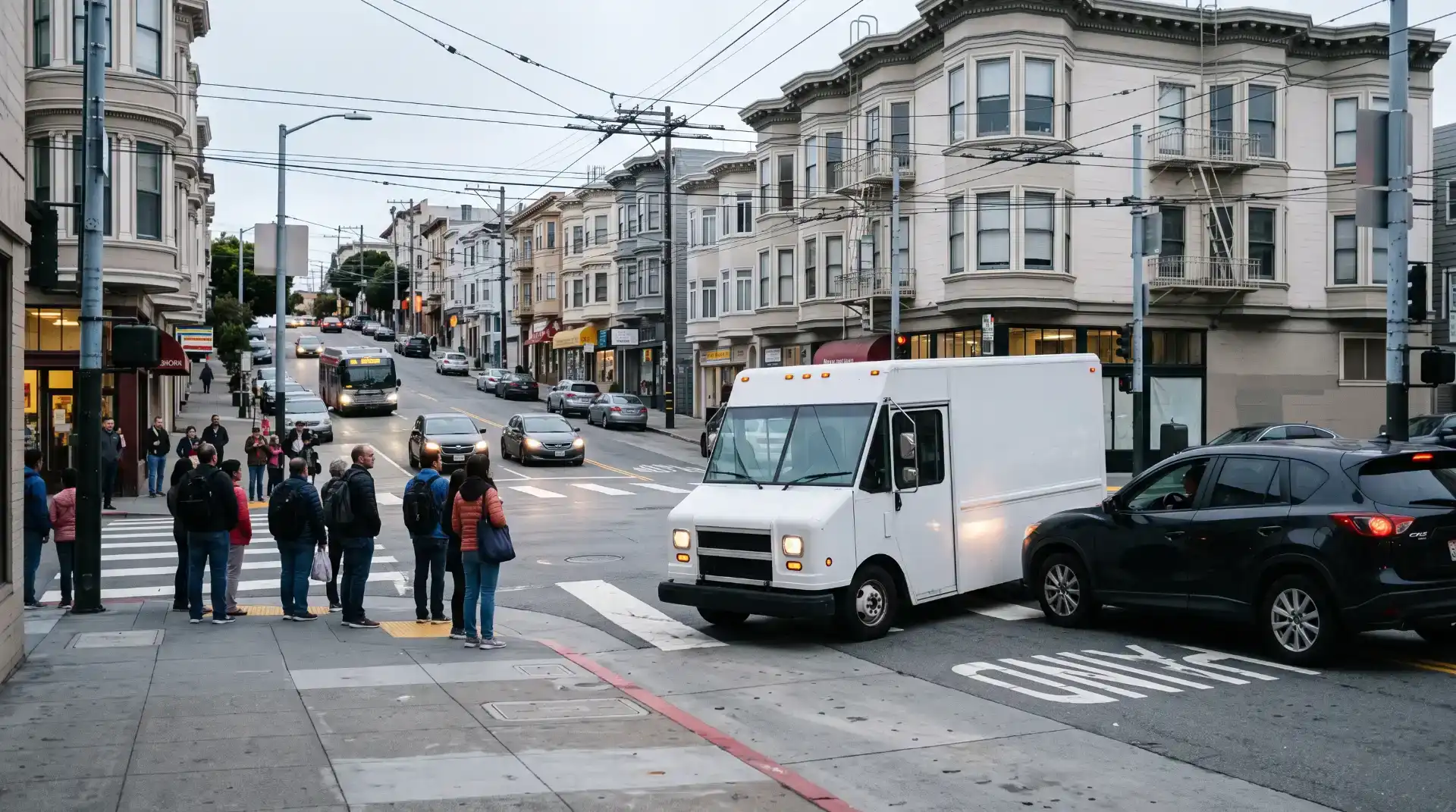
Understanding local loading restrictions is important for delivery businesses and people evaluating a collision. A location that appears convenient for unloading may be subject to restrictions involving bicycle lanes, crosswalks, transit operations, passenger loading, or commercial loading.
The San Francisco Municipal Transportation Agency administers important aspects of the city’s transportation system, including parking and curb management. Rules can vary by block, time of day, signage, and the type of curb or street facility.
Drivers should consult current local regulations and posted signs rather than assume that a brief stop is allowed everywhere. The San Francisco Municipal Transportation Agency provides information about local transportation services, parking, and regulations.
Why Hazard Lights Do Not Guarantee a Legal Stop
Delivery drivers sometimes use hazard lights to alert approaching traffic that their vehicles are stopped. Although this may improve visibility in some circumstances, hazard lights do not automatically authorize stopping in a prohibited bicycle lane, crosswalk, or intersection.
A driver must still consider whether the location is lawful, whether the vehicle creates an obstruction, and whether a safer alternative is available.
Businesses should train drivers to locate permitted loading areas and follow posted restrictions. When a delivery cannot be completed safely from the available curb space, the driver may need to find another location or follow the company’s approved procedure.
How Delivery Companies Can Reduce Risk
Commercial delivery operators can reduce avoidable hazards through better planning, training, and supervision. Route planning should account for urban loading restrictions, while drivers should receive clear instructions for situations where the intended delivery location has no available legal stopping space.
Companies can review incident reports, identify recurring problems along particular routes, and adjust schedules when drivers are consistently pressured to stop unsafely.
These measures benefit cyclists and pedestrians while also reducing vehicle damage, delivery interruptions, insurance disputes, and potential legal exposure for businesses.
How Long Do You Have to File a Delivery Van Accident Claim in California?
Deadlines are an important consideration after a delivery van accident. Under California Code of Civil Procedure Section 335.1, many personal injury actions generally must be filed within two years of the injury. However, the applicable deadline can vary based on the type of claim, the identity of the defendant, and other circumstances.
Claims involving a government entity may be subject to a separate administrative claims process with much shorter deadlines. Under California’s Government Claims Act, a claim for personal injury against a public entity is generally subject to a six-month presentation deadline, although exceptions and special rules may apply.
For example, a collision involving a privately operated delivery van will not necessarily follow the same process as a claim alleging that a public entity’s conduct contributed to the injury. The fact that an accident happened on a public street does not, by itself, make the government liable.
Because deadlines and exceptions can be fact-specific, anyone considering a claim should obtain legal advice promptly rather than rely exclusively on a general timeline. Waiting too long can also make evidence harder to obtain because video recordings may be erased, witnesses may become difficult to locate, and vehicle or delivery records may no longer be readily available.
Common Challenges in Delivery Van Accident Claims
Even when a van appears to have been stopped in an unsafe location, proving liability may require a careful review of disputed facts.
One challenge is determining whether the van actually caused the collision. A vehicle may have been illegally parked nearby without contributing to the impact. In other situations, the van’s obstruction may have forced a cyclist or motorist into a dangerous maneuver that directly preceded the crash.
Another challenge is identifying every potentially responsible party. A driver, employer, contractor, fleet operator, or maintenance provider may have played a different role in the events leading to the collision. The correct defendants cannot be determined solely from the appearance of the van.
Insurance coverage can also complicate the process. Commercial vehicle policies, personal automobile policies, and contractor coverage may contain different conditions and exclusions. Determining which policy applies may require reviewing the vehicle’s use, the driver’s status, and the circumstances of the delivery.
Finally, the extent of the injuries may be disputed. An insurer may question whether all reported symptoms resulted from the collision or whether additional treatment is necessary. Consistent medical documentation and a clear account of the incident can help address these issues.
These challenges do not necessarily prevent an injured person from pursuing a claim. They underscore the importance of preserving evidence and evaluating the facts carefully before reaching conclusions about liability or compensation.
Frequently Asked Questions About San Francisco Delivery Van Accidents
Can I pursue a claim if a delivery van forces me out of a bicycle lane?
Potentially, yes. If a delivery van obstructs a bicycle lane and a cyclist is injured while moving around it, the driver or another responsible party may be liable if the required elements of a negligence claim are established. The investigation should examine the van’s position, the cyclist’s movements, surrounding traffic, and whether the obstruction contributed to the collision.
Is a delivery driver automatically liable for stopping in an intersection?
No. A prohibited stop may be evidence of negligence, but liability for an injury claim generally requires a connection between the conduct and the harm. The circumstances of the stop, any applicable exceptions, and the actions of other road users must be considered.
Can I sue the delivery company instead of the driver?
In some cases, yes. A company may be responsible for an employee’s negligent conduct within the scope of employment or may face liability based on its own conduct. The appropriate legal theory depends on the employment relationship, the delivery arrangement, and the evidence.
What if the driver says there was nowhere else to park?
A lack of convenient parking does not automatically excuse an unsafe or unlawful stop. However, the circumstances may matter when evaluating what precautions were reasonable and whether an exception or emergency situation applied.
What if another motorist actually hit me?
The motorist who made physical contact with the cyclist or pedestrian may bear responsibility, but that does not necessarily eliminate the potential liability of a delivery driver whose obstruction contributed to the crash. Multiple parties may share responsibility when their conduct contributes to the same injury.
What evidence is most useful after a blocked bicycle lane accident?
Photographs, video recordings, witness statements, police reports, medical records, and documentation identifying the delivery vehicle can all be valuable. Evidence showing the van’s precise location and the sequence of movements before the collision may be especially important.
Should I accept an insurance settlement immediately?
Before accepting a settlement, consider whether the amount adequately addresses documented losses and whether future medical needs or other damages remain uncertain. A settlement may limit further recovery for the same incident, so it is important to understand its terms before agreeing.
Conclusion: Understanding Liability After a Delivery Van Accident
San Francisco delivery van accidents can involve more than a careless driving decision. A van stopped in a bicycle lane may force cyclists into moving traffic, while a vehicle blocking an intersection can conceal pedestrians and interfere with safe turning movements.
California traffic laws provide an important starting point for evaluating these situations, but the outcome of a personal injury claim depends on the specific facts. The driver’s conduct, the delivery company’s role, the vehicle’s ownership, the actions of other road users, and the evidence of causation may all influence liability.
For injured cyclists, pedestrians, and motorists, documenting the scene, obtaining appropriate medical care, preserving relevant evidence, and understanding applicable deadlines can help protect their interests. Delivery businesses can also reduce risk by providing realistic schedules, clear loading procedures, and training that prioritizes public safety.
When a collision involves significant injuries or disputed responsibility, a qualified California personal injury attorney can review the circumstances and explain the legal options available.
Disclaimer: This article is for general educational purposes and is not legal advice. California statutes and local regulations may change, and the application of any rule depends on the circumstances of the incident. Have a qualified California attorney review legal claims and statutory references before publication.