

A car accident can become especially frustrating when another driver causes a dangerous situation and then disappears before anyone can identify them. In San Francisco, crowded intersections, busy freeway entrances, narrow streets, steep hills, and heavy commuter traffic can make it difficult to follow what happened after a sudden collision. Sometimes a driver strikes another vehicle and flees. In other situations, a motorist suddenly cuts into a lane, forcing another driver to swerve and crash without making direct contact.
These incidents are often described as phantom vehicle accidents. The term generally refers to a collision or crash sequence allegedly caused by an unidentified vehicle. Depending on the circumstances, the incident may also be described as a hit-and-run, an unidentified-driver accident, or a no-contact crash.
The important question for injured people is whether compensation is available when the driver responsible cannot be found. The answer depends on how the accident occurred, what evidence exists, the insurance coverage available, and the legal requirements that apply under California law.
A person injured by an unidentified driver may have options through uninsured motorist coverage in some circumstances. However, California has specific requirements for uninsured motorist bodily injury claims involving an unknown vehicle. One of the most important is the physical-contact requirement. If an unidentified vehicle causes a driver to swerve but never touches the injured person or the vehicle they occupy, uninsured motorist bodily injury coverage may not be available under the applicable statutory provisions.
That does not necessarily mean every other source of recovery is unavailable. Collision coverage, medical payments coverage, health insurance, and other potential benefits may need to be considered, depending on the policy and circumstances.
Understanding the difference between a hit-and-run collision and a no-contact phantom vehicle incident can help San Francisco drivers make informed decisions after a crash.
What Is a Phantom Vehicle Accident?
A phantom vehicle accident generally involves a driver who claims that an unidentified vehicle caused or contributed to a crash. The other vehicle may leave the scene, may never be identified, or may cause a dangerous reaction without physically striking the injured person’s vehicle.
Consider a driver traveling along a busy San Francisco street. Another vehicle suddenly changes lanes without sufficient space, forcing the driver to brake hard. The driver loses control and strikes a parked car. The other motorist continues driving and cannot be located.
Another example might involve a vehicle that cuts across several lanes on a freeway entrance, forcing a nearby motorist to swerve into a barrier. If the vehicles never make contact and no one can identify the other driver, the incident may be described as a no-contact phantom vehicle accident.
A third situation is a conventional hit-and-run collision. An unidentified vehicle strikes the injured person’s car, damages it, or injures an occupant and then leaves without providing the required information or waiting for authorities.
Although these scenarios may appear similar, they can be treated differently when an insurance claim is evaluated. Physical contact, the nature of the injury, the available evidence, the applicable policy language, and California law can all affect the outcome.
Phantom Vehicle Accidents Versus Hit-and-Run Accidents
The terms “phantom vehicle accident” and “hit-and-run accident” are sometimes used interchangeably, but they do not always describe the same situation.
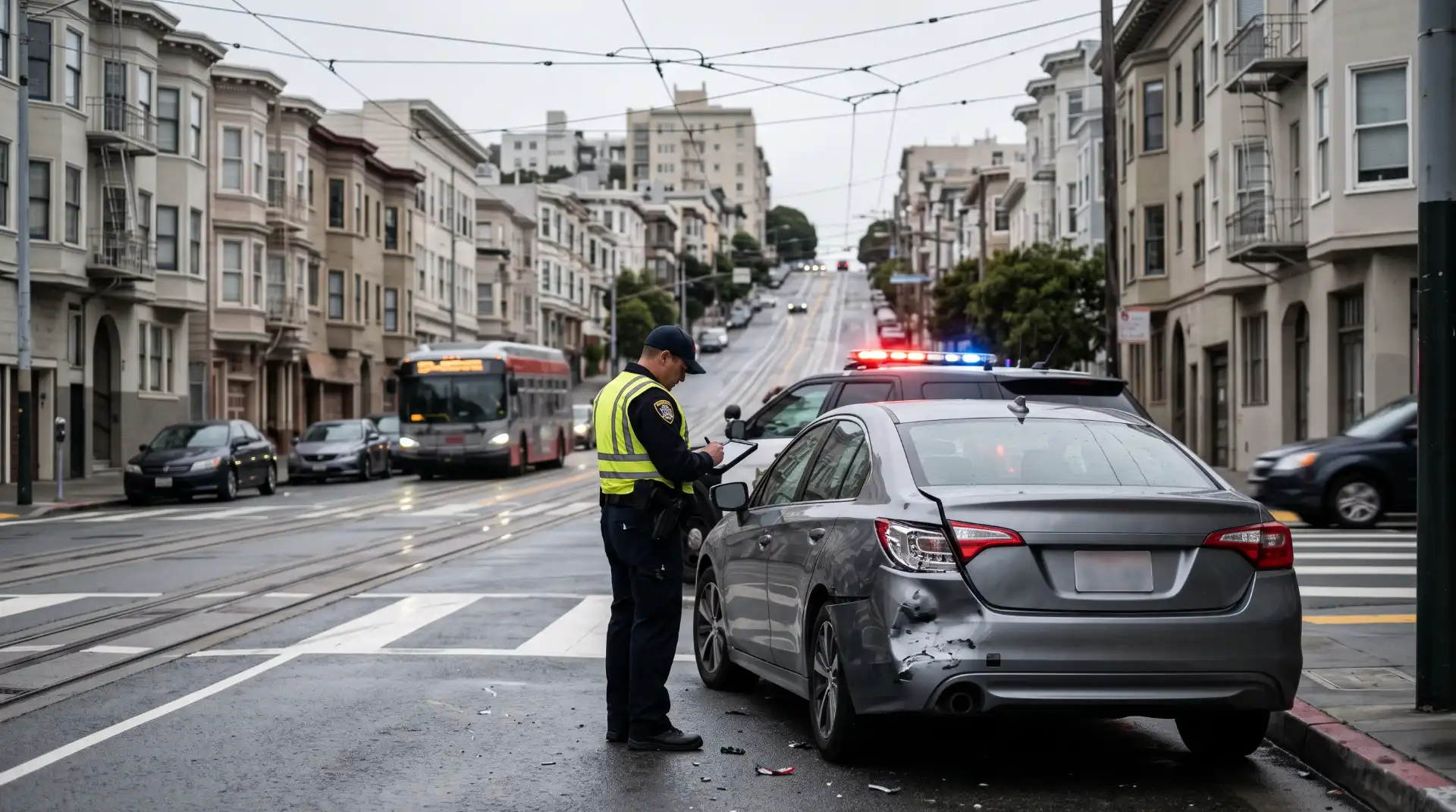
A hit-and-run accident commonly involves physical contact between vehicles, a vehicle and a pedestrian, or a vehicle and another object, followed by the responsible driver leaving the scene. For example, a driver may sideswipe another car and flee before the occupants can record the license plate.
A phantom vehicle incident can involve a similar situation, but the term is also used when the unidentified vehicle allegedly causes a crash without making contact. A driver might cut in front of another vehicle, trigger an emergency maneuver, and disappear while the second driver crashes.
This distinction matters because California Insurance Code section 11580.2 includes requirements for uninsured motorist bodily injury claims involving an unknown vehicle. In general, the statute addresses physical contact between the unknown vehicle and the insured person or the vehicle the insured occupies. It also includes specific reporting and sworn-statement requirements.
As a result, a driver should not assume that every crash caused by an unidentified vehicle automatically qualifies for uninsured motorist benefits.
The exact circumstances should be documented, and the applicable insurance policy and legal requirements should be reviewed carefully.
California’s Physical-Contact Requirement for Unknown Drivers
One of the most important issues in a phantom vehicle accident is whether physical contact occurred.
California Insurance Code section 11580.2 addresses uninsured motorist coverage and provides requirements for situations in which the owner or operator of the other vehicle is unknown. For applicable bodily injury claims involving an unknown vehicle, the statute requires the injury to arise from physical contact between the unknown vehicle and the insured person or a vehicle the insured is occupying.
This requirement can create a significant challenge after a no-contact accident.
Imagine a motorist who claims that an unidentified SUV suddenly entered their lane. The motorist swerves, hits a concrete barrier, and suffers serious injuries. The SUV disappears, and no physical contact occurred.
Even if the injured driver genuinely believes the SUV caused the crash, that belief alone may not satisfy the physical-contact requirement for an uninsured motorist bodily injury claim involving an unknown vehicle.
California courts have addressed this issue in cases involving drivers who swerved to avoid unidentified vehicles without physical contact. The result can be unfavorable for an injured person seeking uninsured motorist benefits, even when witnesses support the account of what happened.
That is why it is important to distinguish between evidence that a vehicle was present and evidence that the legal requirements for a particular type of insurance coverage have been met.
Important: A no-contact crash does not automatically eliminate every possible source of financial recovery. Collision insurance and other coverage may still need to be evaluated, depending on the policy, injuries, and facts. An insurer should not be assumed to cover a claim until the relevant policy terms have been reviewed.
California’s Reporting Requirements for Unknown-Vehicle Claims
California law also includes reporting requirements that may apply to uninsured motorist bodily injury claims involving an unidentified vehicle.
Under Insurance Code section 11580.2, the accident generally must be reported within 24 hours to the police department of the city where it occurred. If the accident occurs in an unincorporated area, the statute identifies the applicable sheriff’s office or local California Highway Patrol headquarters as reporting options.
The statute also requires a statement under oath to be filed with the insurer within 30 days thereafter, setting out the claim against the unidentified person and supporting facts.
These requirements can be important because an injured person might assume that telling an insurance adjuster about the crash is sufficient. However, the law describes specific steps for claims involving unknown vehicle owners or operators.
Anyone who believes they may have an uninsured motorist claim after a phantom vehicle incident should promptly review the requirements with their insurer and, when appropriate, a qualified California attorney. Waiting to report the incident may create avoidable problems.
Read the applicable statute here: California Insurance Code section 11580.2.
What Should You Do Immediately After a Phantom Vehicle Accident?
The first priority after any collision is safety. If someone is seriously injured, call 911 and request emergency assistance. Avoid standing in active traffic lanes or placing yourself at risk while attempting to follow another vehicle.
If it is safe to do so, document the scene before vehicles are moved or evidence disappears. Take photographs of the damaged vehicles, roadway, lane markings, traffic signals, debris, skid marks, barriers, and any visible injuries. If the other vehicle is still visible, do not endanger yourself by pursuing it.
Try to record as many identifying details as possible. These may include the vehicle’s color, make, model, body style, approximate age, direction of travel, visible damage, and partial or complete license plate information. Even a partial plate number may help investigators narrow the search.
Ask witnesses whether they saw the other vehicle or the events leading up to the crash. Obtain their names and contact details if they are willing to provide them. Witnesses may be able to explain whether the other driver made an unsafe maneuver, crossed a lane line, ran a signal, or struck the vehicle before leaving.
Report the incident promptly to law enforcement and obtain the report number. Explain what you observed without guessing about details you did not see. If you are uncertain whether the vehicles made contact, say so rather than presenting an assumption as a fact.
For a broader checklist, read What to Do After a Car Accident in San Francisco: A Step-by-Step Guide.
Why Evidence Is Especially Important When the Other Driver Disappears
When an identifiable driver remains at the scene, investigators can usually collect statements, insurance details, vehicle information, and other evidence directly from that person. When the other driver disappears, the investigation often depends more heavily on physical evidence and independent accounts.
Photographs can show where the vehicles came to rest, the direction of damage, the condition of the roadway, and the location of debris. These details may help investigators reconstruct the collision sequence.
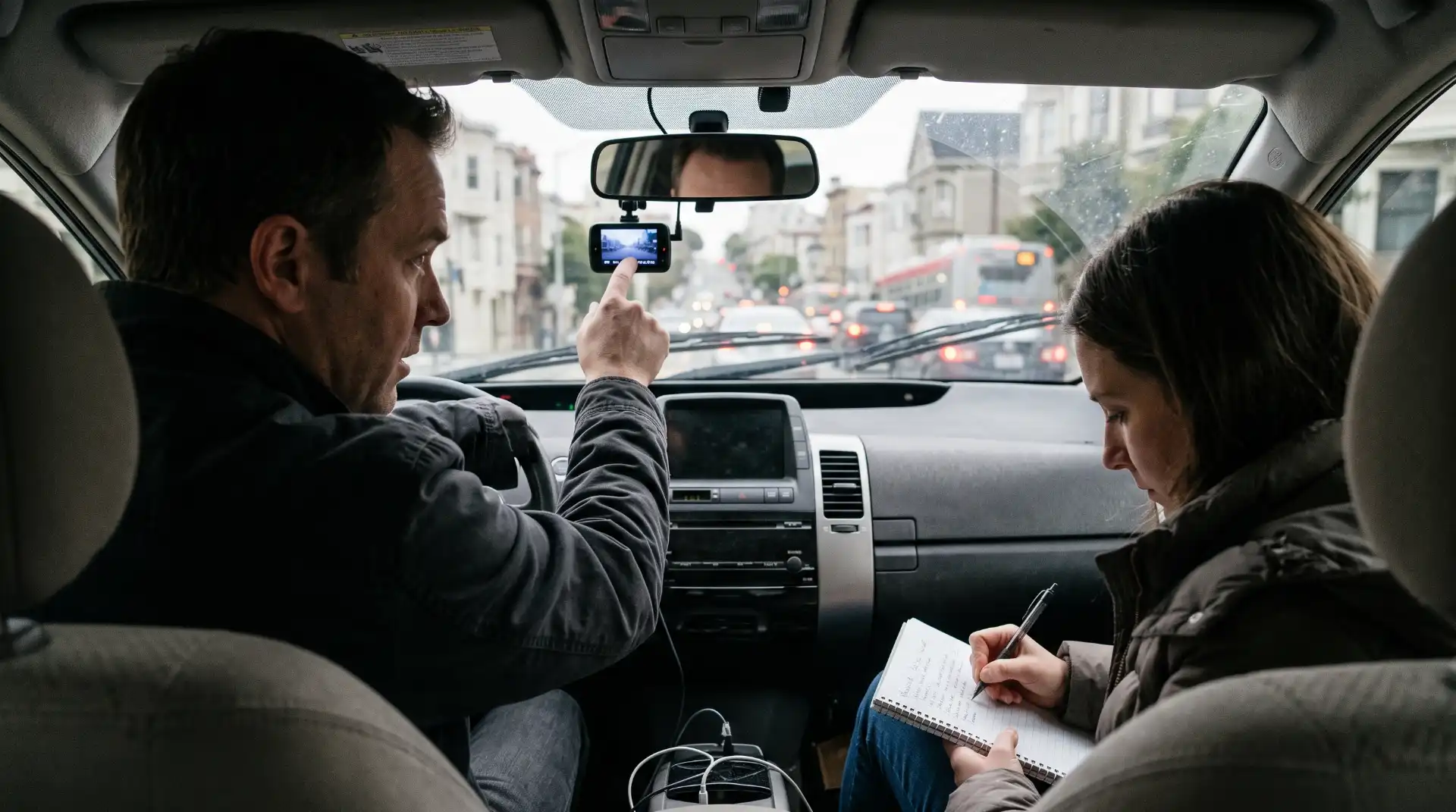
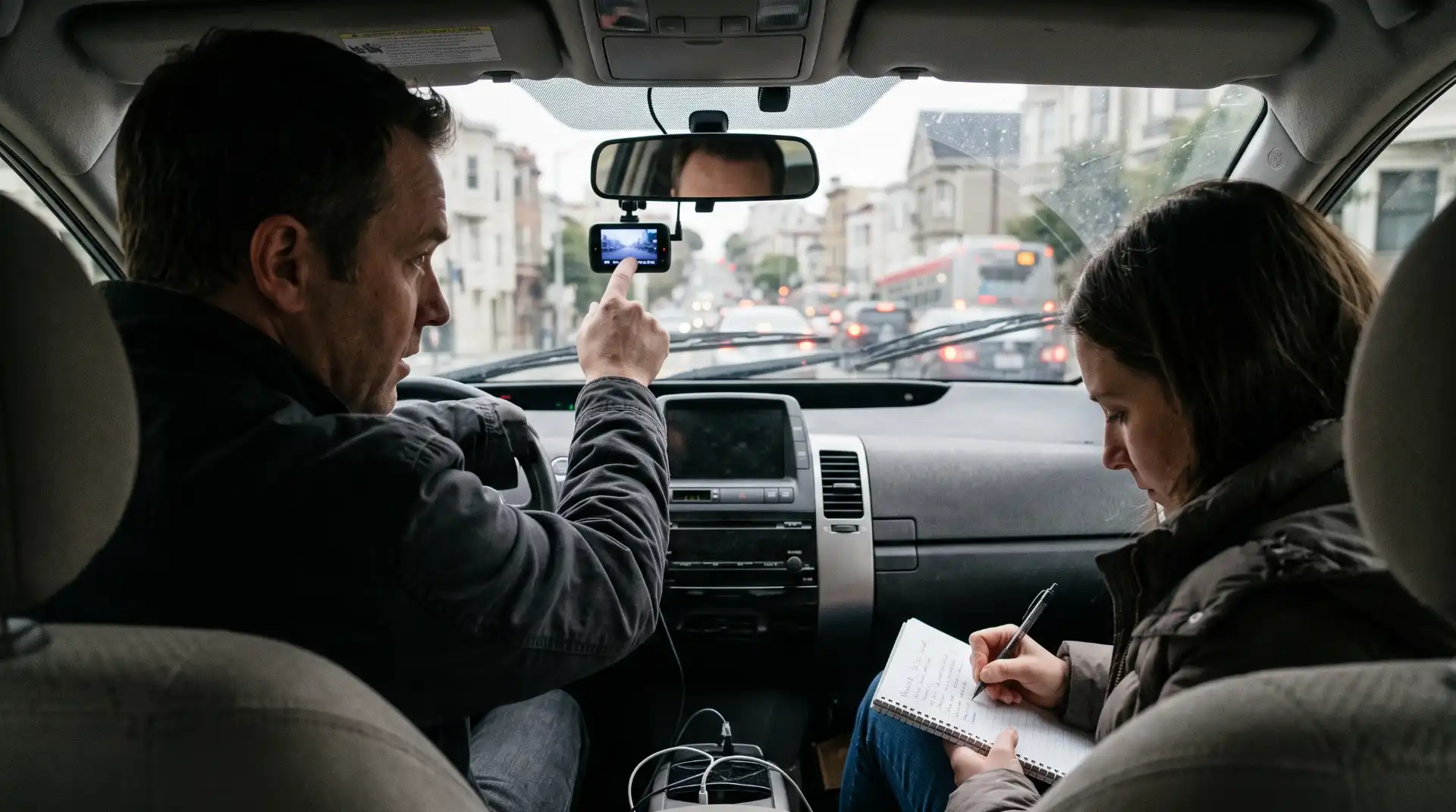
Dashcam footage can be particularly useful. A recording may capture the unidentified vehicle’s movements, a partial license plate, the point of contact, or the moment another driver made an evasive maneuver. Footage from a passenger’s phone or a nearby business may also provide useful information.
San Francisco streets may have cameras at intersections, commercial buildings, parking facilities, or other locations. Availability varies, and not every camera records or retains footage. If you know a nearby business or property may have recorded the incident, note its location and the approximate time of the crash. Prompt requests may be important because some systems automatically overwrite footage.
Witness accounts can help fill gaps in the evidence. A witness who saw the unidentified vehicle strike a car may be able to establish physical contact. Another witness may have observed the vehicle’s lane change or traffic signal violation. Independent evidence can be especially important when the insurer questions how the accident happened.
Your site’s guide, How to Prove Fault in a San Francisco Car Accident, explains other types of evidence that may help establish responsibility after a collision.
Can You Recover Compensation Through Uninsured Motorist Coverage?
Uninsured motorist coverage is designed to help eligible insured people recover for certain injuries caused by uninsured motorists. Depending on the policy and circumstances, uninsured motorist bodily injury coverage may also apply when the responsible vehicle’s owner or operator is unknown.
However, the legal and policy requirements matter. For an unknown vehicle, California’s physical-contact and reporting provisions can be decisive. A claim involving a vehicle that struck the insured’s car and then fled may present different coverage questions from a no-contact event in which the insured swerved to avoid a vehicle.
If you have uninsured motorist coverage, review your policy and promptly notify your insurer of the accident. Ask what documentation it requires and whether it considers the incident to meet the policy and statutory definition of an uninsured motorist event.
Do not assume that a police report alone guarantees coverage. The insurer may investigate the circumstances, request statements, examine photographs, review vehicle damage, and evaluate whether the statutory requirements have been satisfied.
The California Department of Insurance provides consumer guidance about auto insurance and coverage options. Its Auto Insurance Guide is a useful starting point for understanding common coverage types and questions to ask about a policy.
What If the Unidentified Vehicle Never Made Contact?
No-contact crashes are among the most complicated phantom vehicle scenarios.
Suppose a driver on a San Francisco freeway sees another vehicle suddenly cut across two lanes. To avoid a collision, the driver swerves and hits a guardrail. The other vehicle continues down the road, and the drivers never touch.
The injured motorist may have a credible explanation for the crash, and a dashcam or witness may support that explanation. Even so, the lack of physical contact may prevent recovery under the uninsured motorist bodily injury provisions that apply when the other driver is unknown.
That does not necessarily end the insurance inquiry. If the injured motorist carries collision coverage, the policy may cover damage to their own vehicle subject to its terms, deductible, exclusions, and claim requirements. Medical payments coverage, if purchased, may help with eligible medical expenses regardless of who caused the crash, subject to policy limits and conditions. Health insurance may also help pay for treatment.
The availability of each option depends on the policy and facts. A person should not assume that collision coverage pays for injuries or that medical payments coverage pays for vehicle damage. These are different coverage types.
A careful review of the available policies can help determine what losses may be covered even when an uninsured motorist bodily injury claim is unavailable.
Can Collision Coverage Pay for Vehicle Damage?
Collision coverage generally helps pay for damage to the insured vehicle resulting from a collision with another vehicle or object, subject to the policy’s terms. It may be relevant when a driver hits a barrier, curb, parked car, or other object while avoiding an unidentified vehicle.
For example, a driver may swerve to avoid a phantom vehicle and strike a concrete divider. If the driver has collision coverage, the insurer may evaluate the vehicle damage under that coverage, even if the other motorist is never identified.
The policy deductible usually applies, and the insurer may investigate how the collision occurred. Coverage depends on the actual policy language and the facts of the accident.
Collision coverage is not the same as uninsured motorist bodily injury coverage. It generally concerns damage to the covered vehicle rather than compensation for bodily injuries. Medical costs, lost income, and other injury-related losses must be considered separately.
If your vehicle is damaged, take photographs before repairs begin and retain estimates, towing receipts, storage charges, and repair invoices. If the accident may involve important evidence, discuss preservation before allowing a damaged part or vehicle to be discarded.
What About Medical Payments Coverage and Health Insurance?
Medical payments coverage, often called MedPay, may help pay certain accident-related medical expenses for the insured and eligible occupants, regardless of fault, depending on the policy.
It may be useful when the responsible driver cannot be identified or when an uninsured motorist claim is disputed. However, MedPay is subject to the coverage amount, policy definitions, exclusions, and other terms.
Health insurance may also help cover treatment. The health plan’s rules, deductibles, copayments, provider networks, and any reimbursement or subrogation provisions may affect how the claim is handled.
These options do not necessarily compensate an injured person for every type of loss. Medical payments coverage typically does not replace wages or provide compensation for pain and suffering. Health insurance primarily pays covered medical expenses under the health plan.
Even when the at-fault driver is missing, it is important to seek appropriate medical care and keep copies of bills, records, referrals, and receipts. Do not delay necessary treatment while waiting for an insurance company to determine whether another coverage applies.
What If the Other Driver Is Found Later?
Sometimes a driver who initially disappears is identified through a witness, video recording, license plate information, or police investigation. If that happens, the available options may change.
The identified driver’s liability insurance may become relevant, depending on the facts and applicable coverage. Investigators may also examine whether the driver acted negligently and whether that negligence caused the collision and injuries.
If the driver is found but has no applicable insurance or insufficient coverage, uninsured or underinsured motorist provisions may need to be evaluated. The rules and policy conditions for an identified uninsured driver may differ from those for an unknown driver.
Do not assume that identifying the vehicle automatically proves fault. Investigators still need to establish what happened and how the driver’s conduct contributed to the crash.
Keep your claim documentation organized and notify your insurer if new identifying information becomes available. Preserve original photos, videos, witness details, and communications rather than relying solely on memory.
Can Police Help Identify a Phantom Vehicle?
Law enforcement may investigate a hit-and-run or other collision involving an unidentified vehicle. The scope of the investigation depends on the severity of the incident, available evidence, agency procedures, and other circumstances.
A report can document when and where the accident occurred and what the involved people said. It may also record vehicle damage, witness information, and other observations. If the other driver is later identified, additional information may be added or obtained through the investigation.
Provide law enforcement with accurate details. A partial plate number, distinctive vehicle feature, direction of travel, or nearby camera location may be useful. Avoid exaggerating or guessing about details that you cannot reliably remember.
A police report is valuable evidence, but it does not automatically decide civil liability or guarantee insurance coverage. Insurers may conduct their own investigation and evaluate the evidence under the applicable policy and law.
How Insurance Companies Investigate Phantom Vehicle Claims
Insurance companies may scrutinize phantom vehicle claims because the other driver cannot always be independently questioned or identified. An adjuster may ask for a detailed description of the incident, photographs, medical records, witness information, a police report, and any available video.
The insurer may look for evidence of physical contact, such as paint transfer, dents, scratches, debris, or damage patterns that are consistent with the account of the collision. In a no-contact case, the insurer may examine whether the evidence supports the claim that an unidentified vehicle caused the evasive maneuver.
Be accurate and consistent when describing the event. If you did not see the moment of impact, do not claim that you did. If you only saw part of the license plate, distinguish that partial information from a confirmed plate number.
Keep copies of documents and record when you reported the incident. Follow the insurer’s instructions about submitting forms and supporting information, while remembering that statutory requirements may apply in addition to ordinary claim procedures.
If an insurer denies coverage, ask for the decision and explanation in writing. Review the policy provisions cited in the denial and consider obtaining legal advice if you believe the decision is inconsistent with the policy or applicable law.
What Injuries Can Result From Phantom Vehicle Accidents?
A phantom vehicle incident can cause serious injuries even when the unidentified vehicle never makes direct contact with the injured person’s car.
An emergency swerve may send a vehicle into a barrier, curb, parked car, or another lane of traffic. The sudden change in direction can cause occupants to strike interior surfaces or experience forceful movement of the neck, back, and limbs.
Possible injuries include whiplash, muscle strains, fractures, concussions, traumatic brain injuries, spinal injuries, shoulder damage, and internal injuries. The severity depends on factors such as vehicle speed, the angle of impact, seat-belt use, airbag deployment, and the type of object struck.
Symptoms do not always appear immediately. Someone may initially feel shaken but later develop neck pain, headaches, dizziness, back pain, or other symptoms. Prompt medical assessment can help identify injuries and document the care required.
Medical documentation is also important when an insurance claim is evaluated. Keep appointment records, diagnostic reports, prescriptions, treatment instructions, bills, and information about how the injuries affect work and daily activities.
What Compensation May Be Available?
The compensation available after a phantom vehicle accident depends on the type of claim, applicable insurance, evidence, injuries, and policy limits.
If a responsible driver is identified and liability is established, a claim may include eligible medical expenses, lost wages, reduced earning capacity, property damage, and non-economic losses such as pain and suffering. The actual damages available depend on the circumstances and applicable law.
If the driver remains unidentified, the potential recovery may be more limited. Uninsured motorist bodily injury coverage may be available only if the relevant requirements are met. Collision coverage may help pay for vehicle damage. Medical payments coverage and health insurance may help pay eligible medical costs.
These sources of payment are not interchangeable. For example, a collision policy generally does not pay pain-and-suffering damages, and MedPay is typically limited to eligible medical expenses under the policy.
The fact that a person was injured does not by itself guarantee that every loss will be covered. The policy terms, evidence, legal requirements, and applicable limits must be reviewed.
What If You Were Partly Responsible?
An accident involving an unidentified vehicle may involve more than one contributing factor. The injured driver’s own actions may also be examined.
For example, the other vehicle may have made an unsafe lane change, but the injured driver may have been traveling too fast for traffic conditions. Or a driver may have reacted to a sudden maneuver in a way that contributed to the resulting crash.
California generally applies comparative fault principles in negligence cases. However, the effect of comparative fault depends on the type of claim and the specific legal issues involved. Insurance coverage questions, including the unknown-vehicle physical-contact requirement, are separate from the question of how negligence is allocated.
Do not assume that being partly responsible automatically eliminates every possible claim. Equally, do not assume that the other driver is legally responsible simply because their vehicle was present. The evidence and applicable law must be evaluated.
For more information about evidence and liability, see How to Prove Fault in a San Francisco Car Accident.
Why San Francisco’s Road Conditions Can Complicate These Crashes
San Francisco presents a variety of driving conditions that can complicate a phantom vehicle investigation. Steep hills, dense traffic, narrow lanes, intersections, freeway entrances, cyclists, pedestrians, parked cars, and transit vehicles can all affect how a driver responds to a sudden hazard.
On a steep street, a sudden evasive maneuver may lead to a collision with a parked vehicle or another road user. Near a freeway ramp, a driver may have very little room to change lanes safely. In a busy downtown intersection, traffic signals and vehicles moving in several directions can make it difficult to determine exactly which vehicle caused the initial danger.
These conditions do not automatically establish liability. Instead, they make evidence of the sequence of events particularly important.
Photographs, dashcam recordings, nearby surveillance footage, witness accounts, road markings, and the location of vehicle damage may help investigators reconstruct what happened. Accurate location details can also help identify potential witnesses or camera systems.
If the incident happened near a busy interchange or ramp, your readers may also find it useful to review Freeway Ramp Accidents in SoMa: Understanding Liability at San Francisco’s High-Risk Intersections.
How Long Do You Have to Make a Claim?
There is no single deadline that applies to every claim arising from a phantom vehicle accident. The applicable deadline depends on the type of claim, the parties involved, the policy requirements, and other facts.
For an uninsured motorist bodily injury claim involving an unknown vehicle, California Insurance Code section 11580.2 includes the specific reporting and sworn-statement requirements discussed earlier. These requirements can be much shorter than the general time limits for filing a lawsuit.
Other deadlines may apply to a civil personal injury lawsuit, a property damage claim, an insurance policy notice, or a claim involving a public entity. Policy deadlines and statutory deadlines are not necessarily the same.
Do not assume that reporting the crash to police, notifying your insurer, and filing a lawsuit are interchangeable steps. Each may serve a different purpose and have separate requirements.
If you are unsure which deadlines apply, review the policy and seek qualified legal guidance promptly. Waiting until the end of a general lawsuit limitation period may be too late to satisfy an insurance requirement.
Common Mistakes to Avoid After a Phantom Vehicle Accident
One common mistake is leaving the scene without reporting the incident or collecting available information. A person may believe that no report is necessary because the other driver has already disappeared. However, prompt reporting can be important for the investigation and may be required for a potential uninsured motorist claim involving an unknown vehicle.
Another mistake is assuming that a no-contact accident automatically qualifies for uninsured motorist benefits. California’s physical-contact requirement can make that assumption incorrect. Drivers should evaluate the facts and other coverage options rather than relying on the label “phantom vehicle accident.”
People also sometimes fail to preserve evidence. Dashcam footage can be overwritten, surveillance recordings may be deleted, and witnesses may become difficult to locate. Saving the information as soon as possible can improve the chances of establishing what occurred.
Finally, avoid guessing about the other vehicle’s movements or the cause of the crash. Accurate, detailed reporting is more useful than a confident statement that later turns out to be inconsistent with the evidence.
Frequently Asked Questions About Phantom Vehicle Accidents in San Francisco
Can I recover compensation if the other driver is never found?
Possibly. Depending on the circumstances, collision coverage, medical payments coverage, health insurance, or uninsured motorist coverage may be relevant. However, an uninsured motorist bodily injury claim involving an unknown vehicle is subject to California’s statutory requirements, including physical contact and reporting requirements.
Does California require physical contact for a phantom vehicle claim?
For an applicable uninsured motorist bodily injury claim involving an unknown vehicle, California Insurance Code section 11580.2 includes a physical-contact requirement. A no-contact crash may therefore fail to qualify for that specific coverage, even if the injured driver says an unidentified vehicle forced them to swerve.
Should I report a phantom vehicle accident to the police?
Prompt reporting is important. California law includes a 24-hour reporting requirement for applicable uninsured motorist bodily injury claims involving an unknown vehicle. Reporting can also help document the incident and preserve information for an investigation.
What if I only have a partial license plate number?
Provide it to law enforcement and your insurer, along with the vehicle description, direction of travel, approximate time, and location. Do not try to fill in missing characters by guessing. A partial plate may still help investigators when combined with other evidence.
Can dashcam footage help?
Yes. Dashcam footage may show the other vehicle’s movements, a collision, a partial plate number, or the events that led to the crash. Preserve the original recording and make a backup if possible.
Does collision coverage pay for injuries?
Collision coverage generally addresses damage to the covered vehicle, subject to the policy. It typically does not provide bodily injury compensation. Medical payments coverage, health insurance, or another applicable policy may help with medical costs.
What if the other driver is identified later?
The identification may open additional options, including a claim against the driver’s liability insurance if the evidence supports responsibility. The available coverage and legal requirements should be reassessed based on the new information.
Conclusion
Phantom vehicle accidents can leave San Francisco drivers facing injuries, vehicle damage, and uncertainty about who will pay for the losses. When the other driver disappears, physical evidence, witness accounts, dashcam recordings, police reports, and prompt insurance notification can become especially important.
California law treats certain claims involving unknown drivers differently from ordinary collisions. In particular, uninsured motorist bodily injury claims involving an unknown vehicle generally face a physical-contact requirement and specific reporting and sworn-statement deadlines. A no-contact crash may not qualify for that particular coverage, even when the injured driver believes an unidentified motorist caused the incident.
That does not mean every possible avenue of recovery is necessarily closed. Collision coverage, medical payments coverage, health insurance, or other options may be worth reviewing, depending on the circumstances and policy language.
The best next steps are to prioritize safety and medical care, report the incident promptly, preserve available evidence, document the injuries and vehicle damage, and review the applicable insurance policies. When the rules or coverage are unclear, qualified California legal guidance can help clarify the options available in the specific case.
This article is for general informational purposes only and is not legal advice. Insurance coverage and legal outcomes depend on the facts of each incident, the policy terms, and applicable California law.