
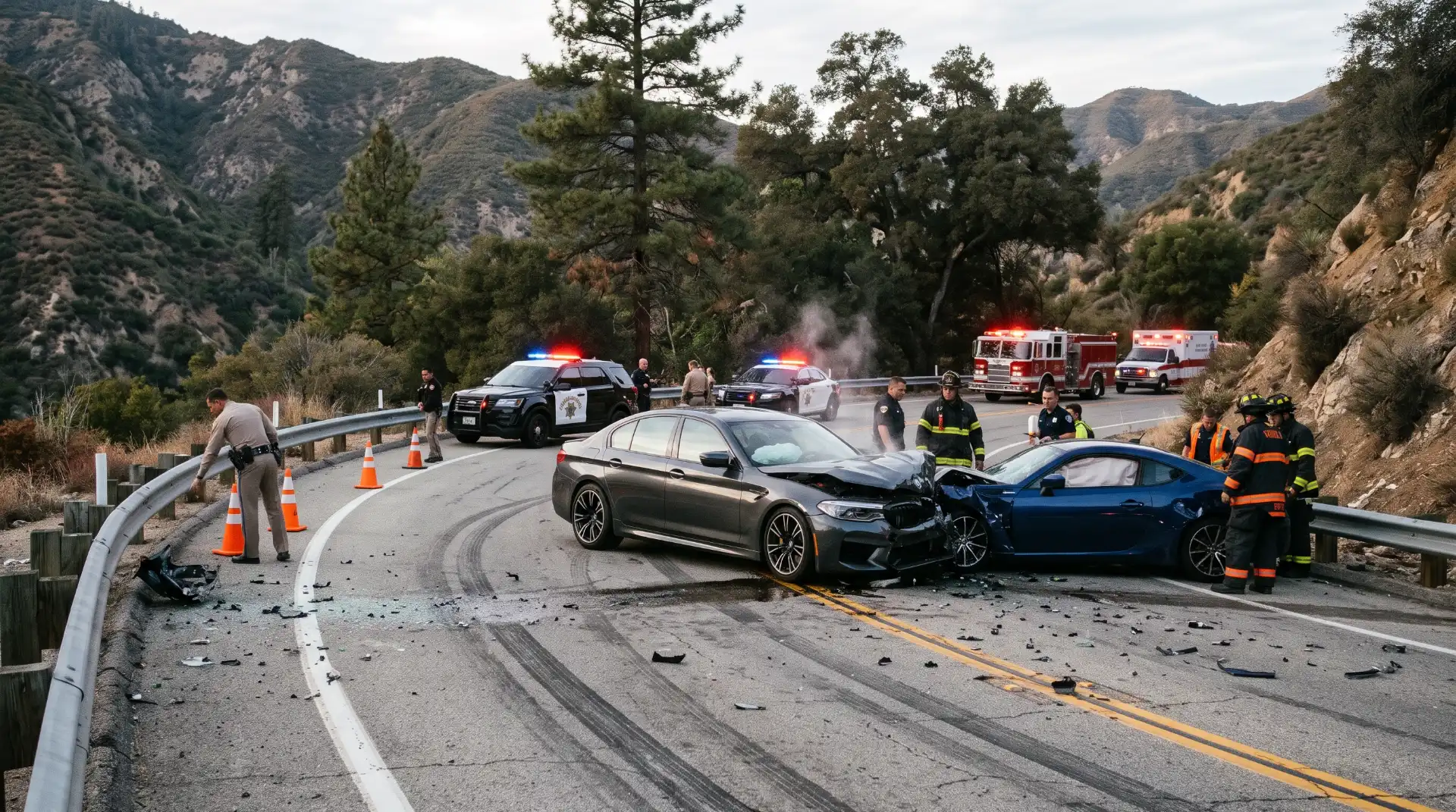
California is home to some of the most scenic mountain highways in the United States. Roads winding through the Santa Cruz Mountains, Sierra Nevada, Angeles National Forest, San Bernardino Mountains, and coastal mountain ranges attract commuters, tourists, motorcyclists, and automotive enthusiasts throughout the year. These routes offer impressive scenery and challenging driving conditions, but they can also become dangerous when motorists fail to respect the limitations of mountain roads.
Sharp curves, steep grades, narrow lanes, limited visibility, changing weather, and unexpected road hazards can create serious risks even for experienced drivers. When excessive speed, reckless overtaking, aggressive group driving, or unauthorized vehicle demonstrations are added to these conditions, the likelihood of a serious collision can increase considerably.
In recent years, organized car meets and high-performance driving gatherings have also attracted attention along several California mountain routes. Although many automotive events are legitimate gatherings where enthusiasts display their vehicles and socialize, some participants may use nearby public highways to demonstrate acceleration, test vehicle handling, or compete with other drivers. These activities can expose innocent motorists, cyclists, passengers, and pedestrians to dangerous situations.
A collision on a mountain highway can have devastating consequences. A vehicle that crosses the centerline may cause a head-on crash, while a driver who loses control on a curve may strike a guardrail, roll down an embankment, or collide with several vehicles. The limited space available for emergency response can make the aftermath even more complicated.
Determining legal responsibility after these accidents is not always straightforward. The driver who caused the collision may be primarily responsible, but other parties may also deserve investigation depending on their involvement. Event organizers, vehicle owners, employers, property operators, and government agencies may become relevant when their actions or omissions contributed to the dangerous conditions.
For people injured in California mountain road accidents, understanding how liability works can help clarify the available legal options and the importance of preserving evidence.
Why California Mountain Roads Create Unique Accident Risks
Mountain highways differ significantly from ordinary urban streets and straight sections of interstate highways. Drivers must constantly adjust their speed, steering, braking, and following distance according to changes in elevation, visibility, and road geometry.
A road that appears manageable during daylight may become much more difficult to navigate at night, during rain, or when fog develops around higher elevations.
Sharp Curves and Limited Visibility
One of the most common hazards on California mountain roads is the presence of sharp curves with limited sight distance. Drivers may approach a bend without being able to see vehicles, cyclists, stopped traffic, or obstacles on the other side.
A motorist traveling too quickly may be unable to maintain control while navigating the curve. If the vehicle drifts across the centerline, it can enter the path of an oncoming vehicle.
These situations are especially dangerous on two-lane mountain highways where there may be little room for evasive maneuvers.
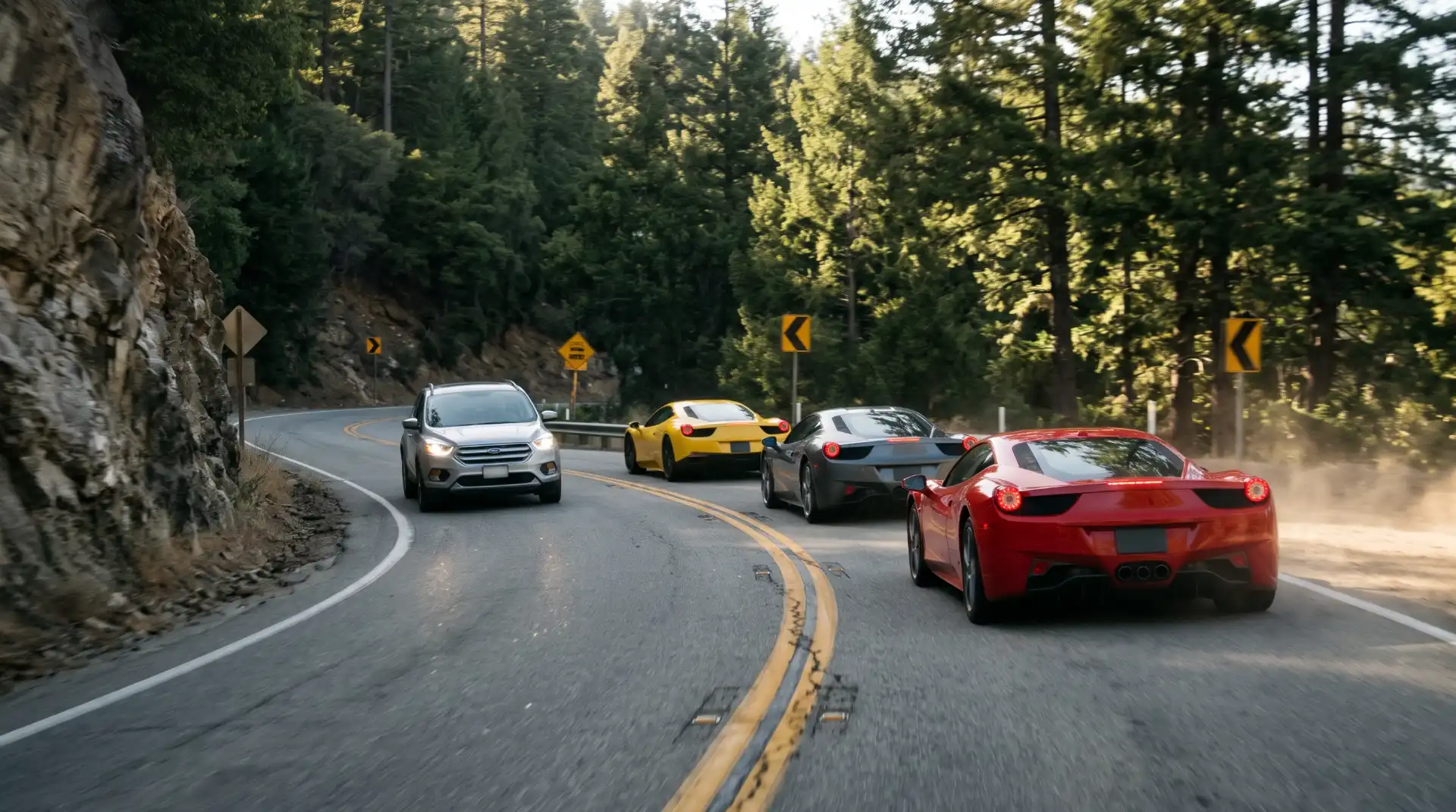
The danger increases when drivers attempt to overtake slower vehicles near curves or pass other motorists without adequate visibility. A driver may assume the opposite lane is clear, only to encounter an approaching vehicle that cannot stop in time.
Steep Grades and Brake Failure Risks
Long downhill sections can place significant demands on a vehicle’s braking system. Continuous braking may increase brake temperatures and reduce stopping effectiveness, particularly when a vehicle is heavily loaded or poorly maintained.
Commercial vehicles, recreational vehicles, trailers, and passenger cars can all experience problems when drivers fail to adjust their driving techniques to steep terrain.
A driver descending a mountain road at excessive speed may have difficulty slowing before a sharp turn or stopped vehicle.
Mechanical problems can also become relevant. Worn brake pads, damaged brake components, inadequate maintenance, or defective parts may contribute to a collision.
When a crash involves a suspected mechanical failure, investigators may need to examine maintenance records, vehicle inspections, repair histories, and physical evidence from the damaged components.
Narrow Lanes and Dangerous Overtaking
Some California mountain roads have narrow lanes, limited shoulders, and sections without clearly separated opposing traffic.
Drivers who attempt aggressive passing maneuvers can create serious risks for everyone nearby.
For example, a motorist following a group of sports cars may move into the opposing lane to overtake several vehicles at once. If another vehicle approaches around a blind curve, the passing driver may have insufficient room to return safely.
A collision may involve a head-on impact, a sideswipe, or a chain reaction in which several vehicles leave the roadway.
Changing Weather and Road Surface Conditions
Weather conditions can change quickly in mountainous areas. Rain, snow, ice, fog, falling rocks, and wet leaves may affect traction and visibility.
Even a driver traveling below the posted speed limit may be moving too quickly for the conditions.
Winter weather can make certain routes especially dangerous. Ice may develop in shaded areas, while snow accumulation can reduce tire traction and make steering difficult.
Caltrans issues traction requirements when mountain highway conditions warrant them. Drivers must follow posted chain controls and other instructions from transportation authorities.
The Caltrans winter driving and chain requirement information provides guidance about traction devices, chain-control levels, and mountain highway conditions.
California Laws That Apply to Mountain Road Accidents
California drivers are required to operate their vehicles with reasonable care, and several state laws are particularly relevant to accidents on mountain highways.
These laws address speed, vehicle control, passing, and dangerous driving behavior.
California’s Basic Speed Law
California Vehicle Code Section 22350 establishes the state’s basic speed law.
Under this provision, motorists cannot drive faster than is reasonable or prudent considering weather, visibility, traffic, and roadway conditions. Drivers also cannot operate vehicles at speeds that endanger people or property.
This is important on mountain roads because the posted speed limit does not necessarily represent a safe speed under every circumstance.
For example, a road may have a posted limit of 45 miles per hour, but heavy rain, poor visibility, and a sharp downhill curve may require a substantially lower speed.
A driver who loses control while traveling at the posted limit may still face allegations of negligence if the speed was unreasonable for the conditions.
Conversely, evidence that a driver was traveling above a posted limit may support an argument that the driver violated the law, although the complete civil claim must still address causation and damages.
California Vehicle Code Section 21662: Mountain Highway Requirements
California has a provision specifically addressing drivers traveling through canyons, defiles, and mountain highways.
Vehicle Code Section 21662 requires drivers in these locations to maintain control of their vehicles.
The provision also establishes requirements concerning road positioning and audible warnings in certain circumstances involving narrow roads without marked centerlines and obstructed curves.
This law is particularly relevant when a collision involves a vehicle crossing the center of a narrow mountain road or approaching a blind curve without taking appropriate precautions.
For example, a driver who attempts to overtake another vehicle on a narrow, winding road may create a dangerous situation when an approaching vehicle appears around an obstructed bend.
Investigators may consider the roadway configuration, the driver’s actions, and whether the applicable requirements were followed.
Passing and Lane-Use Restrictions
California traffic laws also regulate passing and the use of opposing lanes.
Drivers must not make passing maneuvers when prohibited or when the available visibility and roadway conditions make the maneuver unsafe.
Mountain roads frequently contain solid yellow centerlines, limited passing zones, and signs warning motorists about blind curves.
Ignoring these restrictions can expose other motorists to serious danger.
A driver who crosses into opposing traffic while attempting to pass a slower vehicle may face traffic violations and civil liability if the maneuver causes an accident.
Reckless Driving and Street Racing
California Vehicle Code Section 23103 addresses reckless driving. The law generally prohibits driving a vehicle on a highway or in an off-street parking facility with willful or wanton disregard for the safety of persons or property.
Street racing and exhibitions of speed are addressed separately under Vehicle Code Section 23109.
These provisions may become relevant when a mountain road collision involves competitive driving, dangerous acceleration, racing between vehicles, or other prohibited conduct.
However, ordinary negligent driving and criminal reckless driving are not identical legal concepts. A person may be civilly liable for negligence even when prosecutors do not file criminal charges.
Reckless Driving on Mountain Roads and Its Consequences
Reckless driving is one of the most serious factors contributing to preventable mountain highway collisions.
Some drivers underestimate the risks associated with mountain terrain, particularly when operating high-performance vehicles designed for rapid acceleration and responsive handling.
A vehicle’s engineering capabilities do not eliminate the limitations of public roads.
Excessive Speed Around Mountain Curves
Driving too fast around a curve can cause a vehicle to lose traction or move outside its intended path.
When this happens, the driver may cross into opposing traffic, strike a roadside barrier, or leave the roadway entirely.
The consequences can be particularly severe when the road runs alongside a steep embankment or narrow mountain drop-off.
A driver may also misjudge the curve because of limited visibility, changing pavement conditions, or unfamiliarity with the route.
Aggressive Overtaking and Passing
Aggressive passing is another common danger.
Some motorists become impatient when following slower vehicles on mountain highways. They may attempt to pass several cars in a single maneuver or accelerate into opposing lanes without sufficient visibility.
These decisions can produce head-on collisions and force other motorists to take sudden evasive action.
Even when an aggressive passing maneuver does not result in direct contact, it may cause another driver to swerve off the road or collide with a vehicle traveling behind.
Tailgating and Group Pressure
Drivers participating in group outings may follow one another too closely, especially when traveling in a convoy of sports cars or motorcycles.
Tailgating reduces the time available to respond when the lead vehicle brakes unexpectedly.
A driver near the front of the group may encounter an obstacle and slow down suddenly. Following drivers may then collide with one another in a chain reaction.
Group pressure can also encourage unsafe decisions. A driver who wants to remain close to friends may accelerate beyond a comfortable speed or attempt to keep pace with a more experienced driver.
Each motorist remains responsible for making independent driving decisions, regardless of the behavior of other members of the group.
Dangerous Maneuvers by High-Performance Vehicles
Sports cars and modified vehicles may have powerful engines, responsive steering systems, and performance tires.
However, these features do not make public mountain roads appropriate locations for competitive driving.
A driver may lose control because of excessive acceleration, abrupt steering, improper braking, or an attempt to demonstrate the vehicle’s capabilities.
When a collision occurs, investigators may examine the vehicle’s modifications, mechanical condition, tires, brakes, suspension, and recorded driving information.
The fact that a vehicle is designed for performance does not excuse a driver from following traffic laws or adjusting speed to the roadway.
Organized Car Meets and Group Driving on California Mountain Highways
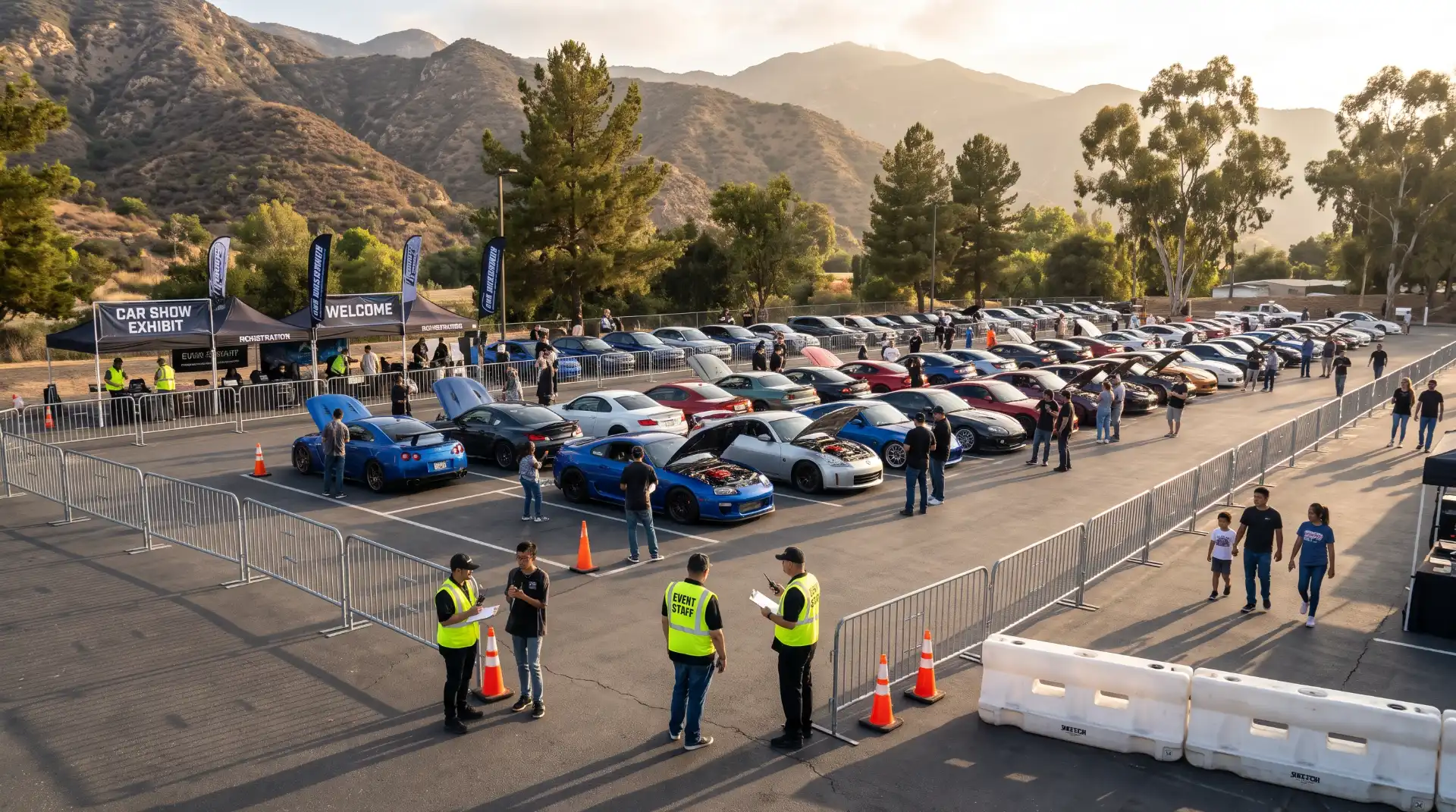
Automotive gatherings have become a popular part of car culture throughout California.
Enthusiasts organize weekend drives, photography outings, vehicle exhibitions, and informal meetings through social media communities and automotive clubs.
Many of these activities are lawful and carefully organized. Nevertheless, some gatherings can create additional accident risks when large groups travel along narrow mountain roads.
How Car Meets Can Create Traffic Hazards
A car meet may begin at a parking facility, restaurant, business, or designated gathering location.
After the event, participants may leave together and travel along nearby mountain highways.
Problems can arise when drivers accelerate rapidly, attempt to remain close to the group, overtake slower traffic, or perform demonstrations along public roads.
Large groups can also create unexpected congestion at roadside pullouts, intersections, and parking areas.
If participants stop along narrow shoulders to take photographs, other motorists may have difficulty seeing parked vehicles or people entering and leaving the roadway.
These circumstances can increase the likelihood of rear-end collisions, sideswipes, and accidents involving pedestrians.
Dangerous Group Driving and Convoy Accidents
Group driving can become dangerous when participants treat public roads as if they were controlled racing environments.
Drivers may attempt to keep up with faster vehicles, follow one another through blind curves, or accelerate aggressively when the group becomes separated.
A single mistake can affect several vehicles.
For example, the lead driver may brake unexpectedly before a sharp curve. A second driver following too closely may collide with the first vehicle, while another driver swerves into opposing traffic to avoid the impact.
This can create a multi-vehicle accident involving drivers who were not directly participating in the original dangerous maneuver.
Group leaders and organizers may become relevant to an investigation if they actively direct unsafe driving activities or arrange demonstrations that create foreseeable hazards. However, merely organizing a lawful recreational drive does not automatically make someone responsible for an independent driver’s negligence.
When an Organized Event Becomes a Liability Issue
The legal position of an event organizer depends on the organizer’s actual involvement and responsibilities.
An organizer who simply invites enthusiasts to a lawful vehicle exhibition generally presents a different situation from someone who coordinates high-speed driving demonstrations on public roads.
Investigators may examine whether the organizer:
- Selected a route unsuitable for the planned activity.
- Encouraged excessive speeds or competitive driving.
- Directed drivers to perform demonstrations on public roads.
- Ignored credible warnings about dangerous behavior.
- Failed to address foreseeable crowd or vehicle movement hazards.
- Exercised control over the activity that contributed to the collision.
These factors are not automatic proof of negligence. The injured person must still establish the applicable duty, breach, causation, and damages.
Liability of Car Clubs and Group Leaders
Automotive clubs and driving communities may have different organizational structures.
Some are informal social groups without a formal business entity. Others operate through registered organizations, commercial event companies, or businesses that arrange paid driving experiences.
The organizational structure may influence how responsibility is evaluated, but it does not automatically determine liability.
For example, a group leader who actively instructs participants to race through mountain curves may face different allegations from a person who simply shares an itinerary for a lawful scenic drive.
The investigation should focus on what the individual actually did, what authority or control existed, and whether the conduct contributed to the accident.
Can Event Organizers, Sponsors, and Vehicle Owners Be Held Liable?
A mountain road accident connected to a car meet can involve several potentially responsible parties.
Although the driver who caused the crash is often the primary focus, other individuals and organizations may also face claims when their conduct contributed to the collision.
Negligence by Event Organizers
Event organizers may face negligence allegations if they create or encourage dangerous driving activities or fail to take reasonable precautions within their control.
For example, an organizer might arrange a high-performance driving demonstration on a narrow public mountain road despite knowing that the route contains blind curves and limited passing areas.
If the organizer actively directs the demonstration and a participant causes a serious collision, the organizer’s decisions may become relevant to the legal investigation.
The analysis would consider whether the risk was foreseeable, whether the organizer owed a duty of care, and whether the organizer’s conduct was a substantial factor in causing the injury.
Negligent Entrustment by Vehicle Owners
Vehicle owners may also face potential liability when they allow another person to operate a vehicle despite knowing that the person is likely to drive dangerously.
This legal theory is commonly known as negligent entrustment.
For example, a vehicle owner may lend a powerful sports car to someone with a known history of reckless driving, repeated street racing, or serious traffic violations.
If the driver subsequently causes a mountain road collision, the owner’s decision to provide the vehicle may become relevant.
California Vehicle Code Section 17150 also addresses certain vehicle-owner liability situations involving permissive use.
However, ownership does not automatically create unlimited responsibility for every accident involving the vehicle. The relevant statutory requirements and limitations must be considered.
Employer Liability During Promotional Driving Activities
A business may become involved when an employee operates a company vehicle during a promotional event or organized demonstration.
Under the doctrine of respondeat superior, an employer may be responsible for certain negligent acts committed by an employee within the scope of employment.
For example, a vehicle manufacturer may assign an employee to demonstrate a vehicle to prospective customers during an automotive gathering.
If the employee causes a serious collision while performing authorized business activities, the employer may face potential vicarious liability.
Separate claims involving negligent hiring, supervision, or entrustment may also be examined when supported by the evidence.
Sponsor Liability
Commercial sponsors sometimes supply vehicles, equipment, promotional materials, and financial support for automotive events.
Sponsorship alone does not automatically make a company responsible for a collision.
However, a sponsor’s role may deserve investigation if the company actively organizes driving demonstrations, selects drivers, provides vehicles, establishes routes, or supervises performance activities.
A business that exercises meaningful control over a dangerous driving activity may face different legal questions from a company that simply provides advertising support.
The central issue is whether the sponsor’s own conduct contributed to the accident.
A Recent Bay Area Mountain Highway Lawsuit Highlights These Risks
A particularly relevant example emerged in November 2026 following a serious collision on State Route 84 near La Honda in San Mateo County.
On August 30, 2026, a Tesla Model Y was involved in a head-on collision with a Honda on a winding section of Highway 84.
Reports published in September described video showing the Tesla traveling above 80 miles per hour in an area where the posted speed limit was approximately 35 miles per hour before the collision.
The incident occurred after a Cars & Coffee gathering organized by an automotive enthusiast group. According to reporting by local media, a Tesla representative was driving the company-owned vehicle and taking photographers on a test drive.
The collision left multiple people injured.
In November 2026, a 70-year-old woman injured in the crash filed a lawsuit naming Tesla, the driver, the car gathering’s organizers, and the event venue among the defendants.
The complaint alleges that the vehicle was being operated negligently and that event organizers proceeded despite prior concerns about traffic safety in the area.
The defendants’ positions and the allegations remain subject to the legal process. The lawsuit should not be treated as a final finding of liability.
Nevertheless, the incident highlights several important issues involving California mountain highways.
First, a lawful car gathering can create additional risks if vehicle demonstrations take place on nearby public roads.
Second, a company representative operating a company-owned vehicle may raise questions about employer responsibility, vehicle entrustment, and supervision.
Third, warnings about dangerous traffic conditions may become important evidence when evaluating an organizer’s decisions.
Finally, the crash demonstrates that innocent motorists can suffer serious injuries when high-performance vehicles are driven aggressively on narrow mountain highways.
The case is particularly relevant to drivers, automotive businesses, event organizers, and residents who regularly use roads such as Highway 84, Highway 35, and Highway 9.
For more information, see NBC Bay Area’s November 2026 report on the Highway 84 crash lawsuit.
Can Government Agencies Be Responsible for Dangerous Mountain Road Conditions?
Not every mountain road accident is caused entirely by driver behavior.
Roadway conditions may also contribute to a collision, particularly when a highway contains damaged pavement, inadequate barriers, obstructed signs, poor drainage, or other dangerous physical conditions.
In certain circumstances, a government agency responsible for maintaining a road may face liability under California law.
However, public-entity liability involves specific legal requirements and is not automatic simply because a crash occurred on a state or county highway.
Dangerous Roadway Conditions
A dangerous condition may involve a physical feature of public property that creates a substantial risk of injury when the property is used with reasonable care in a reasonably foreseeable manner.
Potential issues may include:
- Damaged or missing guardrails.
- Large potholes or pavement deterioration.
- Dangerous roadway edges or shoulder conditions.
- Obstructed traffic signs.
- Inadequate drainage that creates hazardous standing water.
- Physical roadway features that increase the danger of a foreseeable collision.
A driver who loses control because of a damaged road surface may have grounds to investigate whether the responsible public agency knew or should have known about the condition.
However, the investigation must establish the relevant statutory elements rather than relying solely on the existence of a road defect.
California Government Code Section 835
Government Code Section 835 addresses public-entity liability for injuries caused by dangerous conditions of public property.
Generally, an injured person must establish that the public property was in a dangerous condition, that the condition created a reasonably foreseeable risk of the type of injury that occurred, and that the condition substantially contributed to the injury.
The claim also generally requires evidence that a public employee created the dangerous condition through negligent or wrongful conduct within the scope of employment, or that the public entity had actual or constructive notice of the condition with sufficient time to take protective measures.
For example, if a damaged guardrail had been reported repeatedly before a vehicle crashed at that location, the history of complaints and the agency’s response may become relevant.
By contrast, a driver who loses control solely because of excessive speed cannot automatically shift responsibility to Caltrans simply because the collision happened on a mountain highway.
Prior Accidents and Roadway Safety Records
A history of previous collisions may become relevant when investigating a potentially dangerous roadway condition.
Prior accidents can help establish whether a particular location has experienced recurring safety problems.
However, previous crashes do not automatically prove that a government agency was negligent.
Investigators must examine whether the earlier incidents involved substantially similar conditions and whether the available evidence supports the relevant legal requirements.
For example, repeated crashes caused by vehicles leaving a particular curve may justify a closer examination of road geometry, barriers, visibility, and other physical conditions.
The evidence must still connect the roadway condition to the accident being investigated.
Can Caltrans Be Responsible for a Mountain Road Accident?
Potentially, yes, when the legal requirements for public-entity liability are satisfied.
Caltrans maintains portions of California’s state highway system, including many mountain routes.
If a dangerous physical condition on a state highway substantially contributes to an injury, an injured person may investigate whether a claim against Caltrans is appropriate.
The responsible agency may be different when the collision occurs on a county or city road.
Identifying the exact location and the agency responsible for maintaining that section of roadway is therefore important.
How Comparative Fault Applies to Mountain Road Collisions
Serious mountain road accidents frequently involve more than one contributing factor.
A driver may be traveling too fast, another motorist may make an unsafe passing maneuver, and a third vehicle may be following too closely.
California follows a comparative fault system that allows responsibility to be divided among multiple parties.
Multiple Drivers Sharing Responsibility
Consider a hypothetical accident involving three sports cars traveling together along a narrow mountain road.
The lead driver brakes suddenly before a sharp curve. The second driver is following too closely and collides with the first vehicle. A third driver swerves into the opposing lane to avoid the collision and strikes an oncoming SUV.
An investigation may determine that several driving decisions contributed to the sequence of events.
The second driver may be responsible for following too closely. The third driver may face allegations involving an unsafe evasive maneuver, depending on the circumstances. The lead driver’s actions may also require examination if they were unreasonable.
The resulting legal analysis may allocate fault among multiple drivers rather than assigning all responsibility to the vehicle involved in the final impact.
An Injured Person May Still Recover Compensation
California’s comparative negligence system generally allows an injured person to recover damages even when that person shares some responsibility for the accident.
The amount recoverable may be reduced according to the percentage of fault assigned to the injured person.
For example, if a jury determines that an injured motorist suffered $500,000 in damages but was 20% responsible for the collision, the recoverable amount would generally be reduced by that percentage, subject to the applicable legal rules.
The purpose of comparative fault is to evaluate each party’s contribution rather than automatically preventing recovery whenever an injured person made a mistake.
Assumption of Risk at Automotive Gatherings
Defendants may sometimes argue that a person voluntarily attended a car meet or driving event and therefore accepted certain risks.
However, attending an automotive gathering does not automatically mean that a spectator agrees to be injured by reckless driving on a public road.
The legal analysis depends on the nature of the activity, the relationship between the parties, the risks involved, and the applicable assumption-of-risk principles.
A spectator watching a static vehicle exhibition has a different relationship to the risks than a participant who voluntarily enters a competitive racing event.
An injured person’s presence at an event does not automatically eliminate the right to pursue a negligence claim.
What Evidence Can Help Prove Fault After a Mountain Road Accident?
Mountain highway accidents can be difficult to investigate because the road environment may change quickly after a collision.
Vehicles may be removed, debris may be cleared, and weather conditions may improve or worsen before investigators can fully document the scene.
Preserving available evidence is therefore important.
Police Reports and Accident Reconstruction
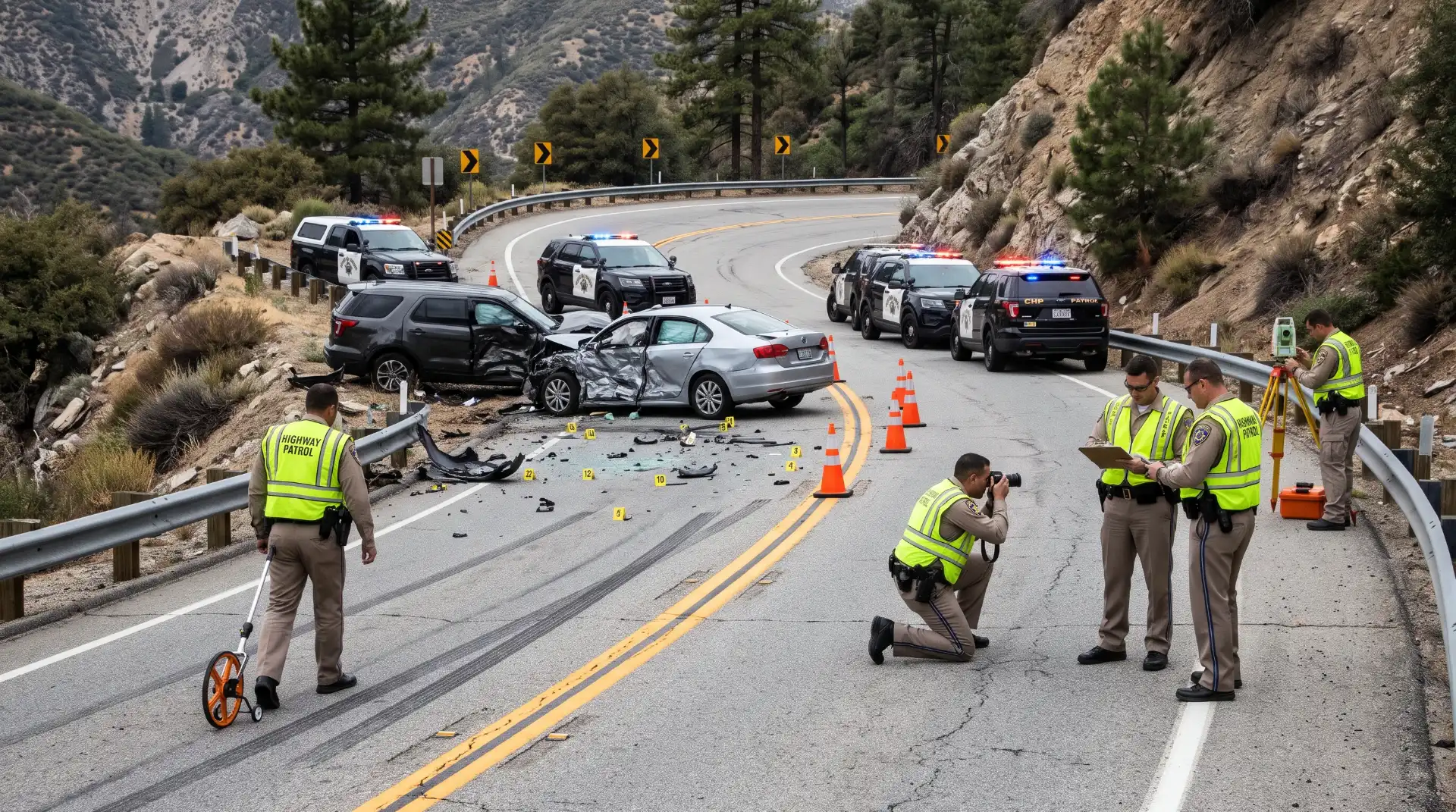
California Highway Patrol officers and other responding agencies may document the accident scene, interview witnesses, inspect vehicles, and prepare reports.
In serious collisions, investigators may use accident reconstruction techniques to determine vehicle speeds, impact locations, braking patterns, and the sequence of events.
Roadway measurements can also help establish the visibility available to drivers before a curve or passing maneuver.
Accident reconstruction may be particularly important when several vehicles were traveling together and their actions contributed to the same collision.
Dashcam and Smartphone Recordings
Many automotive enthusiasts record mountain drives using dash cameras, action cameras, and smartphones.
These recordings can become valuable evidence after a collision.
A video may show whether drivers were racing, following too closely, overtaking other vehicles, or traveling at excessive speeds.
It may also show roadway conditions, traffic signs, curves, and the positions of other vehicles before impact.
Original recordings should be preserved whenever possible. Edited clips may omit important context, and deleting or modifying original files can make later verification more difficult.
Electronic Vehicle Data
Modern vehicles may contain electronic systems that record certain information surrounding a collision.
Depending on the vehicle and available equipment, event data recorder information may include speed, braking activity, accelerator use, and other recorded details.
This information may help investigators evaluate claims that a driver was traveling too quickly or failed to brake before entering a curve.
However, vehicle data is not a complete recording of everything that happened. It must be interpreted alongside physical evidence, video, witness statements, and other information.
For more information, see our existing article on Black Box Data After a Car Accident: How Vehicle Event Recorders Can Help Prove Fault in California.
Tire Marks and Roadway Evidence
Skid marks, tire marks, debris, damaged barriers, and vehicle positions may help establish how a collision occurred.
For example, tire marks leading across the centerline may support an investigation into whether a vehicle lost control or entered opposing traffic.
The location of vehicle damage may also help reconstruct the direction and angle of impact.
However, physical evidence should be interpreted by qualified investigators because different vehicle movements can produce similar marks.
Witness Statements
Witnesses may include other motorists, passengers, cyclists, residents, photographers, and people attending an automotive gathering.
A witness may have observed dangerous driving before the collision or noticed that several vehicles were traveling together at excessive speeds.
Independent witnesses can be especially important when drivers provide conflicting accounts.
For related information, readers can also visit our article on High-Injury Corridors in San Francisco and How Dangerous Streets Can Contribute to Car Accidents.
Common Injuries in Serious California Mountain Road Accidents
Mountain highway collisions can produce severe injuries because vehicles may strike one another at substantial speeds or leave the roadway and collide with fixed objects.
The severity of an injury depends on impact direction, vehicle design, occupant position, restraint use, and other circumstances.
Traumatic Brain Injuries
A head-on collision, rollover, or impact with a roadside barrier can cause a traumatic brain injury.
Symptoms may include headaches, confusion, memory problems, dizziness, concentration difficulties, and changes in behavior.
Some injuries require extensive medical treatment and long-term rehabilitation.
Spinal Cord and Back Injuries
The forces generated during a serious mountain road collision can damage the spine and surrounding structures.
Victims may experience fractures, herniated discs, nerve damage, chronic pain, or permanent mobility limitations.
Severe spinal cord injuries can affect the ability to walk or perform everyday activities independently.
Broken Bones and Internal Injuries
High-impact collisions can cause fractures involving the arms, legs, ribs, pelvis, and other parts of the body.
Internal injuries may also occur when the body experiences sudden deceleration or contact with vehicle structures.
Some injuries require emergency surgery and prolonged hospitalization.
Psychological Effects
Surviving a serious mountain road accident can also have lasting psychological effects.
Victims may experience anxiety, sleep disturbances, emotional distress, and fear of driving on winding roads.
These effects can interfere with employment, family activities, and daily routines.
Compensation Available After a Serious Mountain Road Accident
People injured because of another party’s negligence may be entitled to seek compensation under California personal injury law.
The types of damages available depend on the injuries, evidence, insurance coverage, and applicable legal requirements.
Medical Expenses and Future Treatment
Recoverable medical expenses may include emergency treatment, hospitalization, surgery, medication, physical therapy, rehabilitation, and necessary follow-up care.
When an injury requires continuing treatment, future medical expenses may also become part of the claim.
Lost Income and Reduced Earning Capacity
A serious collision may prevent an injured person from returning to work.
Some victims may miss several weeks or months of employment, while others may experience permanent limitations affecting their ability to earn income.
Lost wages and qualifying future economic losses may be included in a personal injury claim.
Pain and Suffering
California law allows injured people to pursue qualifying noneconomic damages in appropriate personal injury cases.
These damages may involve physical pain, emotional distress, loss of enjoyment of life, and the effects of permanent injuries.
Property Damage
Vehicle damage can be substantial when a collision involves high speeds, steep embankments, or multiple vehicles.
Compensation may involve reasonable repair costs, towing, storage, and the value of a vehicle that is determined to be a total loss.
Insurance Issues Involving Mountain Road Accidents and Group Driving
Insurance coverage can become complicated when a collision involves organized car meets, company-owned vehicles, or several drivers traveling together.
Personal Auto Insurance
A driver who causes a mountain road accident may have personal auto insurance that covers qualifying liability claims.
However, coverage depends on the policy terms and the circumstances of the accident.
Some policies contain exclusions involving organized racing, competitive driving, or certain commercial activities.
The fact that an accident occurred near a car meet does not automatically establish that a racing exclusion applies. The actual driving activity and policy language must be examined.
Commercial Insurance
If an accident involves a business-sponsored demonstration, company vehicle, or organized event, commercial insurance may also become relevant.
Potential coverage may include commercial auto insurance, general liability coverage, or umbrella policies.
The availability of coverage depends on who qualifies as an insured, the purpose of the activity, applicable exclusions, and the facts of the collision.
Multiple Insurance Policies
A single mountain road accident may involve several insurance policies.
For example, the driver may have personal insurance, the vehicle owner may have another policy, and a business involved in the demonstration may carry commercial coverage.
An event organizer may also have insurance for the gathering.
Identifying every potentially applicable policy can be important when injuries are serious and one policy does not provide sufficient coverage.
Uninsured and Underinsured Motorist Coverage
If an at-fault driver has no insurance or insufficient coverage, an injured person’s own uninsured or underinsured motorist coverage may become relevant.
The availability of benefits depends on the policy, the identity of the responsible driver, and the circumstances of the collision.
What Should You Do After a Mountain Road Car Accident?
The immediate aftermath of a mountain highway collision can be especially dangerous.
Narrow shoulders, blind curves, limited cellphone reception, and passing traffic may create additional risks for injured people and other motorists.
Seek Medical Attention Immediately
Medical care should be the first priority after a serious collision.
Emergency personnel should evaluate potentially serious injuries, particularly when the accident involves a head-on impact, rollover, or vehicle leaving the roadway.
Some injuries may not produce obvious symptoms immediately.
Victims should follow medical recommendations and keep records of treatment, prescriptions, and follow-up appointments.
Contact Law Enforcement
Report serious collisions to the appropriate authorities.
California Highway Patrol may respond to accidents on state highways, while local agencies may have jurisdiction over certain county or municipal roads.
Provide accurate information about the vehicles involved, the location, road conditions, and any observed dangerous driving.
Photograph the Scene When Safe
Photographs can help preserve details about the collision.
Useful images may include vehicle damage, tire marks, road signs, guardrails, roadway width, curves, visibility, weather conditions, and debris.
Do not place yourself or others in danger to obtain photographs on a narrow mountain road.
Preserve Video and Digital Evidence
If the accident involved a group drive or organized car gathering, identify potential recordings from participants, photographers, and nearby properties.
Event advertisements, social media posts, messages, and route information may also help investigators understand how the gathering was organized.
Preserve original files and avoid deleting relevant communications.
Identify Witnesses
Obtain contact information from people who saw the collision or the driving activity beforehand, when possible.
Witnesses may help explain whether vehicles were traveling together, whether someone was overtaking, and how the collision developed.
Be Careful When Speaking With Insurance Companies
Insurance representatives may request statements, photographs, or documents after the accident.
Victims should provide accurate information and avoid guessing about facts they do not know.
Before accepting a settlement, it is important to understand the nature of the injuries, the available coverage, and the potential long-term effects of the collision.
Filing Deadlines for California Mountain Road Accident Claims
California has legal deadlines that can affect an injured person’s ability to pursue compensation.
Under Code of Civil Procedure Section 335.1, many personal injury lawsuits generally must be filed within two years of the date of injury.
However, different rules may apply in cases involving government agencies, minors, delayed discovery, or other special circumstances.
Claims against public entities can involve much shorter administrative deadlines. A claim involving a dangerous condition of a state or county highway may require compliance with the California Government Claims Act before a lawsuit can proceed.
For many personal injury claims against public entities, the administrative claim deadline is generally six months, subject to statutory exceptions and requirements.
Missing an applicable deadline can seriously affect the ability to recover compensation.
Victims should also remember that evidence can disappear long before a filing deadline expires. Video recordings may be overwritten, vehicles may be repaired, and witnesses may become difficult to locate.
Prompt investigation can help preserve important information.
Preventing Serious Accidents on California Mountain Highways
Reducing mountain road accidents requires responsible decisions from individual drivers, automotive groups, event organizers, and transportation authorities.
Mountain highways can be enjoyed safely when motorists recognize that the road environment requires a different approach from ordinary city driving.
Adjust Speed Before Entering Curves
Drivers should reduce speed before entering a sharp curve rather than waiting until they are already turning.
Braking and steering should be smooth and controlled.
Motorists should never assume that a vehicle’s performance capabilities make it safe to approach a curve at high speed.
Avoid Competitive Driving on Public Roads
Public mountain highways are not racing facilities.
Drivers should not attempt timed runs, competitive overtaking, acceleration contests, or dangerous demonstrations on roads open to ordinary traffic.
People interested in performance driving should use appropriate closed-course facilities with suitable safety arrangements.
Maintain Safe Following Distances
Drivers traveling in groups should leave sufficient space between vehicles.
Maintaining a reasonable following distance allows each motorist to react independently to braking, road hazards, and unexpected changes in traffic.
Convoy participants should never feel pressured to match the speed of a faster driver.
Plan Group Drives Responsibly
Automotive groups should choose routes appropriate for ordinary public-road driving.
Organizers should communicate traffic rules, discourage dangerous behavior, and avoid encouraging participants to demonstrate vehicle performance on public roads.
Group leaders should also make clear that participants are responsible for their own driving decisions.
Check Weather and Road Conditions
Before traveling through mountainous areas, motorists should review current road conditions, weather forecasts, closures, and traction requirements.
Caltrans QuickMap and highway information services can help drivers identify changing conditions.
Vehicles should also be properly maintained, with particular attention to tires, brakes, steering, lights, and other safety systems.
Respect Other Road Users
Mountain roads are shared by residents, tourists, cyclists, motorcyclists, delivery vehicles, and recreational travelers.
Drivers should anticipate that slower vehicles may be ahead and avoid aggressive reactions when passing opportunities are limited.
Patience and predictable driving behavior can help prevent collisions.
Frequently Asked Questions About California Mountain Road Accident Liability
Who is responsible for a car accident on a California mountain road?
Responsibility generally depends on the circumstances of the collision. A driver who speeds, makes an unsafe passing maneuver, or loses control through negligent driving may be liable. Other parties, including vehicle owners, employers, event organizers, or public agencies, may also become relevant when their conduct contributed to the accident.
Can an event organizer be sued after a group driving accident?
Potentially. An organizer may face a negligence claim if the organizer actively arranged or encouraged dangerous driving activities, failed to address foreseeable risks within their control, and that conduct substantially contributed to an injury. Organizing an ordinary lawful car meet does not automatically create liability.
Are car meets illegal on California mountain roads?
No. A lawful car gathering is not automatically illegal simply because participants travel on mountain roads. However, illegal speed contests, dangerous exhibitions of speed, and other prohibited driving activities can result in criminal and civil consequences.
Can a driver be liable even when traveling below the posted speed limit?
Yes. California’s basic speed law requires motorists to travel at a speed that is reasonable for the actual conditions. Rain, fog, sharp curves, limited visibility, and other hazards may require a driver to travel below the posted limit.
Can Caltrans be responsible for a mountain highway accident?
Potentially, if a qualifying dangerous condition of public property substantially contributed to the injury and the legal requirements for public-entity liability are satisfied. A crash on a state highway does not automatically establish liability against Caltrans.
What if several drivers in a convoy caused the accident?
More than one driver may share responsibility if their actions contributed to the collision. California’s comparative fault system allows fault to be allocated according to the evidence.
Can a passenger sue after being injured during a group mountain drive?
Yes, a passenger may have a personal injury claim if another party’s negligence caused the accident. The specific driver, vehicle owner, employer, or other potentially responsible party may need to be identified.
What evidence is important after a mountain road accident?
Important evidence may include police reports, accident reconstruction findings, dashcam footage, smartphone recordings, vehicle data, photographs, tire marks, maintenance records, witness statements, and event communications.
How long do I have to file a California mountain road accident claim?
Many personal injury lawsuits generally have a two-year deadline under California law. Claims involving government agencies can require an administrative claim much sooner, often within six months. Exceptions may apply, so the specific circumstances should be reviewed promptly.
Conclusion: Determining Liability After a Serious California Mountain Road Accident
California mountain highways offer beautiful scenery and memorable driving experiences, but they also require motorists to exercise caution and recognize the limitations of public roads.
Sharp curves, steep grades, narrow lanes, changing weather, and limited visibility can turn ordinary driving mistakes into devastating collisions. The risks become even greater when drivers engage in competitive behavior, aggressive overtaking, or dangerous group driving.
When a serious accident occurs, the driver who caused the collision may be the primary source of liability. However, the investigation should not automatically stop there. Event organizers, vehicle owners, employers, sponsors, and public agencies may also deserve consideration when their actions or failures contributed to the crash.
California’s basic speed law, mountain highway requirements, negligence principles, comparative fault rules, and public-entity liability statutes provide important legal frameworks for evaluating these claims.
The recent Highway 84 collision near La Honda illustrates how dangerous driving associated with an automotive gathering can lead to serious injuries and complex legal disputes. The pending litigation also highlights the importance of examining event planning, vehicle use, driver conduct, and prior safety warnings rather than focusing exclusively on the final impact.
For injured motorists and passengers, preserving evidence can be essential. Photographs, vehicle data, recordings, witness statements, roadway documentation, and event communications may help reconstruct the collision and identify potentially responsible parties.
Ultimately, every mountain road accident must be evaluated according to its individual circumstances. A thorough investigation can help establish how the collision occurred, whether multiple parties contributed to it, and what legal options may be available to those who suffered injuries.