
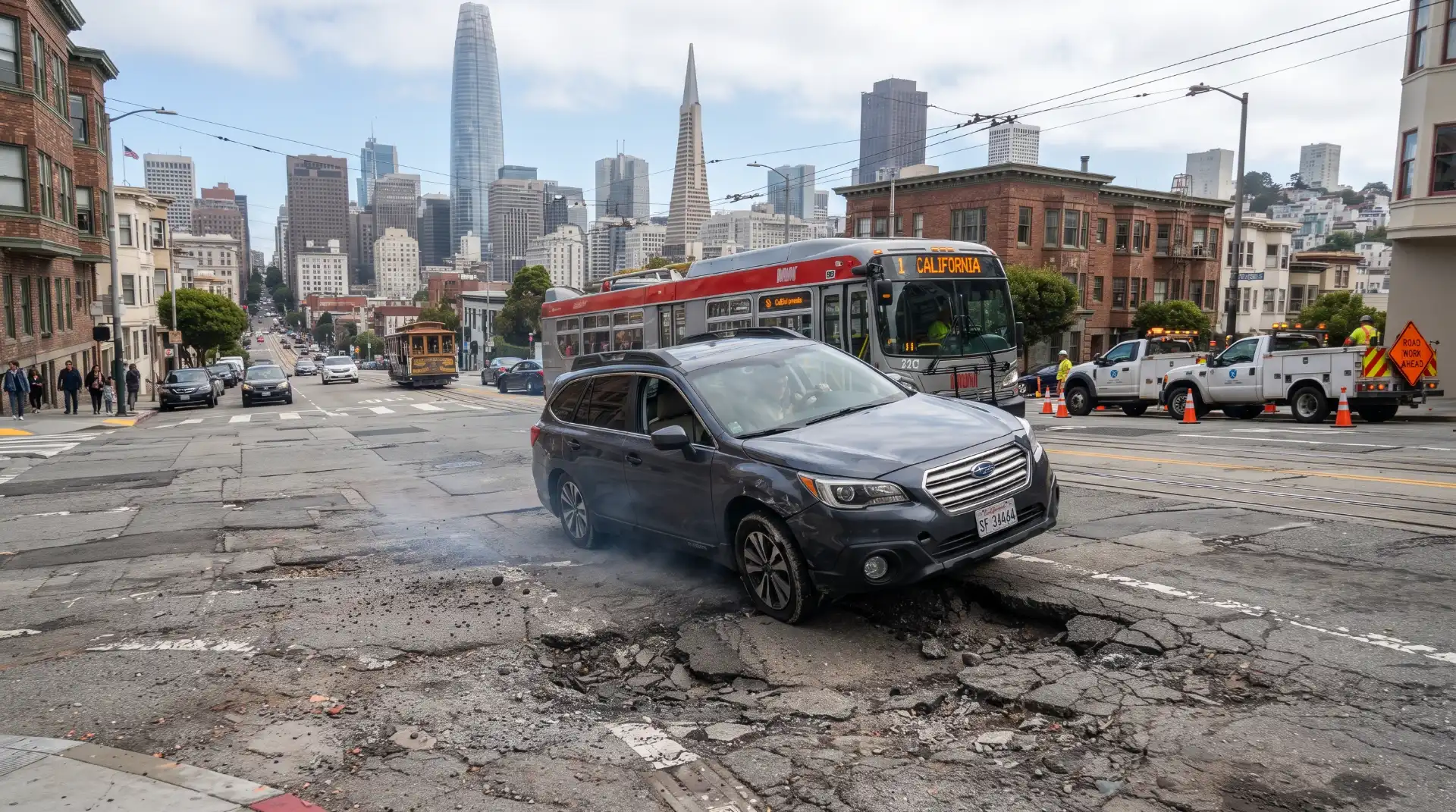
Most drivers expect California’s roads to be reasonably safe. While motorists understand that weather, heavy traffic, and aging infrastructure can eventually damage pavement, they also expect cities and government agencies to repair hazardous conditions before they cause serious crashes. Unfortunately, that doesn’t always happen. Across San Francisco and throughout California, deteriorating roads, large potholes, uneven pavement, malfunctioning traffic signals, faded lane markings, and poor drainage contribute to accidents every year.
When a collision occurs because of dangerous road conditions, many people immediately assume another driver is responsible. However, there are situations where the government agency responsible for maintaining the roadway may also bear legal responsibility. California law recognizes that public entities have a duty to keep public property reasonably safe for motorists, cyclists, pedestrians, and other road users. When that duty is breached and someone is injured as a result, an injured person may have grounds to pursue compensation.
Government liability cases differ significantly from ordinary car accident claims. They involve unique legal standards, shorter filing deadlines, and often require extensive evidence proving that the responsible agency knew—or should have known—about the dangerous condition before the accident occurred. Understanding how these claims work can help accident victims determine whether poor road maintenance played a role in their injuries.
Why Road Maintenance Is Critical for Public Safety
Roadways experience constant wear. Every day, thousands of vehicles travel across city streets, bridges, highways, and intersections. Heavy commercial trucks place enormous stress on pavement, while changing temperatures, rainfall, underground utility work, and natural ground movement gradually weaken road surfaces. Without routine inspections and timely repairs, small defects can quickly develop into dangerous hazards.
In San Francisco, roadway maintenance presents additional challenges. The city’s steep hills increase braking forces on pavement, while older infrastructure requires continuous upkeep. Utility companies regularly excavate streets to repair underground pipes and cables, and if those repairs are not completed properly, uneven pavement may remain for months. During the rainy season, clogged drainage systems can allow water to accumulate on roads, increasing the risk of hydroplaning.
Maintaining roads involves much more than filling potholes. Public agencies must inspect pavement conditions, repaint faded lane markings, repair damaged guardrails, replace missing traffic signs, maintain functioning traffic signals, trim vegetation blocking visibility, and ensure storm drains remain clear. These maintenance activities play an essential role in reducing preventable crashes.
According to the Federal Highway Administration (FHWA), roadway design and maintenance significantly influence traffic safety. Agencies are encouraged to regularly inspect transportation infrastructure and promptly correct hazardous conditions before they contribute to collisions.
How Poor Road Conditions Can Lead to Serious Accidents
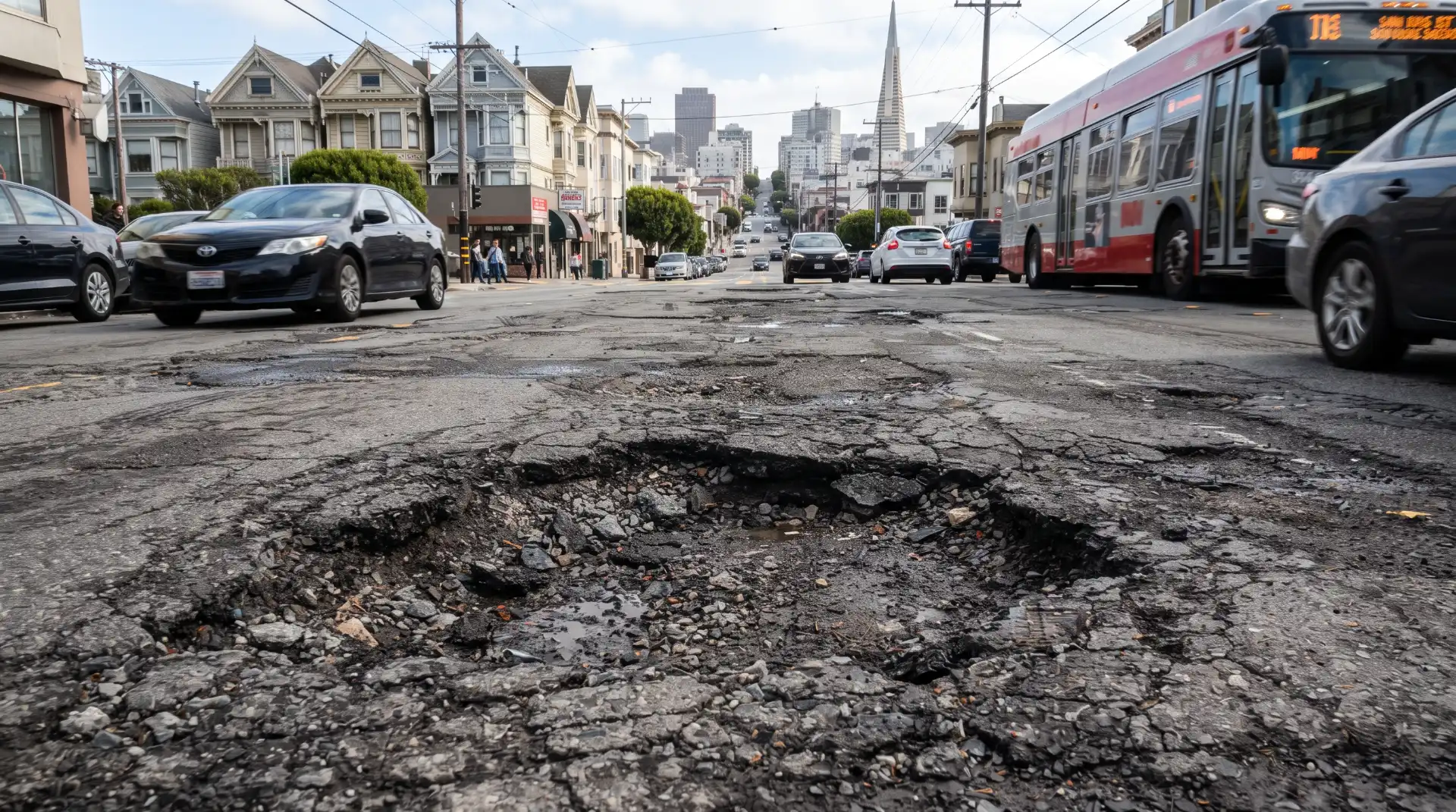
Road defects often create hazards that drivers cannot reasonably anticipate. Unlike aggressive driving or speeding, roadway defects may appear suddenly and leave motorists with little or no opportunity to react.
A deep pothole can cause a tire blowout at freeway speeds, making steering nearly impossible. Broken pavement may cause motorcycles to lose stability, resulting in riders being thrown from their bikes. Uneven asphalt left behind after utility work can unexpectedly shift a vehicle’s direction, while standing water caused by poor drainage may lead to hydroplaning during heavy rain.
Missing or damaged traffic signs create another common danger. Drivers unfamiliar with an area may unknowingly enter intersections without yielding because warning signs have fallen or become obscured. Likewise, faded lane markings become especially hazardous during nighttime driving or storms, when motorists struggle to identify proper travel lanes.
Construction zones also present risks when contractors or public agencies fail to maintain safe conditions. Loose gravel, abrupt pavement changes, missing warning signs, or improperly placed barriers can contribute to collisions that might otherwise have been avoided.
These hazards rarely exist overnight. In many cases, roadway defects develop over weeks or months, providing agencies with opportunities to identify and repair them before someone is injured.
When Can a City Be Held Liable?
Many people assume government agencies cannot be sued. While California law provides certain legal protections to public entities, those protections are not absolute. Cities, counties, and state agencies can sometimes be held liable when dangerous conditions on public property cause injuries.
To establish liability, it generally must be shown that the roadway contained a dangerous condition, that the responsible public agency either created the condition or had notice of it, and that the condition substantially contributed to the accident. It must also be demonstrated that the agency had enough time to repair the hazard or warn motorists but failed to take reasonable action.
For example, suppose residents repeatedly report a large pothole on a busy San Francisco street. If the city receives multiple complaints but fails to repair the roadway for several weeks, and a motorcyclist later crashes because of that pothole, the city’s prior knowledge may become an important factor in determining liability.
On the other hand, if an unexpected sinkhole opens immediately before an accident occurs, the city may argue it had no reasonable opportunity to discover or repair the condition. Every roadway defect case depends heavily on the surrounding facts.
Determining Whether a Roadway Was Actually Dangerous
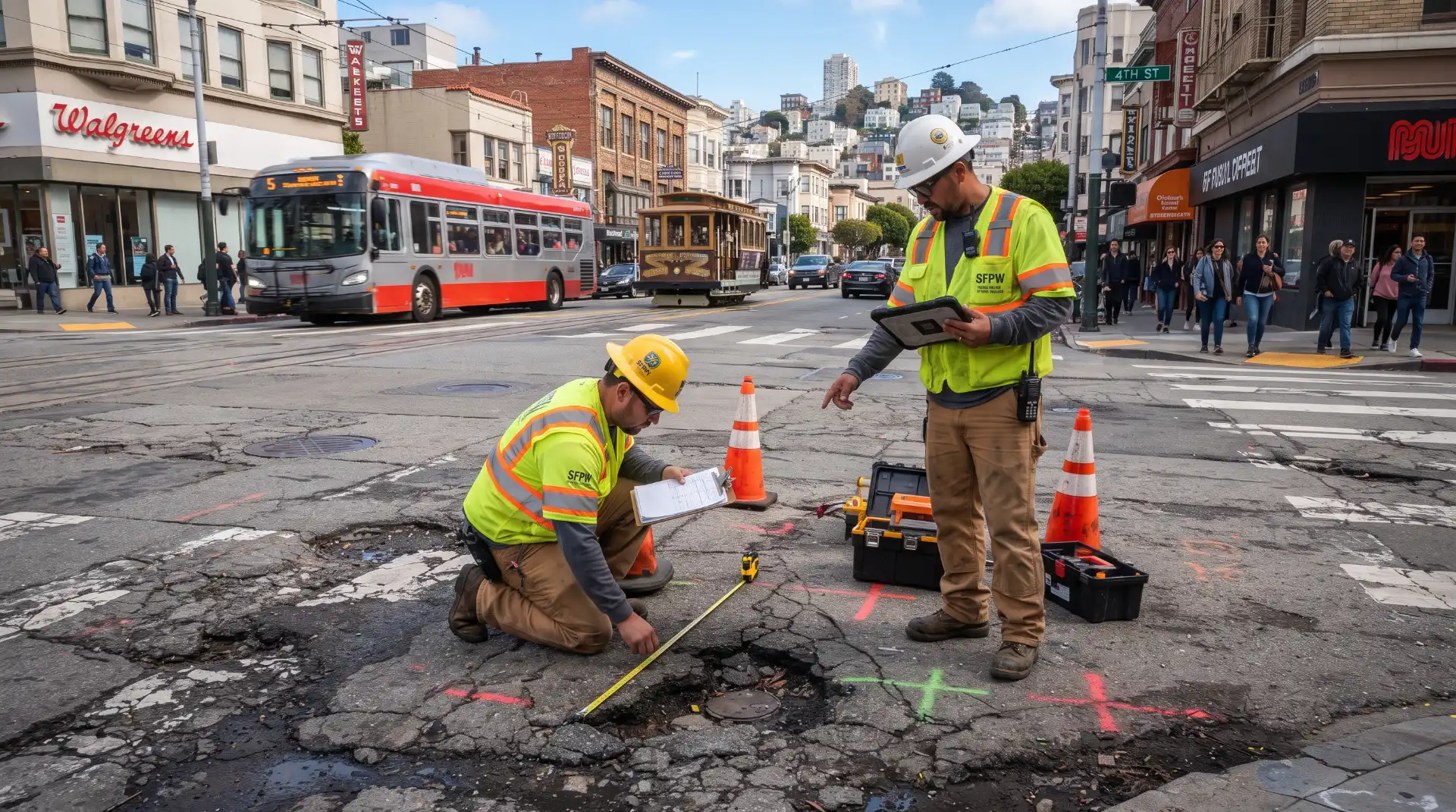
Not every crack in the pavement creates legal responsibility. Courts generally evaluate whether a roadway condition created a substantial risk when the property was used with reasonable care.
The severity of the defect matters. A minor pavement crack on a quiet residential street may not create an unreasonable danger. However, a deep pothole located in the middle lane of a heavily traveled roadway where vehicles regularly travel at higher speeds may present a much greater safety concern.
Judges and investigators often examine numerous factors, including traffic volume, visibility, roadway design, lighting conditions, weather, previous accident history, and whether warning signs were present. They also consider how long the condition existed before the accident.
In San Francisco, where many streets feature steep grades and sharp curves, even relatively modest roadway defects can become more hazardous because of braking distances and limited visibility.
Who Is Responsible for Maintaining the Road?
One of the first questions after a roadway defect accident is determining who actually owns and maintains the road. Many drivers assume every public street belongs to the city, but responsibility varies depending on the location.
Neighborhood streets are often maintained by the City and County of San Francisco, while major highways such as Interstate 80, Interstate 280, and portions of U.S. Highway 101 generally fall under the responsibility of the California Department of Transportation (Caltrans). In some situations, county governments, transportation authorities, or contractors performing road construction may also share maintenance responsibilities.
Identifying the correct agency is essential because filing a claim with the wrong entity can delay the legal process or affect important deadlines. Road ownership records, maintenance contracts, and public maps often become part of the investigation when determining responsibility.
More information about California highway maintenance is available through Caltrans:
Why Notice Is One of the Most Important Issues
One of the biggest legal challenges in roadway maintenance cases involves proving notice. Government agencies are generally not expected to instantly discover every new hazard. Instead, liability often depends on whether the agency knew—or reasonably should have known—about the dangerous condition before the accident occurred.
Actual notice exists when residents, maintenance crews, police officers, or city employees report a hazard through complaints, inspection reports, work orders, or prior repair requests.
Constructive notice may exist when the dangerous condition remained present long enough that regular inspections should have discovered it. For example, a pothole that gradually expands over several months is much different from sudden pavement damage caused by an earthquake or severe storm that occurred only hours before a crash.
Maintenance records, inspection schedules, previous citizen complaints, photographs, and prior accident reports frequently become valuable evidence when establishing notice.
Evidence Can Make or Break a Government Liability Claim
Unlike many ordinary traffic accidents, roadway maintenance claims often depend more heavily on physical evidence than witness testimony alone. The dangerous condition itself may be repaired within days, making early documentation extremely important.
Photographs showing the roadway immediately after the accident often become some of the strongest pieces of evidence. Multiple angles illustrating pothole depth, pavement deterioration, missing traffic signs, or standing water can help investigators reconstruct the scene. Dashcam footage may further demonstrate how the hazard appeared to approaching drivers and whether it could reasonably have been avoided.
Police reports sometimes note hazardous roadway conditions, while witness statements can establish that the defect existed well before the collision. Investigators may also obtain maintenance logs, engineering reports, and public complaint records to determine whether the responsible agency had notice of the problem. In more complex cases, accident reconstruction specialists and roadway engineering experts may evaluate how the defect contributed to the crash.
The sooner evidence is preserved, the greater the likelihood that investigators can accurately determine what happened before repairs alter the accident scene.
Road Defects Are Especially Dangerous for Certain Drivers
Although poor road maintenance can affect anyone, certain groups face significantly higher risks. Motorcyclists often suffer the most severe injuries because even relatively small pavement defects can destabilize a motorcycle. Cyclists face similar dangers, particularly when narrow tires become trapped in broken pavement or drainage grates.
Drivers of compact passenger vehicles may experience tire blowouts after striking deep potholes, while larger commercial vehicles can become difficult to control when uneven pavement shifts heavy loads unexpectedly.
Pedestrians may also be injured when deteriorating sidewalks, malfunctioning traffic signals, or poorly maintained crosswalks contribute to collisions involving vehicles.
Because different road users experience hazards differently, investigators frequently consider the type of vehicle involved when evaluating whether a roadway condition presented an unreasonable danger.
Government Claims Follow Different Rules
One of the biggest surprises for accident victims is discovering that claims against public agencies follow different legal procedures than standard personal injury lawsuits. California law imposes strict requirements for presenting claims against government entities, including relatively short deadlines that may apply long before the general statute of limitations expires.
These procedures are governed by the California Government Claims Act, which establishes the process for notifying public entities of potential claims. Missing these procedural requirements can affect an injured person’s ability to pursue compensation, making it important to act promptly after discovering that poor road maintenance may have contributed to an accident.
Understanding Compensation in Roadway Defect Cases
When government negligence contributes to an accident, injured individuals may seek compensation for many of the same losses available in other personal injury claims. Medical expenses often represent the largest portion of damages, particularly when victims require surgery, rehabilitation, or long-term treatment.
Lost income may also become significant if injuries prevent someone from returning to work for weeks or months. Some individuals experience permanent physical limitations that reduce future earning capacity, while others require ongoing therapy or adaptive medical equipment.
Compensation may also include property damage, pain and suffering, emotional distress, and future medical care when supported by medical evidence. The amount ultimately depends on the severity of the injuries, the strength of the evidence, the degree of governmental responsibility, and whether other parties also contributed to the collision.
What You Should Do After a Road Maintenance Accident
The moments following a crash can have a lasting impact on a potential claim. Seeking immediate medical attention should always come first, even if injuries initially appear minor. Some conditions, including concussions and internal injuries, may not produce symptoms right away.
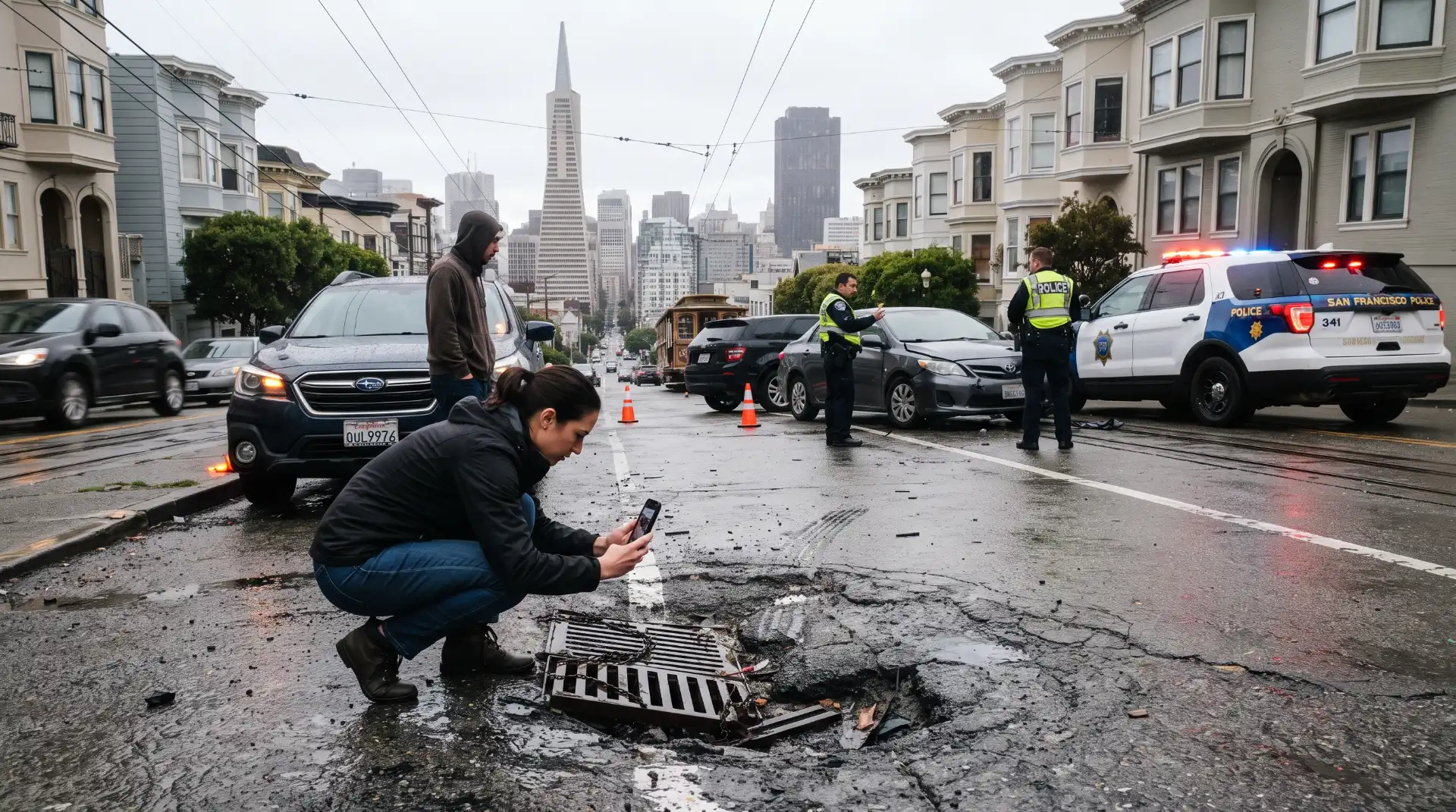
If it is safe to do so, documenting the roadway before leaving the scene can be invaluable. Photographs should capture the overall roadway as well as close-up views of potholes, broken pavement, missing signs, standing water, or other hazards. Recording the exact location, weather conditions, and time of day can also help investigators later reconstruct the circumstances surrounding the crash.
Drivers should preserve dashcam footage whenever available, obtain witness contact information, and request a copy of the responding officer’s report. Because roadway defects are often repaired shortly after an accident, preserving evidence early can make a substantial difference if legal questions arise later.
Learn More About California Car Accident Claims
If you’re researching your legal options, you may also find these resources on SanFranciscoAutoAccidentAttorney.com helpful:
- What to Do After a Car Accident in San Francisco
- How to Prove Fault After a California Car Accident
- What Evidence Helps Win a Car Accident Claim
- How Long Does It Take to Settle a California Car Accident Case?
These related articles provide additional information about protecting your rights, gathering evidence, and understanding the claims process after a collision.
Conclusion
Poor road maintenance is often an overlooked cause of serious traffic accidents. While driver negligence remains a leading factor in many crashes, dangerous roadway conditions such as potholes, deteriorating pavement, malfunctioning traffic signals, inadequate drainage, and missing warning signs can also create significant risks for motorists throughout San Francisco and California.
Public agencies are responsible for maintaining reasonably safe roads, but establishing government liability requires more than simply showing that a defect existed. Victims must often demonstrate that the roadway presented a dangerous condition, that the responsible agency had actual or constructive notice of the hazard, and that it failed to take reasonable action before the accident occurred. Because these cases involve unique procedural rules and strict filing deadlines, preserving evidence immediately after a crash is especially important.
Understanding how roadway maintenance affects public safety can help drivers recognize when a collision may involve more than ordinary driver error. When poor road conditions contribute to an accident, a thorough investigation may reveal whether a government agency shares responsibility for the injuries and losses that follow.