
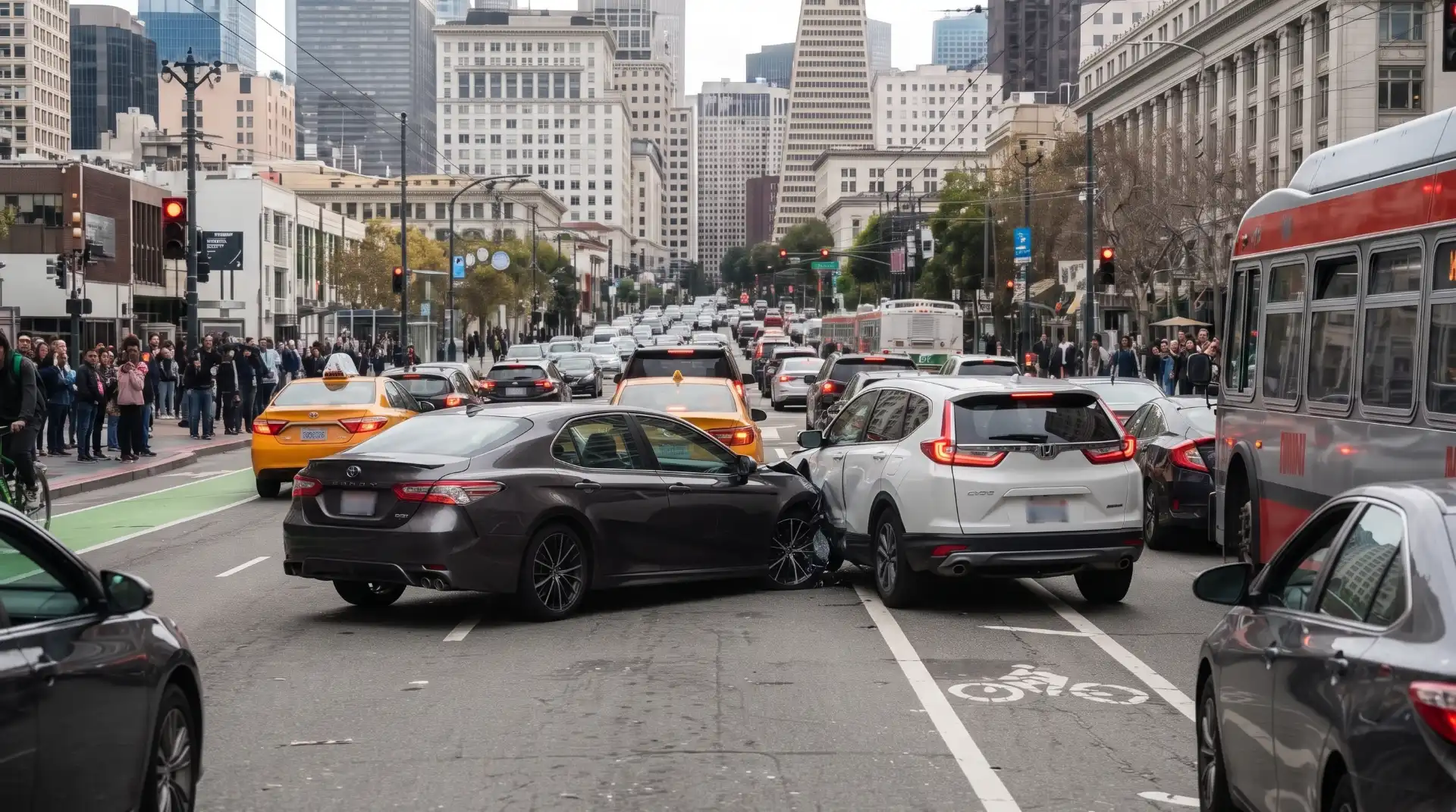
Traffic congestion is part of everyday driving in San Francisco. Commuters heading downtown, rideshare drivers searching for passengers, delivery vehicles stopping near businesses, Muni buses moving through crowded corridors, tourists following navigation apps, cyclists sharing city streets, and drivers entering or leaving freeways can all compete for limited roadway space.
When traffic slows to a crawl, many drivers assume the risk of a serious accident also decreases because vehicles are traveling at lower speeds. In reality, congestion can create a different set of crash risks. Stop-and-go movement, sudden braking, impatient lane changes, blocked intersections, distracted driving, and limited following distances can cause collisions even when vehicles are moving slowly.
Heavy traffic can also make fault harder to determine. A rear-end collision may appear straightforward until evidence shows that another vehicle cut abruptly into the lane. A sideswipe may involve one driver changing lanes while another accelerated to close the gap. A multi-vehicle crash may begin with one sudden stop and end with several drivers blaming each other.
So, can traffic congestion affect fault after a San Francisco car accident? Yes, but congestion itself does not automatically make anyone responsible. Instead, heavy traffic becomes part of the circumstances used to evaluate whether each driver acted reasonably. California law requires motorists to adjust their driving to traffic conditions, maintain reasonable following distances, and make lane changes safely.
Understanding how these rules work can be especially important in a city where congestion, transit activity, pedestrians, bicycles, freeway traffic, special events, and dense intersections frequently overlap.
Why Traffic Congestion Matters in a Car Accident Claim
Traffic conditions are important because drivers have a responsibility to respond reasonably to the environment around them. A motorist cannot drive as though the road were empty when vehicles are packed bumper to bumper.
California’s basic speed law reflects this principle. Vehicle Code section 22350 prohibits driving faster than is reasonable or prudent while considering factors that include visibility, roadway conditions, and traffic. In practical terms, the posted speed limit is not always the appropriate speed.
A driver traveling 25 mph on a street posted at 25 mph may still be moving too fast if traffic ahead has nearly stopped. Likewise, a motorist driving below the posted limit may still be negligent if the speed leaves insufficient time to react to congestion.
Heavy traffic can therefore change what reasonable driving looks like.
In free-flowing conditions, drivers may have several seconds to react to another vehicle. In dense congestion, the available reaction window may shrink dramatically. Safe driving may require additional following distance, slower acceleration, earlier braking, and greater caution before changing lanes.
When a collision occurs, investigators and insurance companies may ask whether the drivers adjusted their behavior to those conditions.
San Francisco’s Traffic Environment Can Be Especially Complicated
San Francisco is not simply a city with heavy automobile traffic. Its street network combines cars with pedestrians, cyclists, buses, light rail, commercial vehicles, delivery activity, construction, steep grades, one-way streets, freeway ramps, and frequent special events.
Traffic patterns can change quickly from one block to another. A driver may travel through moving traffic and suddenly encounter a queue caused by a red light, bus stop, delivery truck, street closure, construction zone, or event.
Congestion can be especially noticeable around Downtown, SoMa, the Financial District, the Embarcadero, Mission Street, Van Ness Avenue, Market Street approaches, freeway connections, and major event venues.
San Francisco regularly implements traffic-control measures for major events. For example, the SFMTA has used temporary street closures and traffic restrictions near Giants games to manage congestion around King Street and nearby streets. The agency likewise warns drivers to expect significant delays during major city events. These measures illustrate how quickly traffic conditions can change when large numbers of vehicles and pedestrians converge in one area.
The important liability point is not that congestion automatically makes these streets dangerous. Instead, congestion creates conditions that require drivers to pay closer attention and adjust their behavior.
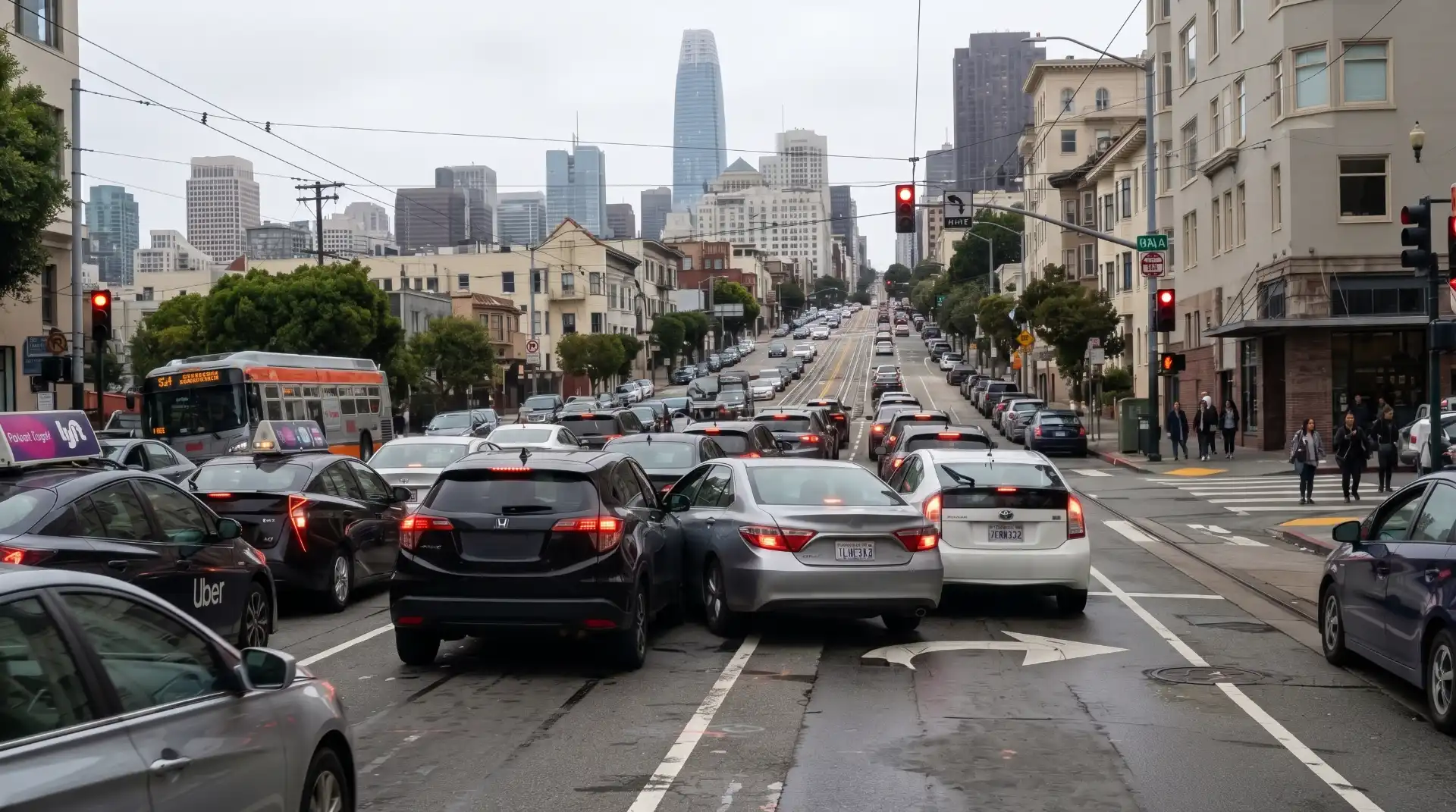
Does Heavy Traffic Automatically Change Who Is at Fault?
No. Traffic congestion does not create a separate rule of liability.
Fault is generally based on the conduct of the drivers and whether their actions caused the collision. Heavy traffic is one of the circumstances considered when evaluating that conduct.
Suppose a driver rear-ends another vehicle in bumper-to-bumper traffic. The rear driver cannot ordinarily defend the crash simply by saying traffic stopped suddenly. Stop-and-go movement is a foreseeable part of congestion, and drivers should leave enough room to stop safely.
However, the situation might change if another vehicle suddenly crossed several lanes and entered the driver’s stopping space immediately before the impact. In that case, the lane-changing driver’s conduct may also be relevant.
Similarly, congestion does not give drivers permission to block intersections, make unsafe turns, ignore traffic signals, or force their way into another lane.
The legal analysis focuses on what each person did, what a reasonably careful driver would have done under similar conditions, and whether that conduct contributed to the crash.
Rear-End Accidents in Stop-and-Go Traffic
Rear-end collisions are among the most common types of congestion-related accidents.
Traffic may repeatedly accelerate to 10 or 20 mph and then stop again only seconds later. Drivers who follow too closely may not have enough distance to respond when traffic suddenly compresses.
California Vehicle Code section 21703 provides that a driver must not follow another vehicle more closely than is reasonable and prudent, taking into account speed, traffic, and roadway conditions.
That last part is important. What counts as a reasonable following distance depends partly on traffic conditions.
A driver may need significantly more space when visibility is poor, pavement is wet, traffic is unpredictable, or the vehicle ahead repeatedly stops.
In many rear-end crashes, the following driver is considered primarily responsible because that person had a duty to maintain enough distance to stop.
But rear-end liability is not automatic in every case.
Consider a driver who is traveling slowly with a reasonable gap ahead. Another motorist suddenly enters that gap from an adjacent lane and immediately brakes. If the first driver has no reasonable opportunity to avoid the collision, the vehicle that cut into the lane may bear some or most of the responsibility.
Video evidence can be extremely important in cases like these because the final vehicle positions may not reveal what happened seconds before impact.
Unsafe Lane Changes During Congestion
Congestion often creates frustration. A lane may appear to move faster than the one beside it, encouraging drivers to move back and forth in search of a small advantage.
These lane changes can lead to sideswipe collisions, rear-end crashes, and chain-reaction accidents.
California Vehicle Code section 22107 states that a driver should not move right or left on a roadway until the movement can be made with reasonable safety. When another vehicle may be affected, an appropriate signal is also required.
In heavy traffic, a safe lane change may require more caution because available spaces are smaller and visibility may be reduced by trucks, SUVs, buses, or other vehicles.
A driver who forces into a gap that is too small can cause another motorist to brake suddenly or swerve.
At the same time, another driver may contribute to a crash by intentionally accelerating to prevent a vehicle from entering an otherwise reasonable opening.
This is one situation where fault can become shared rather than falling entirely on one motorist.
Can Traffic Congestion Affect Speeding Liability?
Yes. Congestion can make a speed unsafe even when the vehicle is traveling below the posted limit.
California’s basic speed law requires motorists to consider traffic conditions. If vehicles ahead are moving at 10 mph, a driver approaching the queue at 35 mph may be traveling too fast for conditions even if the posted limit is 35 mph.
This frequently becomes an issue in crashes where traffic backs up unexpectedly.
A driver may say that the vehicle ahead “stopped suddenly,” but investigators may ask whether the stopped traffic should have been visible earlier. Brake lights, traffic signals, congestion ahead, navigation alerts, and surrounding vehicle behavior can all provide warnings.
Drivers are generally expected to anticipate normal changes in urban traffic.
Congestion does not mean drivers must crawl at all times. It does mean speed should be appropriate for the available stopping distance and surrounding conditions.
Distracted Driving Becomes More Dangerous in Heavy Traffic
Slow traffic can create a false sense of security.
A driver stuck in a queue may decide it is safe to look at a text message, adjust navigation, scroll through a music app, check email, or use a rideshare application because the vehicle is moving only a few miles per hour.
But stop-and-go traffic requires constant attention.
The vehicle ahead may stop unexpectedly. A cyclist may appear beside the car. A pedestrian may enter a crosswalk. A lane may begin moving while another remains stopped.
A distraction lasting only a few seconds may be enough to cause a collision.
Phone use can also become important evidence after a crash. Depending on the seriousness of the case and applicable legal procedures, investigators may examine phone records or other data to determine whether a driver was actively using a device.
Blocked Intersections and “Gridlock” Accidents
Heavy congestion often causes drivers to enter intersections even when there is not enough room to clear them.
The result can be gridlock. Vehicles become trapped in the intersection when the light changes, blocking traffic traveling in the opposite direction.
That situation can lead to angle collisions when cross traffic receives a green light and begins moving while another vehicle is still obstructing the intersection.
Fault in these crashes depends on the sequence of events.
A driver who entered the intersection without adequate space may bear responsibility for creating the obstruction. However, another driver who proceeds into a visibly blocked intersection without reasonable caution could also contribute to the crash.
Traffic-camera footage, dash-camera recordings, and witness accounts may help show which vehicle entered first and what each driver could see.
Congestion Around Freeway Entrances and Exits
Traffic jams near San Francisco freeway connections create another common source of accidents.
Vehicles exiting Interstate 80 or U.S. 101 may encounter slower surface-street traffic almost immediately. Drivers entering the freeway may also compete for limited merge space.
During congestion, freeway queues can extend toward ramps and connecting streets. Drivers who wait until the last moment to merge may cut across lanes, while others may refuse to create space.
The resulting crashes often involve disagreements over lane position and right of way.
These cases are closely related to the site’s guide on Freeway Ramp Accidents in SoMa: Understanding Liability at San Francisco’s High-Risk Intersections. That article can be used as an internal link once it is published.
Multi-Vehicle Accidents During Traffic Jams
Congestion can turn a two-car collision into a multi-vehicle crash.
Suppose the first vehicle brakes for stopped traffic. The second vehicle stops safely. The third vehicle fails to stop and pushes the second vehicle into the first.
The driver of the middle vehicle may initially appear responsible for striking the car ahead, but the evidence may show that the middle car was pushed forward.
In another scenario, several drivers may each be following too closely, causing successive rear-end impacts.
Determining responsibility in a chain-reaction crash can require examining each separate collision.
Vehicle damage patterns may help establish the sequence. Witness statements, dash cameras, event-data recorders, and surveillance footage may also clarify whether a vehicle was already stopped before being struck from behind.
Insurance companies may attempt to divide responsibility among several drivers, especially when the collision sequence is unclear.
California’s Comparative Fault Rule
Heavy-traffic accidents frequently involve more than one mistake.
California follows a pure comparative fault system. This allows responsibility to be divided among the people whose conduct contributed to an accident.
For example, Driver A may make an unsafe lane change while Driver B is traveling too fast for the congested conditions.
If both actions contribute to the collision, fault may be divided between them.
A person who is partly responsible is not necessarily prevented from recovering damages. Instead, the recovery can generally be reduced according to that person’s percentage of fault.
This makes evidence especially important. Even a relatively small difference in the allocation of fault can affect the value of a substantial injury claim.
Can a Driver Blame Traffic for a Crash?
A driver may explain that traffic was unusually heavy, but congestion alone generally does not excuse negligent driving.
In fact, heavy traffic often means that greater caution is required.
A motorist who knows traffic is moving unpredictably should anticipate frequent braking. A driver who sees vehicles packed closely together should recognize that an aggressive lane change creates greater risk.
Congestion is therefore usually a condition to which drivers must adapt rather than a separate cause that eliminates individual responsibility.
There are exceptions where an unexpected event may create a genuine emergency, but ordinary rush-hour congestion, traffic backups, and stop-and-go driving are generally foreseeable conditions in San Francisco.
How Rideshare and Delivery Drivers Affect Congested Traffic
San Francisco has substantial rideshare, food-delivery, courier, and commercial delivery traffic.
These drivers often operate under time pressure and may need to stop near specific addresses that lack convenient loading space.
A rideshare driver may slow unexpectedly while looking for a passenger. A delivery vehicle may partially block a lane. Another driver may cut across traffic to reach a curb.
If one of these actions contributes to a collision, liability may depend on the driver’s conduct and whether that person was working at the time.
For an employee acting within the scope of employment, the employer may potentially become part of the liability analysis.
Rideshare crashes can involve additional insurance questions based on whether the driver was logged into the app, waiting for a trip, traveling to a passenger, or transporting someone.
Pedestrians, Cyclists, and Congested Intersections
Heavy vehicle traffic can also increase risks for pedestrians and cyclists.
When cars queue through intersections, drivers may have limited views of crosswalks. Large SUVs, trucks, and buses can obstruct sightlines. Drivers may also focus so heavily on finding an opening in traffic that they fail to notice someone crossing.
Right-turn collisions can become especially dangerous when drivers are watching traffic approaching from the left and fail to check for pedestrians or cyclists on the right.
Blocked visibility is a recurring street-safety issue in San Francisco. Your existing article Daylighting and Safety Zones: How Blocked Sightlines Affect Crash Fault provides a useful internal resource on visibility and intersection liability.
What Evidence Helps Prove Fault in a Congestion-Related Crash?
Heavy-traffic collisions often produce conflicting stories.
One driver may claim the other cut into the lane. The other may say there was already enough space. Someone may argue that traffic stopped unexpectedly, while another witness says brake lights were visible long before impact.
Scene photographs can help establish vehicle positions, lane markings, surrounding congestion, traffic signals, intersections, road signs, and nearby obstructions.
Video is often even more valuable.
San Francisco businesses, parking garages, apartment buildings, transit vehicles, and dash cameras may record nearby streets. In some locations, a camera may capture the exact sequence of lane changes or braking that led to the crash.
Witness statements can also help determine which driver was moving, which lane each vehicle occupied, whether someone signaled, and whether traffic had already stopped.
Vehicle event data may provide information about speed and braking immediately before a serious collision.
Why Photos of the Traffic Conditions Matter
People often photograph the vehicle damage but forget to document the roadway environment.
In a congestion-related case, wide-angle photos can be extremely useful.
A photograph showing a long line of stopped vehicles may support an argument that a driver should have anticipated the slowdown. Images showing a blocked lane or temporary construction may explain why traffic suddenly merged.
Photos can also document whether a vehicle was stopped partly in another lane, whether sightlines were obstructed, or whether an intersection was already congested.
The more accurately the scene is documented, the easier it may be to reconstruct what occurred later.
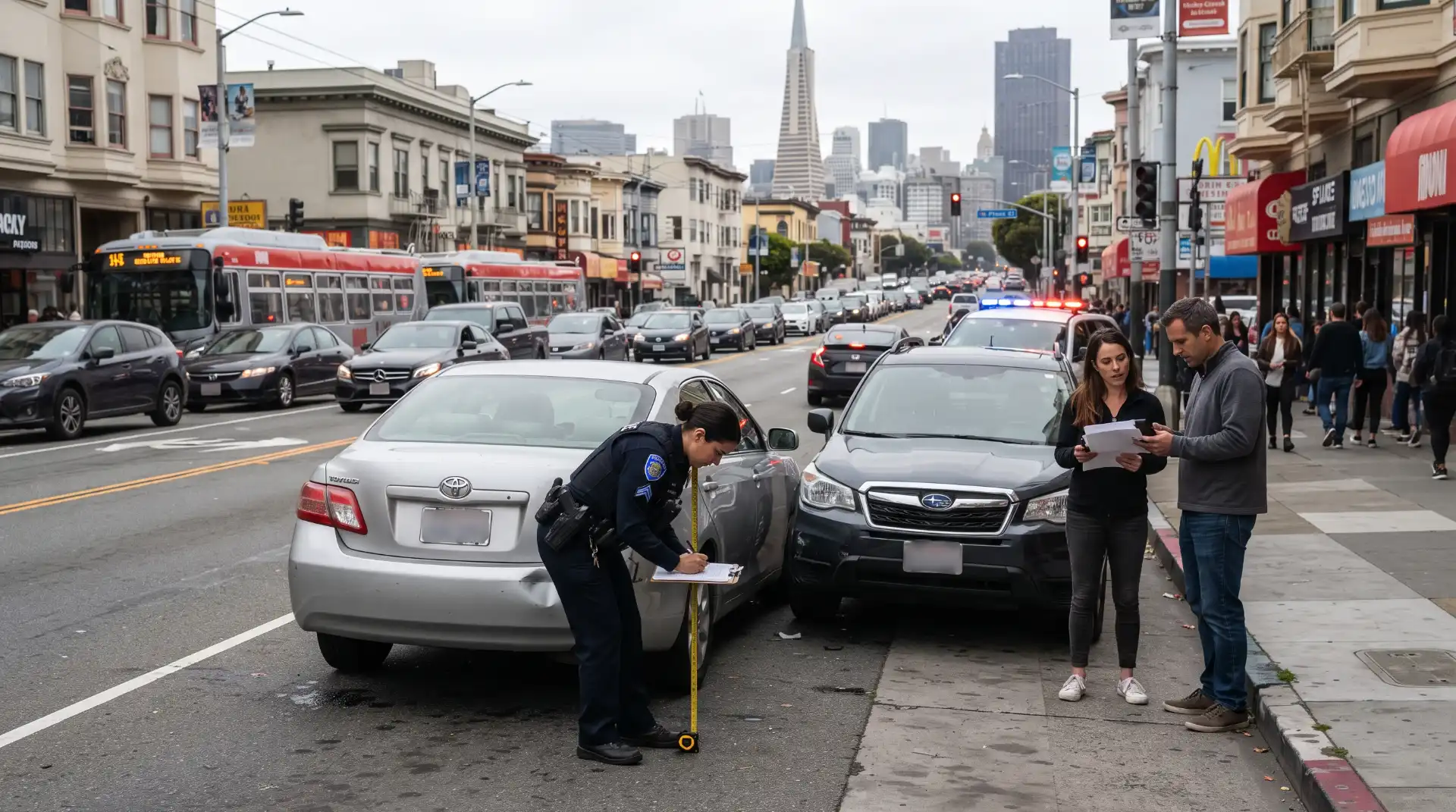
Police Reports and Witness Statements
Police reports are often used by insurance adjusters when evaluating liability, although the report itself does not necessarily decide a civil claim.
An officer may record driver statements, witness accounts, roadway conditions, visible damage, and potential traffic violations.
Neutral witnesses can be especially helpful in congested accidents because the drivers may have completely different versions of what happened.
A pedestrian waiting at an intersection, a rideshare passenger, a cyclist, or another driver may have had a clearer view than either person involved in the collision.
If possible, obtaining witness contact information before people leave the scene can preserve a potentially important source of evidence.
Insurance Company Arguments After Heavy-Traffic Accidents
Insurance companies may use congestion to support several different liability arguments.
An insurer representing a rear driver may argue that the vehicle ahead stopped unexpectedly or changed lanes immediately before impact.
An insurer representing the front driver may point to the rear driver’s failure to maintain a reasonable following distance.
In a sideswipe case, one carrier may argue that the other motorist made an unsafe lane change. The opposing insurer may contend that its driver already occupied the lane and the other vehicle accelerated into the space.
Comparative fault can become a major issue when neither version is fully supported by independent evidence.
This is why video, physical damage, witnesses, and roadway evidence can have greater value than competing driver statements alone.
Can Road Design or Traffic Control Affect Liability?
Sometimes a crash involves more than driver behavior.
A malfunctioning traffic signal, missing sign, obscured lane marking, or other roadway condition may contribute to confusion.
However, a congested street does not automatically qualify as a dangerous condition of public property, and a crash does not automatically create liability for the City and County of San Francisco or another public agency.
Public-entity liability involves separate legal requirements, including questions about the condition of the property, causation, foreseeable risk, and whether the entity created the condition or had sufficient notice of it.
Claims involving public entities also can have substantially shorter procedural deadlines than ordinary personal injury cases.
San Francisco’s Ongoing Traffic-Safety Efforts
San Francisco continues to study where severe crashes occur and what contributes to them.
The city’s High Injury Network identifies corridors where severe and fatal traffic injuries are concentrated so agencies can better target safety improvements.
City officials reported that San Francisco recorded 25 traffic deaths in 2025, compared with 43 in 2024. While that represented a significant decrease, the SFMTA emphasized that traffic fatalities are only one measure of road safety and that collision patterns, injuries, crash severity, contributing factors, and crash locations also matter.
For people evaluating a particular accident, these citywide statistics do not determine fault. They do show why San Francisco continues to focus on driver behavior, speed, intersection design, and high-injury corridors.
Special Events Can Dramatically Change Traffic Conditions
Traffic congestion in San Francisco is not limited to weekday rush hour.
Giants games, concerts, festivals, holiday events, conventions, demonstrations, street fairs, and other large gatherings can create sudden changes in traffic flow.
The SFMTA frequently uses temporary street closures, transit reroutes, parking restrictions, and traffic-control measures during major events.
A driver familiar with a neighborhood may therefore encounter completely different traffic patterns on an event day.
Drivers remain responsible for responding reasonably to those conditions.
If lanes are temporarily closed or vehicles are being redirected, motorists should slow down, follow traffic controls, avoid sudden movements, and allow additional space.
What Damages May Be Available After a Congestion-Related Crash?
If another person’s negligence causes an accident, an injured person may seek compensation for losses resulting from the collision.
Depending on the circumstances, damages may include emergency care, hospitalization, diagnostic testing, physical therapy, medication, surgery, future medical treatment, and other reasonable medical expenses.
Lost wages may also be part of a claim when injuries prevent someone from working.
More serious injuries can affect future earning capacity, particularly when the person cannot return to the same job or must reduce work hours.
Property damage may include vehicle repairs, replacement value for a totaled vehicle, towing, storage, and other related expenses.
Non-economic damages can include physical pain, emotional distress, inconvenience, and reduced enjoyment of normal activities.
The value of any particular claim depends on the evidence, liability, severity of injuries, insurance coverage, and other case-specific factors.
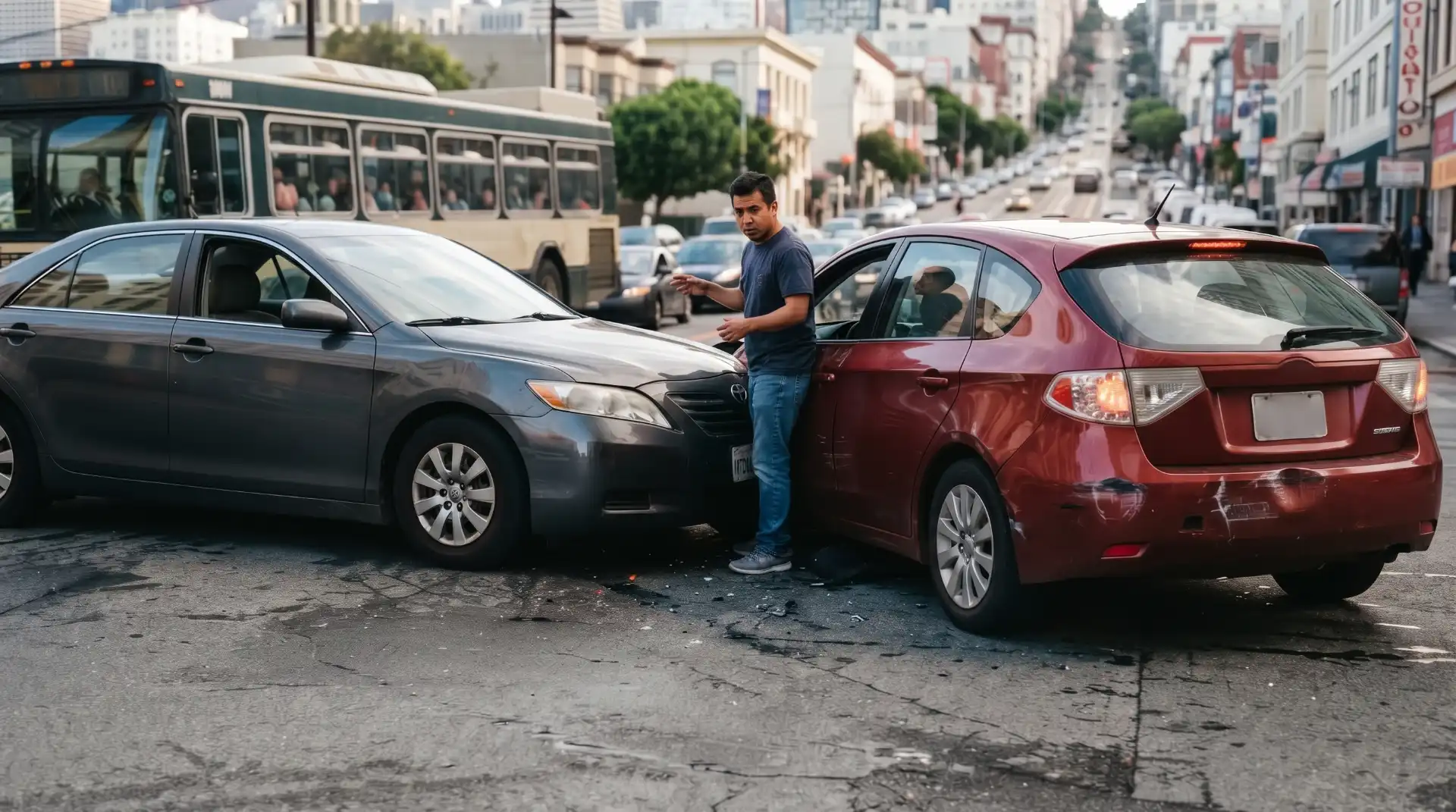
What Should You Do After a Crash in Heavy San Francisco Traffic?
The first priority is safety.
If the crash occurs in an active travel lane and the vehicles can be moved safely, getting out of the path of moving traffic may reduce the risk of a secondary collision. Emergency assistance should be requested when anyone is injured or when the crash creates an immediate roadway hazard.
If it is safe to do so, photograph the vehicles and surrounding traffic conditions before the scene changes. Capture lane markings, traffic signals, intersections, nearby construction, vehicle positions, and any visible damage.
Exchange contact and insurance information and obtain witness information when possible.
Medical care should not be ignored simply because the collision happened at low speed. Even congestion-related crashes can cause neck injuries, back injuries, concussions, shoulder injuries, and other conditions.
For a broader post-crash checklist, readers can visit What to Do After a Car Accident in San Francisco: A Step-by-Step Guide.
Why Low-Speed Traffic Does Not Always Mean Minor Injuries
Many congestion accidents occur below freeway speeds, but speed alone does not determine injury severity.
A person may be turned in the seat when the collision happens. A vehicle may be struck from an unexpected angle. A second vehicle may push the car into another object.
Older adults or people with prior vulnerabilities may also experience significant injuries from impacts that cause relatively little visible vehicle damage.
Rear-end collisions can cause neck and back trauma. Side impacts may injure shoulders, ribs, hips, or the head. Multi-vehicle crashes can involve several separate impacts.
Medical symptoms may also appear hours after the collision rather than immediately at the scene.
How Long Do You Have to File a Claim?
California generally provides a two-year statute of limitations for many personal injury lawsuits arising from negligence.
However, different deadlines can apply depending on the defendant and circumstances.
If a public entity may be involved, a government claim may need to be presented much sooner, often within six months for personal injury claims.
Deadlines can also affect evidence even before the legal filing period expires. Surveillance footage may be deleted, witnesses may become difficult to locate, and vehicles may be repaired or destroyed.
Prompt investigation can therefore matter even when the lawsuit deadline appears far away.
Can Traffic Congestion Strengthen or Weaken a Liability Claim?
It can do either, depending on the facts.
Congestion may strengthen a claim against a driver who followed too closely because stop-and-go traffic made sudden braking foreseeable.
It may support an argument that a driver should have slowed because the roadway was visibly crowded.
On the other hand, congestion may complicate liability if vehicles were changing lanes at the same time or if visibility was obstructed.
An insurance company may use the crowded conditions to argue that both drivers contributed to the collision.
The important question is not whether traffic was heavy. It is whether each driver responded to the heavy traffic with reasonable care.
Final Thoughts
Traffic congestion can significantly affect how a San Francisco car accident happens and how fault is evaluated afterward.
Heavy traffic shortens reaction times, reduces available stopping distance, encourages frequent lane changes, and creates situations where several vehicles may contribute to the same collision.
California law expects drivers to account for these conditions. Motorists must maintain reasonable following distances, make lane changes safely, and travel at speeds appropriate for the traffic around them.
Congestion itself is not usually a legal excuse for causing a crash. In many situations, it is a reason drivers should exercise greater caution.
When fault is disputed, evidence can make the difference. Photographs, surveillance footage, dash cameras, witness statements, vehicle data, police reports, and documentation of the surrounding traffic conditions may help reconstruct what occurred.
For anyone involved in a congestion-related collision, understanding these factors can provide a clearer picture of how California liability rules apply and why even a seemingly simple stop-and-go traffic accident may require careful investigation.
Frequently Asked Questions About Traffic Congestion and Accident Fault
Does heavy traffic automatically make the rear driver responsible?
No. The rear driver is often responsible when that person fails to maintain a reasonable following distance, but liability depends on the circumstances. If another vehicle suddenly cuts into the lane or creates an unavoidable emergency, responsibility may be shared or assigned differently.
Can I be at fault for driving the speed limit in heavy traffic?
Potentially. California’s basic speed law requires drivers to travel at a speed that is reasonable for current traffic and roadway conditions. A posted speed limit does not necessarily make that speed safe when traffic ahead is nearly stopped.
Who is at fault in a sideswipe during a traffic jam?
Fault often depends on which driver moved from the established lane and whether the lane change could be completed safely. Video, vehicle damage, witnesses, and lane markings may help determine what happened.
Can both drivers share fault in a San Francisco traffic accident?
Yes. California’s comparative fault system allows responsibility to be divided among multiple parties when more than one person’s conduct contributes to a collision.
Does stop-and-go traffic make rear-end accidents unavoidable?
No. Stop-and-go conditions are common and generally foreseeable. Drivers are expected to maintain enough space and attention to react to traffic slowing or stopping ahead.
Can an Uber or Lyft driver be liable for causing a crash in congestion?
Yes. Rideshare drivers are subject to normal driving rules. Insurance coverage may depend on the driver’s app status and whether the driver was waiting for, traveling to, or transporting a passenger.
What evidence is useful after a traffic-jam accident?
Useful evidence can include photos of the vehicles and roadway, traffic conditions, dash-camera footage, nearby surveillance video, witness statements, police reports, phone records when legally obtainable, and electronic vehicle data.
Can road construction affect fault?
It can be relevant if temporary traffic controls, lane changes, visibility problems, or another roadway condition contributed to the collision. However, construction alone does not automatically make a contractor or public entity liable.
Are low-speed congestion crashes capable of causing serious injuries?
Yes. Injury severity depends on many factors beyond speed, including impact direction, occupant position, secondary collisions, age, and individual medical circumstances.
Should I photograph the traffic jam after the accident?
If it is safe to do so, photographs of the surrounding traffic can be useful. They may help establish how crowded the roadway was, whether traffic was already stopped, and whether construction, blocked lanes, or visibility problems affected the crash.