
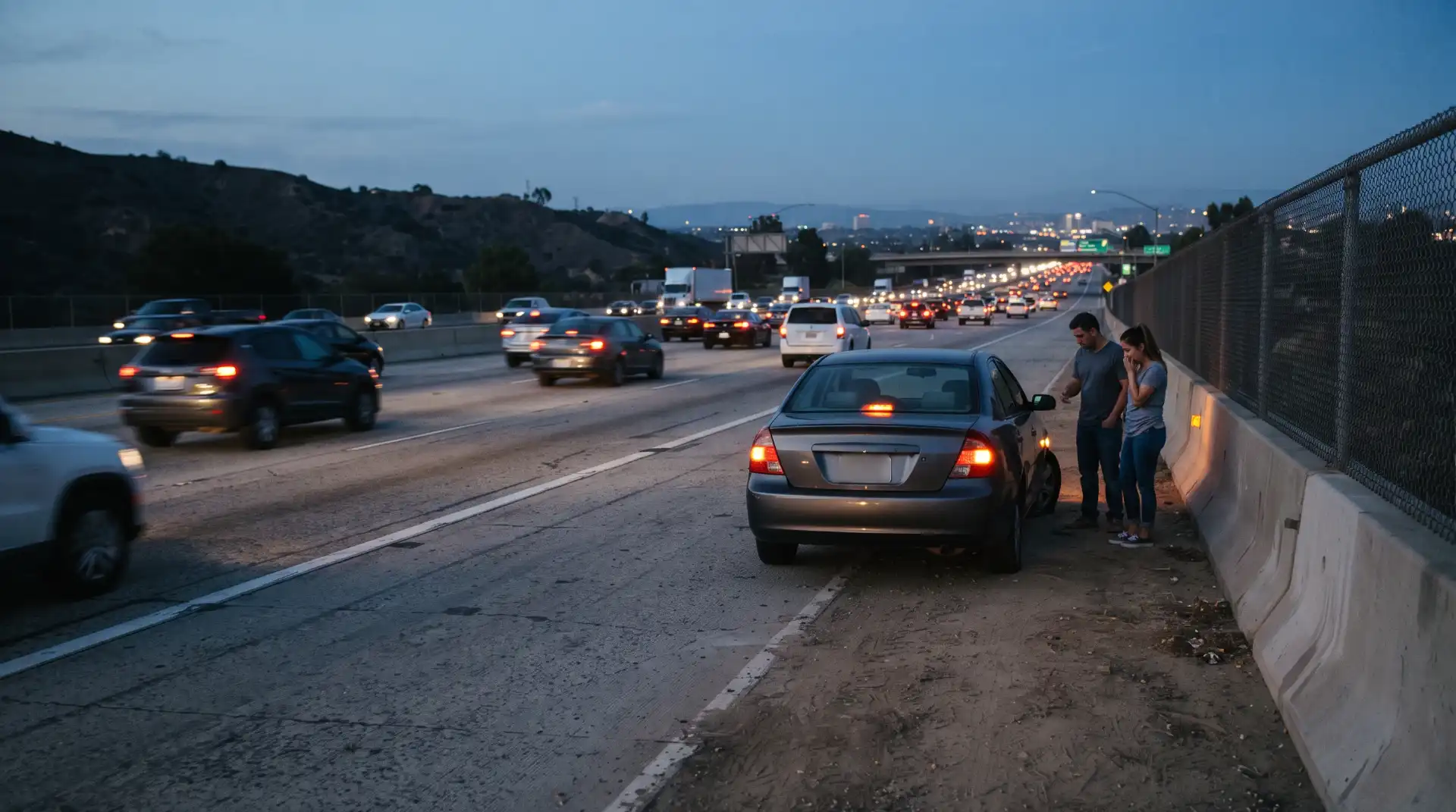
A vehicle breakdown on a California highway can quickly become more than an inconvenience. A flat tire, mechanical failure, dead battery, overheating engine, or collision can leave a vehicle stopped near fast-moving traffic. When approaching motorists fail to notice the disabled vehicle or do not leave enough space, another collision may occur.
California addressed part of this danger with an expanded Slow Down, Move Over law that took effect January 1, 2026. The rule now applies more broadly to stationary vehicles displaying flashing hazard lights or another warning device, in addition to certain emergency and highway maintenance vehicles. Drivers approaching these vehicles must take appropriate precautions under the circumstances. California DMV explains the 2026 change as part of the state’s latest traffic-safety laws.
For people involved in car accidents involving disabled vehicles, determining responsibility can be complicated. The driver who strikes the stopped vehicle may bear responsibility, but the disabled vehicle’s location, visibility, warning lights, mechanical condition, traffic conditions, and actions of other motorists can also matter.
Understanding these factors can help motorists recognize why highway breakdown crashes happen and what evidence may become relevant afterward.
Why Disabled Vehicles Are Dangerous on California Highways
California highways carry vehicles traveling at relatively high speeds, often with limited space between traffic and the shoulder.
A vehicle that suddenly loses power may slow dramatically before reaching the shoulder. In other situations, a driver may be unable to move completely outside a traffic lane.
That difference can turn an ordinary mechanical problem into a serious road hazard.
Drivers approaching from behind may have only seconds to recognize that a vehicle is stopped rather than moving with traffic. Darkness, rain, curves, congestion, glare, large trucks, or distracted driving can further reduce the time available to react.
California Highway Patrol policies recognize disabled vehicles as potential roadway hazards. CHP guidance calls for officers to investigate disabled vehicles within their jurisdiction and considers moving a vehicle from a hazardous location or obtaining repair assistance when appropriate.
The danger may become particularly significant when a vehicle is stranded in an active freeway lane.
A driver traveling at highway speed may initially assume that the vehicle ahead is moving. Once the driver realizes that it is stationary, there may be insufficient distance to brake or change lanes safely.
This situation can produce high-impact rear-end collisions and, in some cases, multi-vehicle crashes.
California’s 2026 Slow Down, Move Over Law
One of the most relevant changes for this topic took effect on January 1, 2026.
California’s expanded Slow Down, Move Over requirements now cover more stationary vehicles. According to the California DMV, AB 390 expanded the requirement to include stationary vehicles displaying flashing hazard lights or another warning device, along with marked highway maintenance vehicles and other covered vehicles.
The change has particular significance for ordinary motorists experiencing roadside emergencies.
Historically, many drivers associated Move Over laws mainly with police cars, fire engines, ambulances, and tow trucks. The 2026 expansion recognizes that an ordinary disabled vehicle on or near a highway can also expose its occupants and nearby people to substantial risk.
A motorist approaching a stopped vehicle should therefore pay attention to hazard lights and other warning devices.
When conditions permit, creating additional space between moving traffic and the stationary vehicle can reduce the chance of a secondary collision.
The law does not mean that the approaching driver automatically bears full civil responsibility every time a crash occurs near a disabled vehicle. Accident liability remains dependent on the specific circumstances.
However, compliance with traffic laws can become relevant when investigators examine whether a driver acted reasonably before the collision.
Common Reasons Vehicles Become Disabled on Highways
Vehicles can become disabled for many reasons, and the cause of the breakdown may affect what happens next.
A flat or damaged tire can cause a driver to lose speed quickly. Tire failures can also make steering difficult, particularly when they occur at highway speeds.
Engine overheating may force a motorist to stop before additional mechanical damage occurs. Electrical failures, alternator problems, dead batteries, fuel-system issues, and transmission failures can also leave vehicles unable to continue.
Electric vehicles introduce additional scenarios. An EV can become disabled because of battery depletion, electrical-system problems, tire damage, or other mechanical failures.
Some vehicles stop because they were already involved in a collision. A minor impact that might otherwise result mainly in property damage can become more dangerous when damaged vehicles remain in or beside moving traffic.
Whatever caused the initial problem, the position of the disabled vehicle may become one of the most important factors in determining the risk of a subsequent accident.
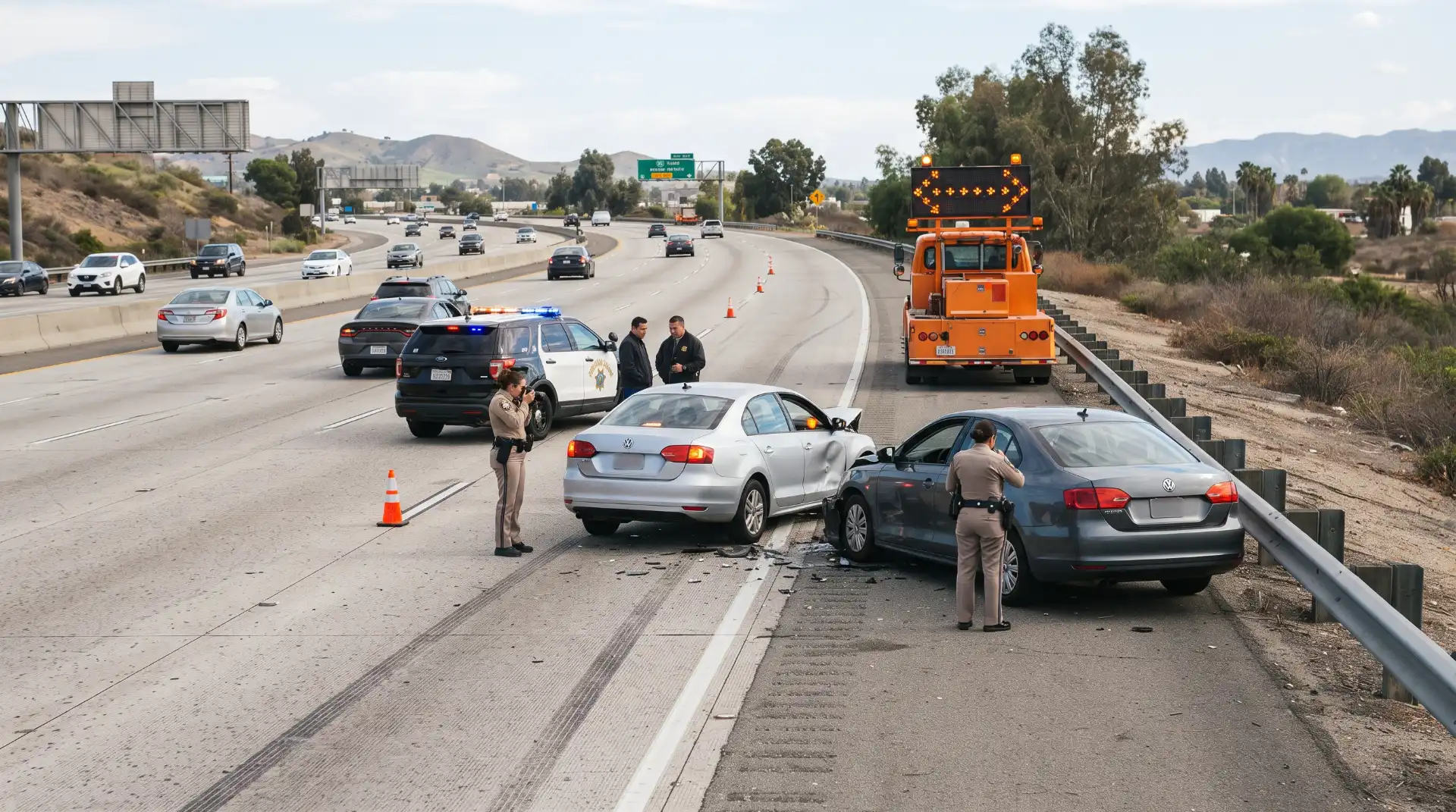
Who May Be Liable When a Moving Vehicle Hits a Disabled Car?
There is no single liability rule that applies to every disabled-vehicle collision.
In many cases, investigators begin by looking at the driver who struck the stationary vehicle.
Motorists generally need to maintain control of their vehicles, monitor the roadway, and react to reasonably visible hazards. Speed, following distance, distraction, impairment, and visibility may all become relevant.
If an approaching driver saw or reasonably could have seen flashing hazard lights but continued without slowing or changing position when conditions permitted, those facts may become part of the liability analysis.
California’s expanded 2026 Move Over rule makes those circumstances even more significant.
However, the stopped driver’s actions can also matter.
For example, investigators may examine whether the vehicle could have been moved farther from traffic, whether hazard lights were activated, where the vehicle stopped, and what circumstances prevented the driver from reaching a safer location.
Mechanical failure itself does not necessarily mean the disabled motorist acted negligently.
A sudden failure can happen without meaningful warning.
Liability depends more heavily on what each person knew, what options were reasonably available, and what actions they took under the circumstances.
California also applies comparative fault principles. As a result, more than one person may potentially share responsibility when separate actions contribute to the same collision.
Readers interested in the broader process can also review our guide on how to prove fault in a San Francisco car accident.
Rear-End Collisions With Disabled Vehicles
Rear-end crashes are among the most foreseeable types of collisions involving disabled vehicles.
A vehicle may stop partially or completely in a traffic lane because the driver cannot reach the shoulder. Approaching traffic may continue moving at freeway speed.
The resulting speed difference can be substantial.
A driver traveling behind the stopped vehicle may be unable to brake in time if they are following too closely, looking at a phone, adjusting vehicle controls, or otherwise distracted.
Nighttime conditions can increase the problem.
A dark-colored vehicle without functioning lights may be difficult to recognize until another motorist is relatively close. Curves and hills may also reduce sight distance.
Investigators may examine skid marks, impact location, vehicle damage, electronic vehicle data, dashboard camera footage, hazard-light operation, and witness accounts when reconstructing the collision.
These details can help establish when the approaching driver likely perceived the hazard and what happened immediately before impact.
Secondary Crashes Can Involve Several Vehicles
A collision with a disabled vehicle does not always stop after the first impact.
One driver may brake suddenly after seeing the stopped car. Another motorist behind that driver may then collide with them.
A driver attempting to avoid the disabled vehicle may change lanes and sideswipe another car.
Debris from the first impact may create another roadway obstruction.
A commercial truck may become involved because its longer stopping distance limits its ability to respond to suddenly stopped traffic.
These chain-reaction scenarios can make determining liability considerably more complicated.
Instead of examining only two vehicles, investigators may need to reconstruct the movements of several drivers.
Each driver’s speed, following distance, lane position, reaction time, and awareness may matter.
A multi-vehicle collision does not necessarily result in a single person being assigned all responsibility.
Different drivers may contribute to different stages of the crash.
What If the Disabled Vehicle Is Stopped on the Shoulder?
Being on the shoulder generally reduces exposure to moving traffic, but it does not eliminate the danger.
Vehicles can drift onto shoulders when drivers are distracted, fatigued, impaired, or attempting to avoid traffic in another lane.
Narrow shoulders can create additional risk because the disabled vehicle may remain close to passing traffic.
Occupants who exit the vehicle may also face serious danger.
CHP guidance specifically recognizes the physical welfare of people in and around disabled vehicles as an important safety consideration. Officers may provide or coordinate assistance when motorists face foreseeable danger.
Drivers who approach a disabled vehicle displaying hazard lights also need to account for California’s expanded Move Over requirements.
This is particularly relevant when a driver or passenger is standing beside the vehicle.
A collision involving a person outside a disabled vehicle can result in severe injuries because there is little protection from an approaching passenger car, SUV, or commercial truck.
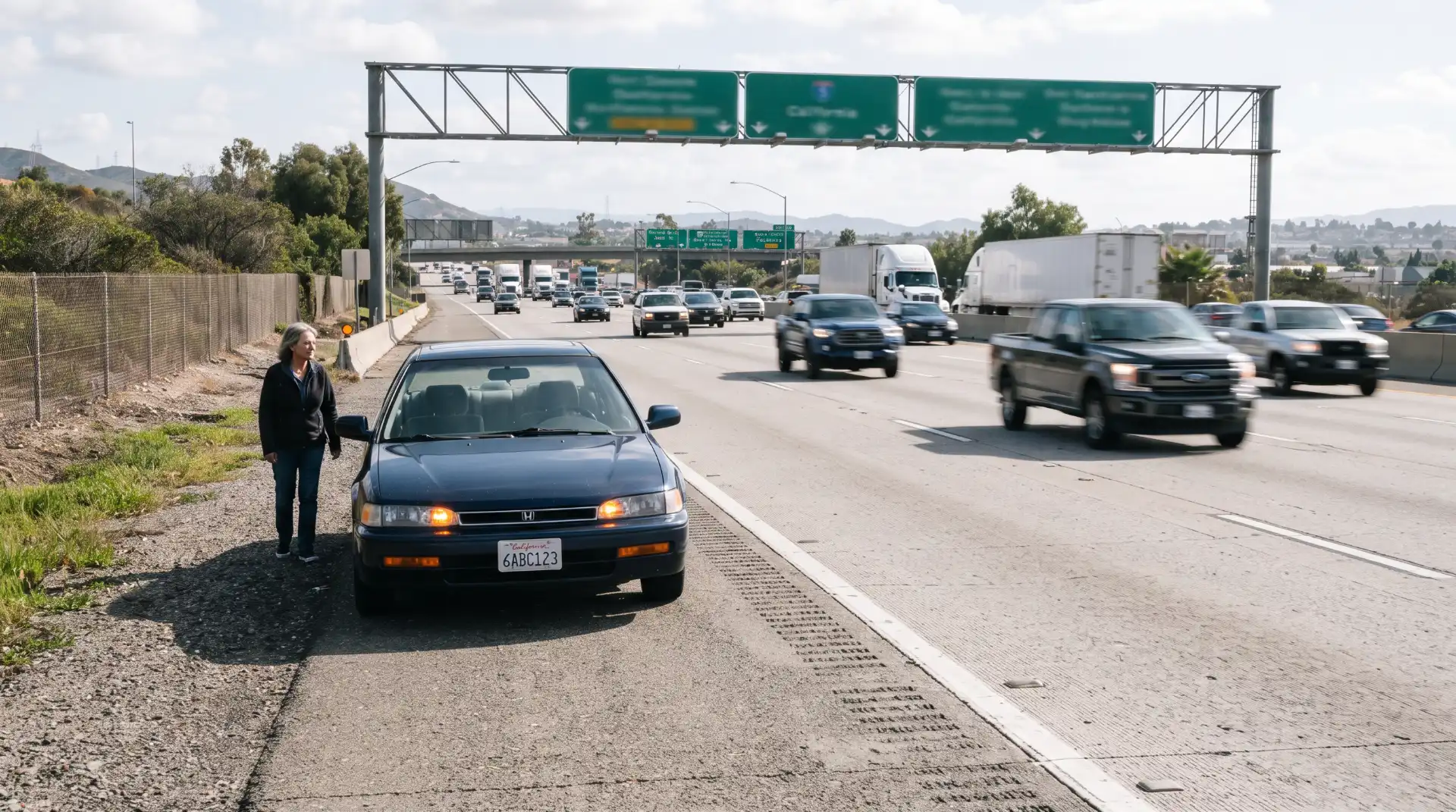
Should You Stay Inside a Disabled Vehicle?
There is no single answer that fits every highway breakdown.
The safest action depends on where the vehicle stops, the surrounding traffic, visibility, barriers, available escape areas, vehicle condition, and whether another immediate hazard exists.
A car stopped well off the roadway presents different considerations from a car disabled in the center lane of a busy freeway.
Motorists facing an immediate emergency should contact appropriate emergency services.
Drivers should avoid standing unnecessarily in active traffic lanes or attempting repairs in locations where passing traffic creates a serious risk.
CHP’s Freeway Service Patrol may also assist motorists on designated California freeway routes. The program operates through CHP, Caltrans, and local transportation agencies and uses participating tow trucks to help remove disabled or stranded vehicles from congested freeway corridors.
According to CHP, Freeway Service Patrol services can include limited assistance such as providing fuel, jump-starting batteries, addressing certain cooling-system problems, and changing flat tires. When a vehicle cannot be restarted, the program may arrange a free tow to an approved drop location. Availability depends on the freeway corridor and operating period.
Why Freeway Service Patrol Matters
Disabled vehicles do more than create risks for their occupants.
They can also disrupt traffic flow and contribute to secondary collisions.
California’s Freeway Service Patrol was designed partly to address that problem by removing disabled and stranded vehicles from busy freeways as quickly as practical.
CHP reports that the program assists approximately 650,000 motorists on California highways each year and operates hundreds of participating tow trucks across heavily traveled freeway corridors.
The program serves the Golden Gate Division, which includes San Francisco and other Bay Area counties.
For motorists in the San Francisco region, that makes the service particularly relevant.
Quickly removing a disabled car from a freeway can reduce both traffic disruption and exposure to fast-moving vehicles.
What Evidence Matters After a Disabled-Vehicle Accident?
Evidence from a disabled-vehicle crash can disappear quickly.
The vehicle may be towed. Debris may be removed. Traffic conditions change. Hazard lights may stop functioning because the battery loses power.
Photographs taken shortly after the collision can therefore become especially useful.
Images may show where the disabled vehicle was positioned in relation to the shoulder and traffic lanes.
They may also show vehicle lighting, warning triangles, road curves, barriers, visibility, weather conditions, debris, skid marks, and damage patterns.
Dashboard camera footage can provide additional context.
A recording from the striking vehicle may show how long the disabled car was visible. Footage from another motorist may reveal braking, lane changes, or warning lights.
Nearby traffic cameras or business surveillance systems may also capture parts of the incident.
Electronic information from newer vehicles can sometimes help reconstruct speed, braking, steering, and other events around the time of a crash.
Witness accounts can supplement that technical evidence.
Someone traveling behind the vehicles may have seen whether traffic suddenly slowed or whether hazard lights were visible.
Because liability disputes can depend heavily on small details, preserving available information can become an important part of evaluating the accident.
Our existing article on the role of witnesses in San Francisco auto accident cases provides additional information about witness evidence.
Mechanical Problems and Vehicle Maintenance
Sometimes an investigation extends beyond what happened after a vehicle stopped.
The reason the vehicle became disabled may also deserve examination.
Suppose a driver ignored obvious mechanical warning signs and continued operating a vehicle until it stopped in a dangerous location.
Those circumstances may differ from an unexpected failure involving a properly maintained vehicle.
Maintenance records may help show whether a known condition existed before the breakdown.
Repair invoices, inspection reports, dashboard warnings, recall information, and communications with mechanics can potentially provide context.
In other cases, a defective automotive component may be involved.
A sudden tire failure, electrical defect, fuel-system problem, or other component failure could raise questions about the manufacturer, repair shop, maintenance provider, or another business.
Those situations require fact-specific analysis.
A breakdown does not automatically establish that the vehicle owner or another business acted negligently.
Commercial Vehicles and Roadside Breakdowns
Disabled commercial vehicles present additional hazards because of their size.
A tractor-trailer, delivery truck, bus, or other large vehicle can occupy substantial roadway space.
Even when most of the vehicle reaches the shoulder, a portion may remain near an active traffic lane.
Commercial-vehicle crashes can also involve additional records.
Driver logs, fleet maintenance records, inspection documents, company policies, dispatch communications, and electronic vehicle information may help explain why the vehicle became disabled and what happened afterward.
If another driver strikes the stopped commercial vehicle, the collision may involve questions about both the approaching driver’s actions and the commercial vehicle’s condition.
As with passenger-vehicle crashes, liability depends on the evidence rather than the type of vehicle alone.
Disabled Vehicles at Night
Darkness can substantially affect the visibility of a stopped vehicle.
A vehicle with working hazard lights may be easier to detect from a distance.
A complete electrical failure, however, can leave the vehicle without functioning lights.
Drivers approaching at highway speed may then have less time to recognize the object ahead.
Headlight range, ambient lighting, weather, roadway geometry, reflective surfaces, and surrounding traffic may all affect visibility.
These factors can become important when the drivers involved provide different accounts of what happened.
An approaching motorist may argue that the disabled vehicle was nearly impossible to see.
The stopped driver may state that hazards or other warning devices were operating.
Photographs, video footage, witness observations, and examination of the electrical system may help resolve those conflicting accounts.
Distracted Driving and Disabled Vehicle Collisions
A disabled vehicle presents a stationary hazard, but an attentive driver may sometimes have enough time to react.
Distraction can remove that opportunity.
A driver looking at a mobile phone, navigation screen, passenger, or dashboard control can travel a considerable distance without fully monitoring the road ahead.
By the time the driver notices the disabled vehicle, the remaining stopping distance may be insufficient.
This is one reason physical and electronic evidence may matter.
Phone records, vehicle data, onboard cameras, and eyewitness statements may provide information about the driver’s actions before impact.
A driver does not need to be using a handheld phone for distraction to become relevant.
Modern vehicles contain touchscreens, infotainment systems, navigation tools, and other controls that can divert attention from traffic.
What Happens When a Disabled Vehicle Causes Another Driver to Swerve?
Not every disabled-vehicle accident involves direct contact with the stopped car.
An approaching motorist may suddenly change lanes to avoid it and collide with another vehicle.
A motorcycle rider may lose control while reacting to the obstruction.
Another driver may brake sharply and trigger a rear-end collision behind them.
These cases can raise difficult causation questions.
Investigators may need to determine whether the disabled vehicle created the initial hazard, whether the responding driver reacted reasonably, and whether other motorists were traveling too closely or too quickly.
The fact that one vehicle never physically touched another does not necessarily end the inquiry.
Liability analysis focuses on the actions that contributed to the collision.
Insurance Issues After a Disabled-Vehicle Crash
Insurance claims following these accidents may involve several types of coverage.
Property-damage claims may address vehicle repairs or replacement.
Bodily injury claims may involve medical costs and other accident-related losses.
If an at-fault driver lacks sufficient insurance, uninsured or underinsured motorist coverage may become relevant depending on the policy and circumstances.
Insurance companies may also dispute fault.
One carrier may argue that the approaching driver should have reacted sooner. Another may claim that the disabled vehicle was positioned dangerously or lacked adequate warning lights.
These disagreements highlight why documentation matters.
Photographs, reports, vehicle records, medical documentation, witness information, and other evidence can provide a more complete picture than the drivers’ statements alone.
Injuries From Disabled-Vehicle Highway Crashes
Highway-speed collisions can cause significant injuries because of the forces involved.
Occupants may experience head injuries, fractures, spinal injuries, soft-tissue injuries, chest injuries, or other trauma.
People standing outside a disabled vehicle face additional exposure because there is no passenger compartment around them.
Symptoms do not always appear immediately after a crash.
Someone involved in a collision may initially focus on the damaged vehicle, traffic conditions, or getting safely away from the roadway.
Our guide on the importance of medical treatment after a car accident discusses why accident-related symptoms and medical documentation may deserve attention after a collision.
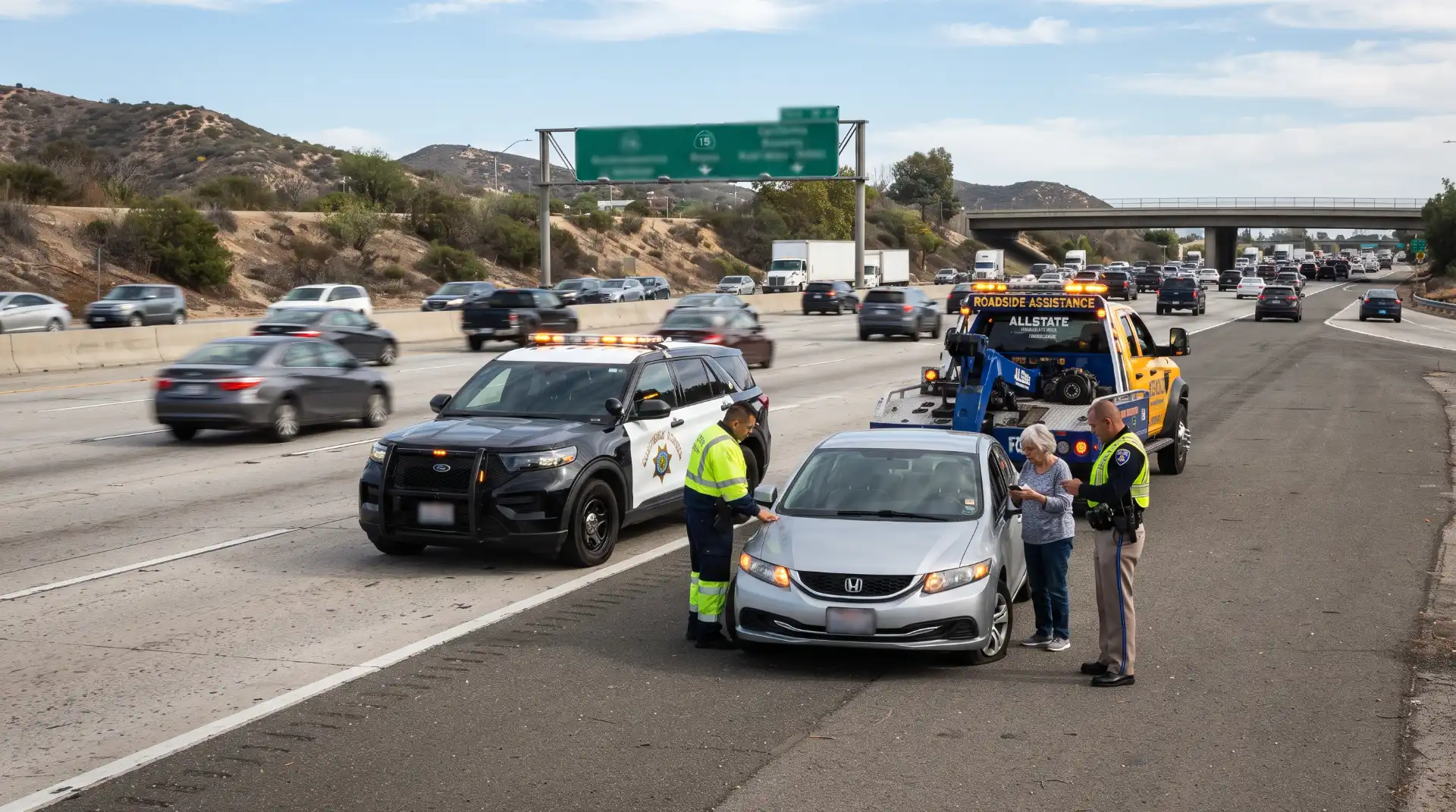
What to Do After a Collision With a Disabled Vehicle
The immediate priority after any highway collision is safety.
If someone is injured or the crash creates an immediate roadway hazard, emergency assistance may be appropriate.
Drivers should avoid unnecessarily exposing themselves to moving freeway traffic.
When conditions permit, documenting the location and vehicles can help preserve evidence.
Useful photographs may include the overall roadway, lane positions, shoulder width, vehicle damage, warning lights, skid marks, debris, traffic signs, and surrounding conditions.
Drivers can also collect identification and insurance information from the parties involved and obtain contact information from witnesses when practical.
Additional guidance is available in our step-by-step guide to what to do after a San Francisco car accident.
How Fault May Be Evaluated
Determining fault in a disabled-vehicle accident often requires answering several questions.
Why did the vehicle stop?
Where was it positioned?
Could it have been moved?
Were hazard lights or warning devices operating?
How fast was the approaching vehicle traveling?
How far away could the driver reasonably see the stopped car?
Did the approaching driver slow down or move over?
Was the motorist distracted?
Did another vehicle prevent a safe lane change?
Were weather or road conditions involved?
These questions illustrate why liability cannot be determined from one fact alone.
Even an apparently straightforward rear-end collision may involve multiple contributing circumstances.
California’s expanded 2026 Slow Down, Move Over rule adds another consideration when a stationary vehicle displays flashing hazard lights or another covered warning device.
Car Accidents Involving Disabled Vehicles Require Careful Investigation
A disabled car on a California highway can create a dangerous mismatch between stationary traffic and vehicles traveling at freeway speeds.
The risk increases when visibility is poor, the shoulder is narrow, traffic is congested, or motorists fail to recognize the hazard early enough.
California’s 2026 expansion of its Slow Down, Move Over law reflects growing attention to the safety risks surrounding stationary vehicles.
When a collision occurs, responsibility may depend on the actions of the approaching driver, the position and condition of the disabled vehicle, warning signals, traffic conditions, mechanical evidence, and the conduct of other motorists.
Careful documentation can help reconstruct those circumstances.
Drivers can also use California Highway Patrol resources, including the Freeway Service Patrol, when they become stranded on participating freeway routes. The program focuses on quickly assisting disabled motorists and removing freeway obstructions.
Understanding these risks can help California motorists respond more cautiously when approaching disabled vehicles and recognize the issues that may arise when a roadside breakdown leads to a serious collision.