
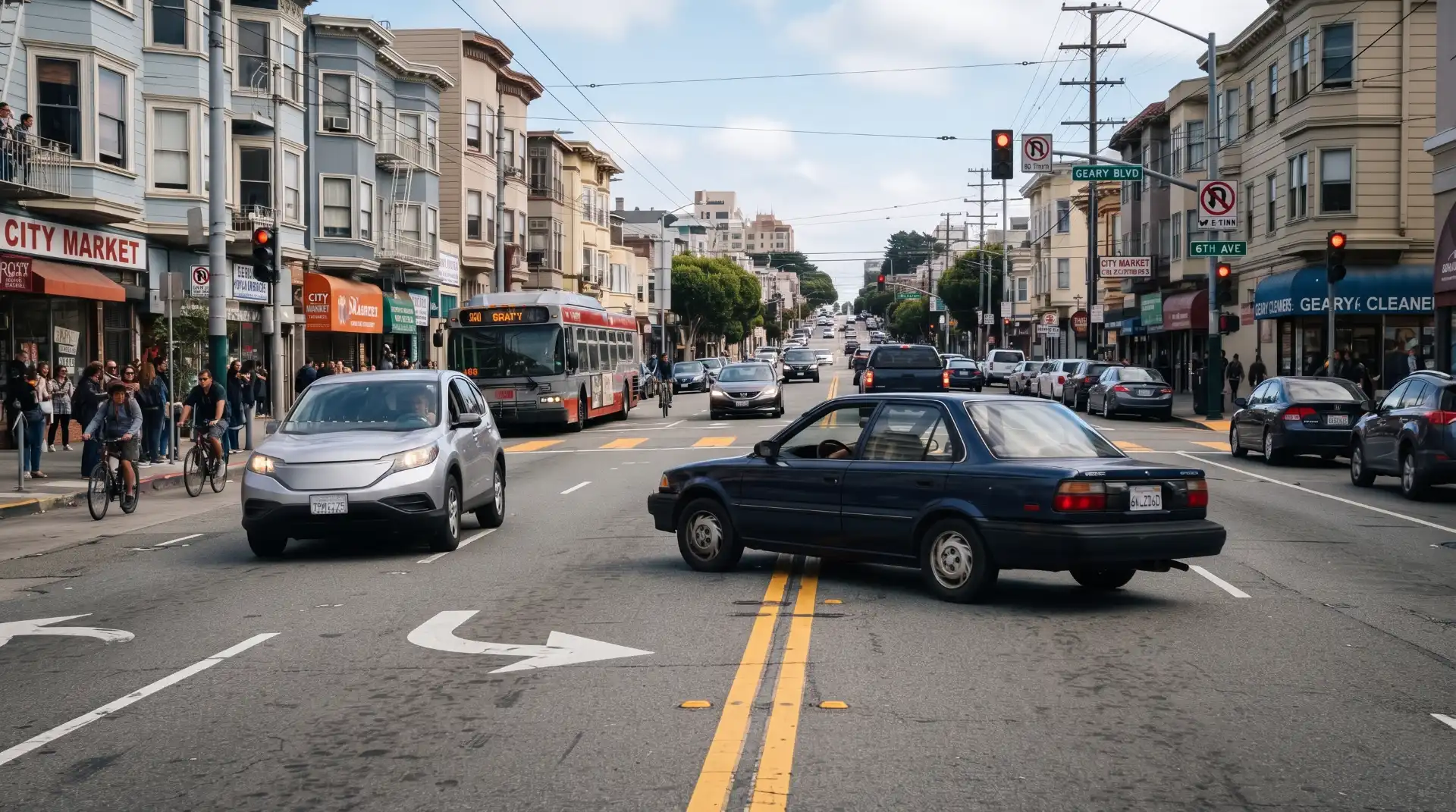
A U-turn can appear to be one of the simplest ways for a driver to change direction. A motorist may miss a destination, pass an unfamiliar street, realize that a business is on the opposite side of the road, or simply decide that turning around is faster than continuing to the next intersection. In San Francisco, however, a U-turn can become a complicated maneuver because of dense traffic, narrow streets, steep hills, transit vehicles, bicycle lanes, pedestrians, parked cars, and frequent intersections.
When a driver makes a U-turn without properly considering surrounding traffic, the maneuver can create a sudden conflict with another road user. An approaching vehicle may have only seconds to react. A cyclist may be traveling alongside the turning vehicle. A pedestrian may be crossing nearby. Another driver may be preparing to make a permitted turn and suddenly encounter a vehicle moving across the roadway.
The consequences can range from minor property damage to serious crashes involving multiple vehicles and significant injuries.
For someone injured in an accident involving an unsafe U-turn, an important question is whether the turning driver may be legally responsible for the collision. The answer depends on the facts. Investigators may need to examine whether the U-turn was permitted at that location, whether the driver had adequate visibility, whether the driver yielded appropriately, whether traffic conditions made the maneuver unsafe, and whether another driver’s actions also contributed to the collision.
San Francisco also has location-specific traffic restrictions. SFMTA has authority to designate intersections where right, left, or U-turns are prohibited, meaning drivers cannot assume that a U-turn that is permitted somewhere else is automatically legal at a particular San Francisco intersection.
Understanding these rules can help drivers avoid dangerous maneuvers and can help accident victims recognize the types of evidence that may become important after a collision.
Why U-Turns Are Particularly Complicated in San Francisco
San Francisco’s streets are different from many suburban or rural roadways. Drivers may move from a residential neighborhood into a heavily traveled commercial corridor within a few blocks. A roadway can also change from a relatively open street into a congested area with multiple lanes, transit stops, bicycle infrastructure, and frequent pedestrian crossings.
These conditions can make a U-turn more difficult because the driver must evaluate several potential hazards simultaneously.
A motorist attempting to turn around may need to check approaching vehicles, vehicles traveling behind the car, vehicles in adjacent lanes, pedestrians, cyclists, signs, traffic signals, lane markings, and parked vehicles that could block visibility. If the street is on a hill or curves near the turning location, judging the distance and speed of approaching traffic can become even more difficult.
Traffic congestion can create another problem. A driver may become impatient after missing a turn and decide to make a U-turn in a location that does not provide enough space. The driver may believe there is a sufficient gap, but another vehicle may be approaching faster than expected.
San Francisco’s transportation authorities regularly modify traffic controls and roadway configurations to address safety, congestion, pedestrian movement, bicycle travel, transit operations, and other transportation concerns. SFMTA’s current regulations recognize that traffic restrictions can include turn restrictions and other modifications at specific intersections.
This makes location-specific information important in an accident investigation.
Are U-Turns Legal in San Francisco?
A U-turn is not automatically illegal throughout San Francisco. Whether a particular U-turn is permitted depends on California law as well as the traffic controls and restrictions applicable to the specific roadway.
California traffic rules address U-turns in different circumstances, including rules concerning business districts, residential districts, approaching traffic, and visibility. Drivers should also obey posted signs and other traffic controls.
San Francisco can impose additional restrictions at individual locations. SFMTA regulations specifically provide authority to designate intersections where U-turns are prohibited.
This distinction is important because a driver might legally make a U-turn at one location but violate a posted restriction at another. A driver cannot necessarily rely on previous experience at a different intersection to determine whether a maneuver is allowed.
The safest approach is to look for signs, lane markings, traffic signals, and other roadway controls before turning. Drivers should also consider whether they have adequate visibility and enough space to complete the maneuver without interfering with other road users.
A collision investigation should therefore focus on the exact location and circumstances rather than simply asking whether U-turns are generally legal in San Francisco.
When Can a Legal U-Turn Still Be Unsafe?
One of the most important distinctions in an accident case is that a maneuver can be legally permitted but still potentially unsafe under the circumstances.
For example, suppose a driver is at a location where U-turns are permitted. The driver may still need to wait for approaching traffic, check surrounding lanes, observe pedestrians and cyclists, and make sure the turn can be completed without creating a hazard.
A driver who begins a U-turn without adequate visibility could create a serious risk even if there is no posted No U-Turn sign.
Similarly, a driver may have permission to turn but execute the maneuver too quickly or without sufficient attention to surrounding traffic. The manner in which the maneuver is performed can therefore matter just as much as whether the maneuver itself is allowed.
California traffic rules generally require motorists to make turns safely and with appropriate signaling. San Francisco’s transportation regulations also contain detailed provisions concerning turn movements and traffic controls.
This means an accident victim should not assume that a lack of a No U-Turn sign ends the investigation.
The more useful question is often whether the driver made the maneuver in a reasonably safe manner under the conditions that existed at the time.
How Visibility Can Affect a U-Turn Accident
Visibility is particularly important when evaluating U-turn collisions.
A driver needs to be able to identify approaching traffic before crossing into its path. Obstructions can make this difficult. Parked vehicles, delivery trucks, buses, construction equipment, landscaping, buildings, roadway curves, and hills can interfere with a driver’s view.
A driver who cannot see far enough down the road may have difficulty determining whether there is enough time to complete a U-turn.
This issue can become particularly significant in San Francisco because of the city’s hills and varied street configurations. A vehicle approaching from the other side of a crest or curve may not be visible until it is relatively close.
If an accident occurs under these conditions, photographs showing the driver’s viewpoint can be valuable. An investigator may want to know what the driver could actually see before beginning the maneuver.
The position of parked vehicles and temporary construction equipment can also matter. San Francisco’s current street-work regulations address temporary lane changes, traffic-control arrangements, roadway configurations, and visibility of traffic signals during construction activities.
A U-turn collision occurring in an active construction zone may therefore require an examination of the temporary roadway configuration in effect on the date of the crash.
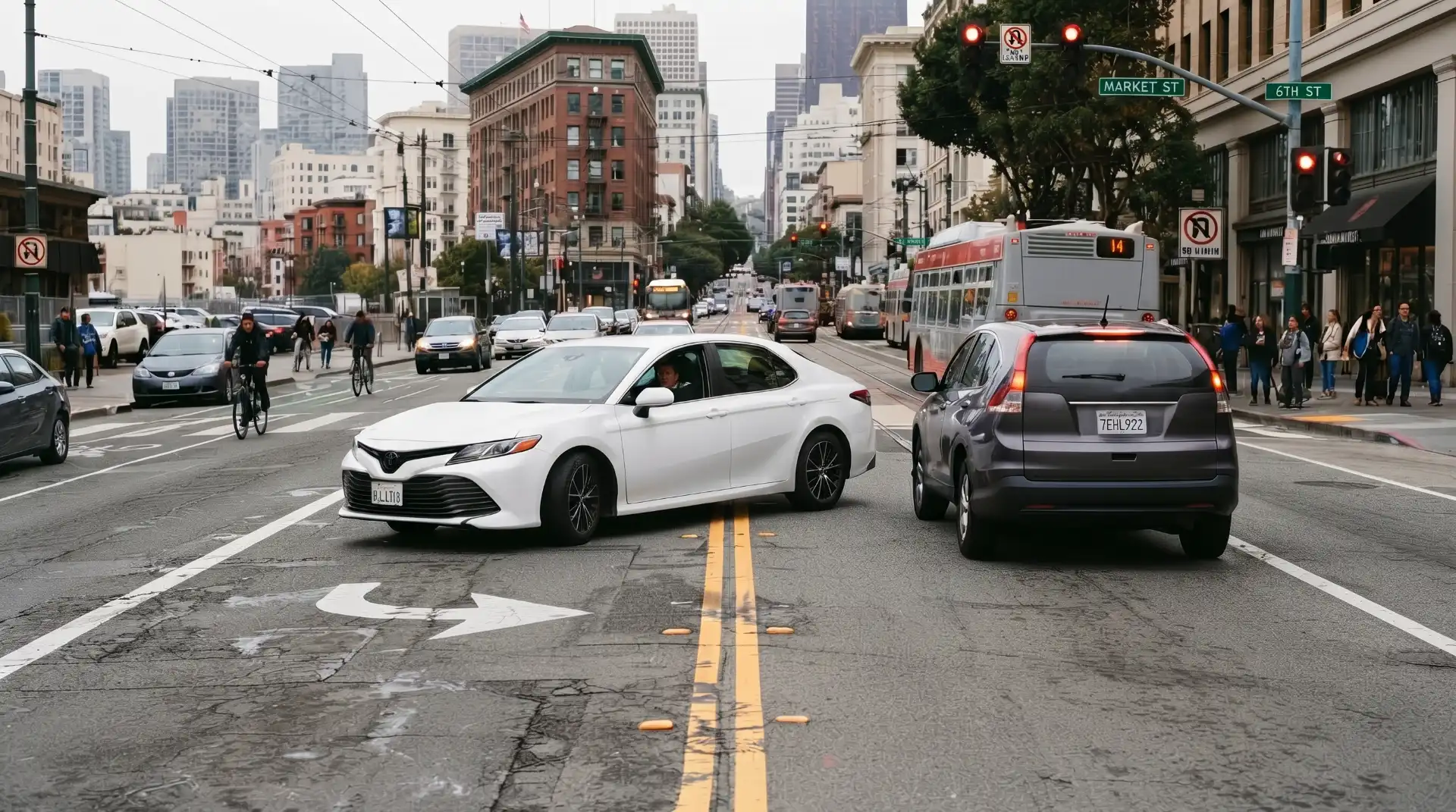
Common Causes of Unsafe U-Turn Accidents
Unsafe U-turn crashes can result from several different driving behaviors. Some involve intentional risk-taking, while others may result from inattention, impatience, poor visibility, or a misunderstanding of traffic conditions.
One common cause is failure to check approaching traffic. A driver may look in one direction, begin turning, and fail to notice another vehicle approaching from a different lane.
Another problem is attempting a U-turn in heavy traffic. When vehicles are traveling close together, a turning driver may not have enough time or space to safely cross the roadway.
Improper lane positioning can also contribute to crashes. A driver may begin a turn from a lane that does not provide adequate space, forcing the vehicle across another lane unexpectedly.
Failure to signal can create another hazard because surrounding motorists may not realize that the vehicle intends to change direction.
Some drivers also make U-turns after becoming frustrated because they missed a street or exit. Rather than continuing to a safer location, they may attempt to turn around immediately.
Other accidents involve drivers who simply misjudge the speed or distance of an approaching vehicle.
Although these causes are different, they can all produce the same basic problem: one vehicle suddenly moves into a path that another road user expects to remain clear.
Rear and Side Collisions Caused by U-Turns
U-turn accidents are often associated with front-end impacts, but they can also produce side-impact and rear-end collisions.
A driver may begin a U-turn while another vehicle is traveling alongside the turning vehicle. The turning car may move across the neighboring lane and strike the other vehicle’s side.
In another situation, a driver may brake suddenly before beginning a U-turn. A vehicle behind the turning driver may not have enough distance to stop, producing a rear-end crash.
These situations demonstrate why investigators need to consider the entire sequence of events.
Vehicle damage can provide clues. Damage to the side of one vehicle and the front of another may indicate how the vehicles interacted, but physical damage alone does not necessarily establish every detail about fault.
Photographs should ideally show the entire vehicle as well as close-up images of damaged areas. Images of the roadway, lane markings, signs, traffic signals, and surrounding conditions can provide additional context.
Head-On and Front-Corner U-Turn Collisions
Some U-turn crashes involve a vehicle crossing directly into the path of approaching traffic.
These collisions can be particularly serious because the approaching vehicle may be traveling at a relatively high speed while the turning vehicle is moving across its path.
The approaching driver may have only a short distance in which to brake or steer around the turning vehicle.
A front-corner collision can also occur if the approaching driver attempts an evasive maneuver but cannot completely avoid the turning vehicle.
The severity of these crashes can depend on speed, vehicle size, point of impact, occupant position, seat-belt use, and other factors.
When injuries are significant, the resulting claim may involve substantial medical treatment, lost income, rehabilitation, and other damages.
U-Turn Accidents Involving Pedestrians
A driver making a U-turn must also be aware of pedestrians.
Turning movements near crosswalks can create complicated traffic patterns because pedestrians may have a lawful expectation of crossing the roadway while vehicles are turning.
A driver who focuses only on approaching vehicles may fail to notice someone walking through the crosswalk.
San Francisco has implemented numerous transportation measures designed to address pedestrian safety and reduce conflicts at intersections. SFMTA has described its High Injury Network as the portion of San Francisco streets that accounts for a large share of severe traffic injuries and fatalities.
A U-turn collision involving a pedestrian can therefore require careful examination of the traffic signal, crosswalk, vehicle movement, pedestrian location, and visibility.
Pedestrian injury cases can also involve different evidence and legal considerations from vehicle-to-vehicle crashes, making accurate documentation particularly important.
U-Turn Crashes Involving Cyclists
San Francisco has a substantial amount of bicycle traffic, and cyclists can be particularly vulnerable when a vehicle changes direction unexpectedly.
A cyclist traveling alongside a vehicle may be difficult for a driver to see, especially when the vehicle’s mirrors or blind spots obscure the cyclist’s position.
A U-turn may require the driver to cross an area used by cyclists. California traffic rules address circumstances in which a motor vehicle crosses a bicycle lane to make a turn.
A collision can occur when the driver begins turning without checking the bicycle lane or surrounding area.
The consequences can be serious because a cyclist has substantially less physical protection than an occupant of a passenger vehicle.
Evidence in these cases may include helmet-camera footage, bicycle damage, vehicle damage, witness statements, nearby surveillance video, and photographs of bicycle-lane markings.
U-Turns Near Transit Vehicles and Transit Lanes
Transit vehicles add another layer of complexity to San Francisco traffic.
A driver attempting a U-turn may encounter a Muni vehicle, transit-only lane, bus stop, or other transit-related roadway feature.
SFMTA explains that transit-only lanes have specific rules governing when motorists may enter them, including circumstances involving permitted turns. Drivers are expected to follow the applicable lane markings and restrictions rather than entering such lanes simply to bypass traffic.
A driver who attempts to turn across a transit lane without accounting for an approaching bus or other vehicle can create a collision risk.
These situations can also complicate an accident investigation because investigators may need to examine the traffic-control configuration and whether a vehicle was legally permitted to enter a particular lane.
How San Francisco’s Turn Restrictions Can Affect an Accident
San Francisco’s traffic restrictions are not necessarily identical from one intersection to another.
SFMTA has formal authority to establish turn restrictions, including prohibitions on U-turns, left turns, and right turns at designated locations.
There are also examples of specific locations where SFMTA has proposed or established No U-Turn restrictions during particular hours. For example, SFMTA records include turn restrictions intended to address congestion and safety around school pickup and drop-off periods.
This illustrates why the date and time of an accident can matter.
A restriction may apply only during certain hours, or temporary traffic controls may change how vehicles are expected to move through an area.
An accident occurring during a construction project may also involve temporary signs, lane shifts, or detours.
For these reasons, an accident investigation should consider the roadway conditions that existed when the collision happened, rather than relying solely on what the intersection looks like months later.
Evidence That May Help Establish Liability
Evidence is often one of the most important parts of an unsafe U-turn accident investigation.
Photographs can document vehicle damage, road markings, traffic signs, traffic signals, nearby obstructions, and the positions of vehicles after the collision.
Dashcam footage can be especially valuable because it may show what happened immediately before impact. A video may reveal whether the turning driver signaled, whether another vehicle was already approaching, whether traffic was stopped, and how quickly the U-turn occurred.
Security cameras may also capture the accident. Depending on the location, footage could potentially come from businesses, residences, traffic systems, parking facilities, or other nearby sources.
Witnesses can provide independent observations. Someone standing at a nearby intersection may have seen the U-turn from a different angle than the drivers.
Police reports can provide another source of information, including statements from the drivers, witness information, roadway observations, and descriptions of the collision.
Medical records are important when injuries are involved because they can document diagnoses, treatment, symptoms, and the relationship between the accident and subsequent care.
Why Dashcam Footage Can Be Important
Dashcams can provide a chronological record of events that may otherwise depend on conflicting memories.
In an unsafe U-turn case, the most important part of the recording may not be the collision itself. The seconds immediately before impact can show vehicle positioning, speed, signaling, traffic density, and the turning driver’s actions.
Drivers who have dashcam footage should preserve the original recording.
Some dashcams automatically overwrite older recordings when the storage card fills. If a collision occurs, preserving the footage promptly can help prevent important evidence from being lost.
A driver should also avoid editing the original recording before preserving it. If a shorter clip is created for convenience, the original file should still be maintained.
Dashcam footage is not necessarily conclusive on every issue, but it can provide an objective perspective that may be valuable when accounts differ.
The Importance of Witness Statements
Witnesses can be especially helpful when the drivers give conflicting accounts.
For example, one driver may say that the U-turn was made slowly and with a clear view, while another driver may say the vehicle suddenly turned across several lanes.
A witness who observed the vehicles before the crash may be able to describe what actually happened.
Witnesses should not be coached or pressured. Their value comes from providing an independent account of what they personally observed.
If someone voluntarily provides contact information after an accident, the information should be preserved.
A witness may also have video footage or photographs that the involved drivers do not have.
How Police Reports May Affect a U-Turn Claim
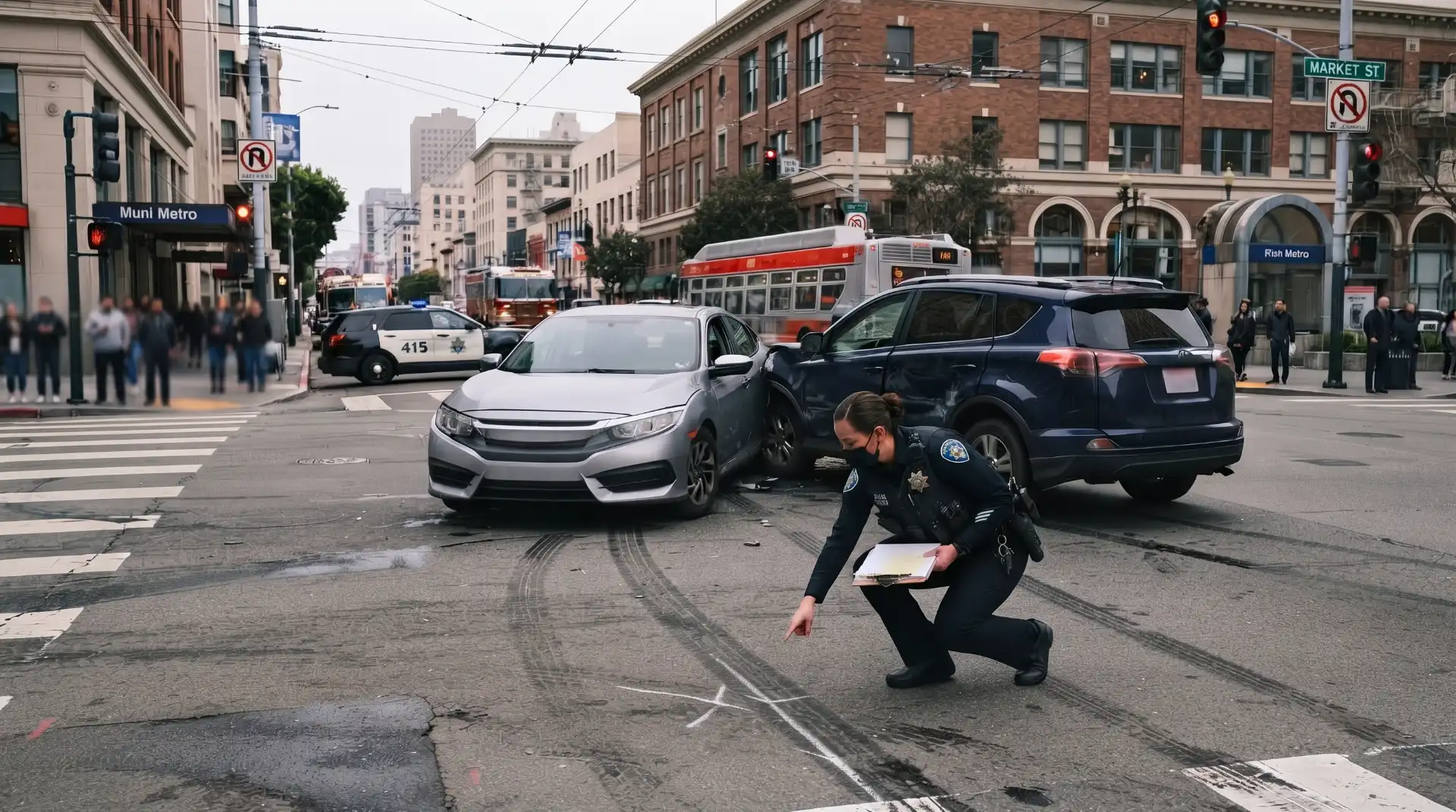
Law enforcement officers who respond to a collision may document the scene and collect statements.
A police report can become an important part of an insurance investigation, particularly when a traffic violation is suspected.
However, an accident report should generally be viewed as one piece of evidence rather than the entire case.
An officer may arrive after the vehicles have been moved, after witnesses have left, or after some physical evidence has changed.
The report may also reflect statements made by drivers rather than independently proving every part of the accident.
Additional evidence such as photographs, video, vehicle damage, witness testimony, and medical records can therefore remain important.
Comparative Fault in California U-Turn Accidents
California’s comparative fault system can become relevant when more than one person contributed to a collision.
Consider a situation in which one driver makes an unsafe U-turn while another driver is traveling faster than conditions reasonably allow. The turning driver’s conduct may be important, but the speed of the approaching vehicle may also need to be examined.
Similarly, another driver might be distracted or fail to react appropriately after the U-turn begins.
This does not mean that every U-turn accident involves shared responsibility. The evidence may establish that one driver’s actions were the primary or sole cause of the collision.
The point is that California accident cases can involve multiple contributing factors.
The California civil jury instructions address comparative negligence and allocation of responsibility in civil cases. The specific application depends on the facts and applicable law.
For this reason, accident victims should avoid making assumptions about fault before the evidence has been evaluated.
Can an Illegal U-Turn Automatically Make a Driver Liable?
An illegal U-turn can be significant evidence, but it does not necessarily answer every question in a civil injury claim.
Suppose a driver violates a No U-Turn restriction but completes the maneuver without interacting with another vehicle. If a separate driver later causes an unrelated collision, the prohibited maneuver may not establish that the first driver caused the accident.
On the other hand, if a driver makes a prohibited U-turn directly into the path of an approaching vehicle and the vehicles collide as a result, the traffic violation may become highly relevant.
The investigation therefore needs to connect the violation to the collision.
The same principle applies to other traffic violations. A ticket or citation may be relevant, but the accident claim generally still requires an analysis of causation and damages.
What If There Was No No-U-Turn Sign?
The absence of a No U-Turn sign does not necessarily mean that a driver can make a U-turn under any circumstances.
California law contains rules concerning when and where U-turns may be made, including provisions involving visibility and approaching traffic.
The driver must also consider whether the maneuver can be performed safely.
A driver who has a clear view and enough space may be in a different factual situation from a driver attempting a U-turn on a hill with limited visibility.
Therefore, photographs showing the exact roadway conditions can be important.
An accident victim should not assume that the case is either clearly won or clearly lost simply because a sign was or was not present.
What to Do Immediately After an Unsafe U-Turn Accident
Safety should be the first priority after any collision.
If the accident creates an immediate danger, call 911 and follow the instructions of emergency personnel. If it is safe and practical to do so, move away from active traffic lanes.
Do not argue with the other driver about fault at the scene. Emotions can be elevated immediately after a collision, and a confrontation can create additional danger.
Exchange required information and cooperate with law enforcement.
If possible, photograph the vehicles and surrounding roadway. Capture the intersection, traffic signs, lane markings, traffic signals, visible skid marks, and other relevant features.
If witnesses are present, obtain their contact information if they are willing to provide it.
Preserve dashcam footage and other digital evidence.
If anyone is injured, seek appropriate medical attention.
These steps can help preserve information that may otherwise disappear as vehicles are moved, road conditions change, and memories become less precise.
Medical Injuries After an Unsafe U-Turn Crash
The injuries associated with a U-turn collision depend heavily on the type and severity of the impact.
Some people experience relatively minor injuries, while others suffer fractures, spinal injuries, traumatic brain injuries, internal injuries, or other serious conditions.
Neck and back injuries can occur when the body is suddenly accelerated and decelerated during a collision. Shoulder injuries can also result from impact with seat belts, doors, steering wheels, or other parts of the vehicle.
Headaches, dizziness, confusion, and other symptoms may occur following some crashes.
A person involved in an accident should not attempt to diagnose an injury based solely on how they feel immediately afterward. The stress and adrenaline associated with a collision can sometimes make symptoms difficult to evaluate.
Medical professionals can determine whether examination, testing, treatment, or follow-up care is appropriate.
Medical documentation can also become important if an injury claim is later pursued.
How Insurance Companies May Investigate a U-Turn Crash
Insurance companies typically examine evidence before determining how a claim should be handled.
The insurer may request information about the accident, vehicle damage, medical treatment, employment, and other losses.
The insurance investigation may include police reports, photographs, witness statements, video recordings, repair estimates, medical records, and statements from the drivers.
In a disputed U-turn case, the insurer may question whether the turning driver actually violated a traffic rule or whether another driver contributed to the collision.
An injured person should provide accurate information and avoid guessing about facts they did not personally observe.
It can also be helpful to maintain a personal record of medical appointments, treatment, missed work, expenses, and communications related to the accident.
Compensation After an Unsafe U-Turn Accident
The potential compensation in a California car accident case depends on the facts, injuries, insurance coverage, and applicable law.
Economic losses can include medical expenses, rehabilitation costs, lost income, and property damage.
Medical costs may involve emergency treatment, hospital care, physician appointments, diagnostic testing, medication, physical therapy, and other reasonably related treatment.
Lost income can become important when injuries prevent a person from working. A serious injury may also raise questions about future earning capacity.
Vehicle damage is another potential component of an accident claim. Repair estimates, invoices, photographs, towing records, rental-car expenses, and insurance documents may help establish the financial impact.
Depending on the circumstances, California law may also permit recovery for certain noneconomic losses, including pain and suffering.
The potential value of a claim cannot be determined from the fact that an accident involved an illegal or unsafe U-turn alone. The severity of the injuries, medical evidence, financial losses, available insurance, and other circumstances can all affect the claim.
Serious Injuries Can Make U-Turn Claims More Complicated
A minor property-damage accident may be resolved differently from a collision involving hospitalization or long-term treatment.
When injuries are serious, questions can arise about future medical care, lost earning capacity, rehabilitation, disability, and other consequences.
For example, a person with a spinal injury may require months or years of treatment. Another person may suffer an injury that affects their ability to perform their occupation.
These cases can involve substantial documentation.
Medical records, employment records, expert opinions, rehabilitation records, and other evidence may become relevant depending on the circumstances.
The severity of the injury can also make the consequences of comparative fault more significant because the financial amount at issue may be much larger.
Why the Exact Location of the Accident Matters
The location of the collision can be one of the most important facts in a U-turn case.
A driver may face a No U-Turn restriction at one intersection but not at another.
There may also be different lane configurations, traffic signals, bicycle lanes, transit lanes, crosswalks, or visibility conditions.
SFMTA’s current transportation materials show that San Francisco regularly makes traffic and roadway modifications, including changes involving lane configurations and traffic restrictions.
Temporary construction can make location-specific analysis even more important.
For this reason, an accident victim should record the exact intersection, street names, direction of travel, and nearby landmarks whenever possible.
A photograph of the location can also help preserve information that might change later.
Construction Zones and Temporary U-Turn Restrictions
Construction can temporarily change how drivers navigate a roadway.
Lane closures, temporary barriers, detours, relocated traffic lanes, and temporary signs may affect whether a driver can safely or legally make a particular movement.
SFMTA’s 2026 Blue Book contains detailed requirements concerning temporary lane closures, lane shifts, traffic control, signal visibility, and other construction-related roadway conditions.
Suppose a U-turn accident occurs in an area undergoing road construction. The normal roadway configuration may not have been in place on the day of the accident.
An investigation may therefore need to determine what temporary signs and lane markings were present at the time.
This can be particularly important when the roadway looks different after construction is completed.
U-Turn Accidents During Heavy Traffic
Heavy traffic can create an environment in which drivers make poor decisions.
A motorist who has been stuck in congestion may attempt to save time by making an unexpected U-turn. Another driver may be focused on finding an opening in traffic and fail to notice the turning vehicle.
Stop-and-go traffic also reduces the amount of space available for a turning maneuver.
In a dense San Francisco corridor, several vehicles may be positioned within a relatively small area. A U-turn can therefore affect multiple lanes simultaneously.
A driver should not assume that a gap between two vehicles automatically provides enough space to turn.
Traffic speed can change quickly, and a vehicle that appears distant may approach much sooner than expected.
Nighttime U-Turn Accidents
Visibility can also become a significant issue after dark.
Street lighting, headlights, reflections, parked vehicles, rain, glare, and shadows can affect what a driver sees before turning.
A driver making a U-turn at night may misjudge the speed of an approaching vehicle or fail to notice a cyclist or pedestrian.
If a nighttime collision occurs, photographs and video can help show the lighting conditions.
Weather should also be documented when relevant. Rain can affect visibility and roadway traction, although the presence of poor weather does not automatically excuse unsafe driving.
What If the Other Driver Was Speeding?
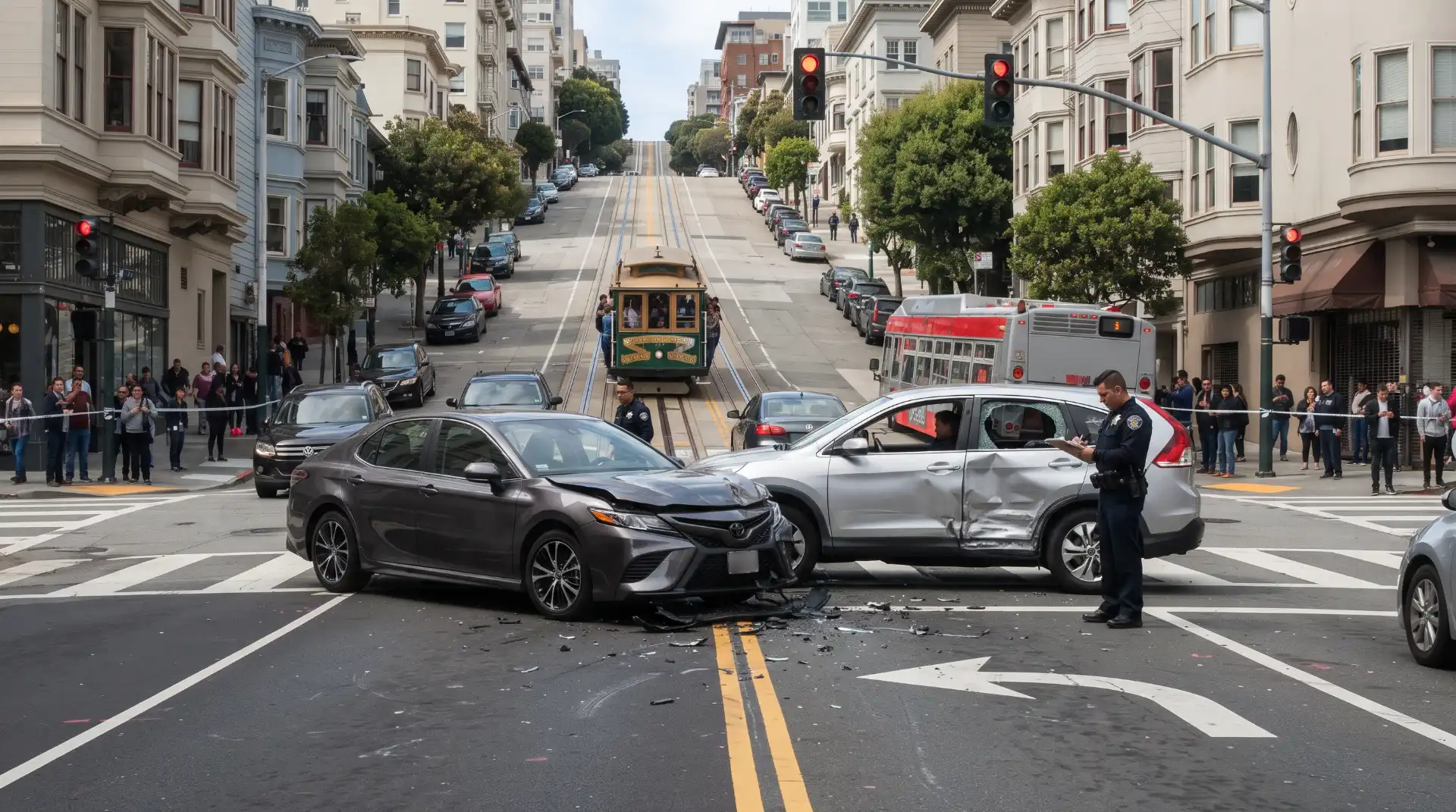
Speeding can complicate a U-turn accident because both drivers’ conduct may need to be examined.
A turning driver may argue that an approaching vehicle was traveling too fast to be reasonably anticipated. The approaching driver may argue that the U-turning vehicle entered the roadway without adequate warning.
Evidence can include dashcam footage, surveillance video, eyewitness testimony, roadway markings, vehicle damage, and accident reconstruction.
The analysis should focus on what each driver did and whether those actions contributed to the collision.
California’s comparative fault principles can become relevant if evidence shows that multiple parties contributed to the accident.
What If the Other Driver Was Distracted?
Distracted driving may also become relevant.
A driver approaching a U-turning vehicle may fail to react because they are looking at a phone, adjusting a navigation system, reaching for something, or otherwise not paying adequate attention to the roadway.
Similarly, the driver making the U-turn could be distracted and fail to check traffic.
The presence of a U-turn does not automatically establish that the turning driver is responsible for every collision.
Investigators may need to determine whether distraction, speeding, failure to yield, visibility, traffic controls, or other factors contributed to the crash.
When an Attorney May Be Helpful
Not every U-turn accident requires legal representation. A minor accident with no injuries and clear insurance coverage may be handled through the normal claims process.
A lawyer may become more useful when injuries are significant, fault is disputed, multiple vehicles are involved, insurance coverage is complicated, or the other driver denies responsibility.
An attorney can review the facts, explain potential legal issues, help organize evidence, and communicate with insurance companies when appropriate.
This can be particularly useful when the accident involves a disputed traffic restriction or a question about comparative fault.
Because California personal injury claims are subject to legal deadlines, accident victims should not assume they can wait indefinitely before investigating their options.
Frequently Asked Questions About Unsafe U-Turn Accidents
Are U-turns illegal throughout San Francisco?
No. U-turns are not automatically prohibited throughout the city. California law establishes rules governing U-turns, while San Francisco can establish additional restrictions at particular intersections and locations. SFMTA specifically has authority to designate intersections where U-turns are prohibited.
Can I be liable if my U-turn was legal?
Potentially, depending on how the maneuver was performed and the circumstances of the collision. A permitted U-turn still needs to be performed safely and with appropriate attention to surrounding traffic.
Does a No U-Turn sign automatically prove fault?
A violation can be important evidence, but it does not necessarily resolve every issue in a civil accident claim. The evidence still needs to connect the violation to the collision and resulting injuries or losses.
What if there was no sign prohibiting the U-turn?
Other California traffic rules can still apply. Visibility, approaching traffic, roadway conditions, lane position, signaling, and the manner in which the turn was performed can all matter.
What should I photograph after a U-turn crash?
If it is safe, photograph the damaged vehicles, roadway, lane markings, traffic signs, traffic signals, intersection, surrounding obstructions, skid marks, and the broader accident scene.
Can a U-turn accident involve comparative fault?
Yes. If evidence indicates that more than one driver contributed to the collision, California comparative fault principles may become relevant.
Can a cyclist or pedestrian make a claim after being hit by a U-turning vehicle?
Potentially. The circumstances of the collision, applicable traffic rules, evidence, and injuries would need to be evaluated individually.
What if the U-turn happened during construction?
Temporary roadway configurations, signs, lane closures, barriers, and traffic controls may become relevant. San Francisco’s current street-work regulations address temporary traffic configurations and traffic-control requirements.
Should I keep my dashcam recording after an accident?
Yes. If the camera captured the collision, preserve the original footage and avoid allowing the device to overwrite it.
How Drivers Can Avoid Unsafe U-Turns
The easiest way to prevent a U-turn accident is to avoid making the maneuver unless the driver is confident that it is permitted and can be completed safely.
Drivers should pay attention to posted signs and roadway markings rather than assuming that a familiar maneuver is permitted everywhere.
A driver should also check approaching traffic carefully and consider vehicles in adjacent lanes, cyclists, pedestrians, and transit vehicles.
If visibility is limited, continuing to a safer location may be preferable to attempting an immediate U-turn.
Drivers should avoid making sudden maneuvers simply because they missed a turn.
Using navigation systems before beginning a trip can also reduce the need for last-second direction changes. If a driver misses a destination, continuing to the next safe location and rerouting is generally less risky than attempting an unexpected maneuver in heavy traffic.
Patience is particularly important in dense urban traffic.
Final Thoughts
Unsafe U-turns can create serious risks on San Francisco streets because the maneuver often requires a vehicle to cross or enter the path of traffic traveling in another direction. The danger can increase around busy intersections, steep streets, bicycle lanes, pedestrian crossings, transit routes, construction zones, and congested roadways.
California law establishes rules governing U-turns, while San Francisco can impose additional restrictions at specific intersections. SFMTA’s transportation regulations expressly allow the city to designate locations where U-turns and other turning movements are prohibited.
A driver who violates a U-turn restriction may face a traffic citation, but an accident claim involves a broader analysis. Investigators may need to determine whether the maneuver caused the crash, whether the driver failed to act safely, whether another motorist contributed to the collision, and what injuries and financial losses resulted.
For accident victims, evidence can be critical. Photographs of the roadway and vehicles, dashcam footage, surveillance video, witness information, police reports, medical records, and documentation of financial losses can all help establish what happened.
The exact location and conditions of the accident are also important. San Francisco regularly modifies traffic controls and roadway configurations, including turn restrictions and temporary construction-related traffic arrangements.
If you or someone in your family has been seriously injured in a collision involving an unsafe U-turn, obtaining information about the accident and understanding your legal options can be important. California personal injury law is fact-specific, and the appropriate course of action depends on the circumstances of the individual collision.