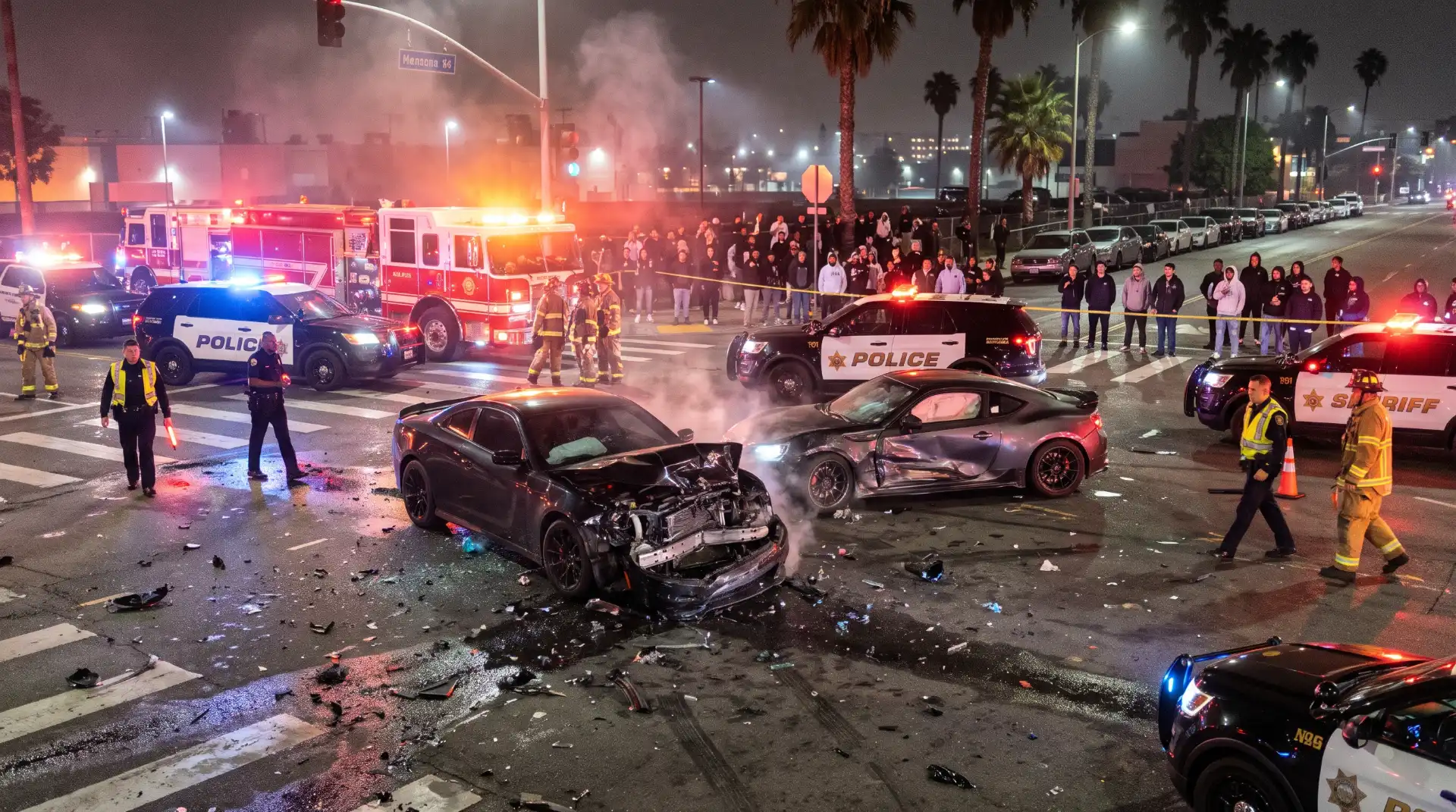
Street racing has become a serious traffic safety concern in many American communities, particularly in metropolitan areas where high-performance vehicles, modified cars, and large automotive gatherings attract drivers and spectators. What may begin as an informal car meet, an organized automotive demonstration, or an illegal racing competition can quickly turn into a dangerous situation when drivers accelerate at excessive speeds, perform stunts, or compete on roads that were never designed for racing.
The consequences can extend far beyond the drivers participating in the event. Spectators, pedestrians, cyclists, nearby motorists, passengers, and people living along the surrounding streets may become victims of collisions caused by reckless driving. A vehicle that loses control during a race can strike parked cars, cross into opposing traffic, hit pedestrians, or trigger a chain-reaction collision involving several vehicles.
Although the driver who causes the crash may appear to be the obvious person responsible, street racing accident liability can involve considerably more complicated legal questions. Depending on the circumstances, event organizers, property owners, vehicle owners, commercial sponsors, employers, and other participants may also face allegations of negligence or other legal responsibility.
These issues are particularly important in California, where illegal street racing and sideshows have prompted increased enforcement and public safety efforts. Recent developments involving automotive gatherings and dangerous vehicle demonstrations also illustrate why responsibility after a serious collision may extend beyond the person behind the steering wheel.
For accident victims, understanding the potential responsibilities of everyone involved can be essential when evaluating compensation options. A thorough investigation may reveal that several individuals or businesses contributed to the circumstances that made the collision possible.
Understanding the Difference Between Street Racing, Car Meets, and Organized Motorsports
Before determining who may be responsible for a street racing accident, it is important to understand that not every automotive gathering or performance demonstration is legally considered street racing.
Car enthusiast gatherings, automotive exhibitions, manufacturer demonstrations, and professional motorsports events can serve legitimate recreational and commercial purposes. However, their legal responsibilities depend on where they take place, how they are conducted, what safety measures are implemented, and whether participants follow applicable laws.
Illegal Street Racing on Public Roads
Illegal street racing generally involves drivers competing against each other or attempting to achieve a particular speed on roads that remain open to ordinary traffic. Some competitions are spontaneous, while others are arranged through private messages, social media groups, or informal automotive communities.
Participants may choose relatively isolated roads, industrial areas, intersections, or highway stretches where they believe they can avoid law enforcement. However, these locations can still contain unsuspecting motorists, pedestrians, cyclists, and other road users.
The danger increases when organizers or participants encourage spectators to gather near the racing area. People may stand along sidewalks, parking lots, medians, or road shoulders to record vehicles accelerating at high speeds.
A driver who loses control in these circumstances can cause serious injuries even without directly colliding with another racing vehicle. A car may strike an innocent bystander, hit a parked vehicle, or cross several lanes before stopping.
Organized Car Meets and Automotive Demonstrations
Car meets are generally gatherings where vehicle owners display their cars, exchange information, discuss modifications, and participate in automotive-related activities.
These events are not automatically unlawful or dangerous. Many are held at private venues, parking facilities, convention centers, dealerships, and other locations with established rules.
Problems arise when an otherwise legitimate gathering includes unsafe activities. For example, an organizer might permit drivers to demonstrate acceleration on a nearby public road, encourage passengers to participate in high-speed demonstrations, or allow spectators to gather in areas exposed to moving vehicles.
A commercial event may also become more complicated when a manufacturer or sponsor provides a vehicle, invites photographers, arranges demonstrations, or encourages promotional driving activities.
The legal analysis may therefore focus on what the organizers knew, what they controlled, what precautions they could reasonably take, and whether their actions contributed to the resulting accident.
Legal Motorsports and Controlled Racing Events
Professional motorsports events operate under a different framework from illegal street racing. Licensed tracks and established racing facilities generally have designated competition areas, safety barriers, emergency response procedures, participant requirements, and event rules.
However, the fact that an event is organized does not automatically eliminate every possibility of liability.
A racetrack operator may face allegations involving dangerous property conditions, inadequate safety procedures, or negligent supervision. A participant may also be responsible for conduct that falls outside the expected risks of the activity.
The distinction matters because a legal motorsports event may involve recognized racing risks, while an unauthorized street race exposes members of the public to hazards they did not agree to encounter.
California Laws Governing Street Racing and Sideshows
California has specific laws addressing motor vehicle speed contests, exhibitions of speed, and activities that facilitate dangerous street racing events.
One of the most relevant provisions is California Vehicle Code Section 23109.
California Vehicle Code Section 23109
California Vehicle Code Section 23109 prohibits motor vehicle speed contests on highways and in off-street parking facilities. The law also addresses aiding or abetting speed contests and exhibitions of speed.
A speed contest can involve two vehicles racing against each other or a vehicle competing against a clock or another timing device.
This distinction is important because a person does not necessarily need to be driving one of the competing vehicles to become involved in conduct prohibited by the statute.
Someone who actively helps arrange or facilitate an illegal speed contest may also face legal consequences under the applicable provisions.
The law additionally addresses placing barricades or obstructions to facilitate speed contests or exhibitions of speed.
For example, individuals who deliberately block an intersection so that two vehicles can race may become part of the investigation even if they never operate a racing vehicle.
California Vehicle Code Section 23109 also provides enhanced consequences in certain circumstances involving repeat offenses and bodily injury. Vehicle impoundment and driver’s license restrictions may apply under specified conditions.
The complete statutory language is available through California Vehicle Code Section 23109.
How Sideshows Affect Accident Liability
Sideshows, sometimes called street takeovers, are gatherings in which people block or impede traffic to allow vehicles to perform stunts, speed contests, exhibitions of speed, or reckless driving for spectators.
These activities create several potential sources of danger.
Spectators may stand dangerously close to vehicles performing donuts or other maneuvers. Drivers may lose control while attempting stunts. Other motorists may suddenly encounter blocked intersections or unexpected traffic obstructions.
California law specifically addresses sideshow-related conduct and provides additional consequences in certain situations.
The legal consequences can become more serious when a person is injured because of a speed contest or other prohibited activity.
California Vehicle Code Section 23109.1 addresses certain speed contests that proximately cause specified injuries to people other than the driver.
However, criminal penalties and civil liability are separate legal matters. A criminal conviction may provide relevant evidence, but an injured person still needs to establish the necessary elements of a civil claim against each defendant.
Why Criminal Violations Can Matter in Civil Injury Claims
A driver who participates in an illegal street race may face criminal charges, traffic penalties, or vehicle-related consequences.
Separately, an injured person may pursue a civil claim seeking compensation for medical expenses, lost income, pain, suffering, and other legally recoverable damages.
The existence of a criminal violation can become relevant when evaluating the driver’s conduct. Depending on the circumstances and applicable evidentiary rules, a violation may support arguments that the driver failed to exercise reasonable care.
However, the legal analysis does not end with identifying an illegal act.
A civil claim must also address whether the defendant’s conduct caused or substantially contributed to the injury and whether the plaintiff suffered compensable damages.
An organizer, sponsor, or vehicle owner cannot automatically be held responsible simply because someone else violated Vehicle Code Section 23109. Their own conduct and the connection between that conduct and the collision must be evaluated.
Can Event Organizers Be Held Responsible for Street Racing Accidents?
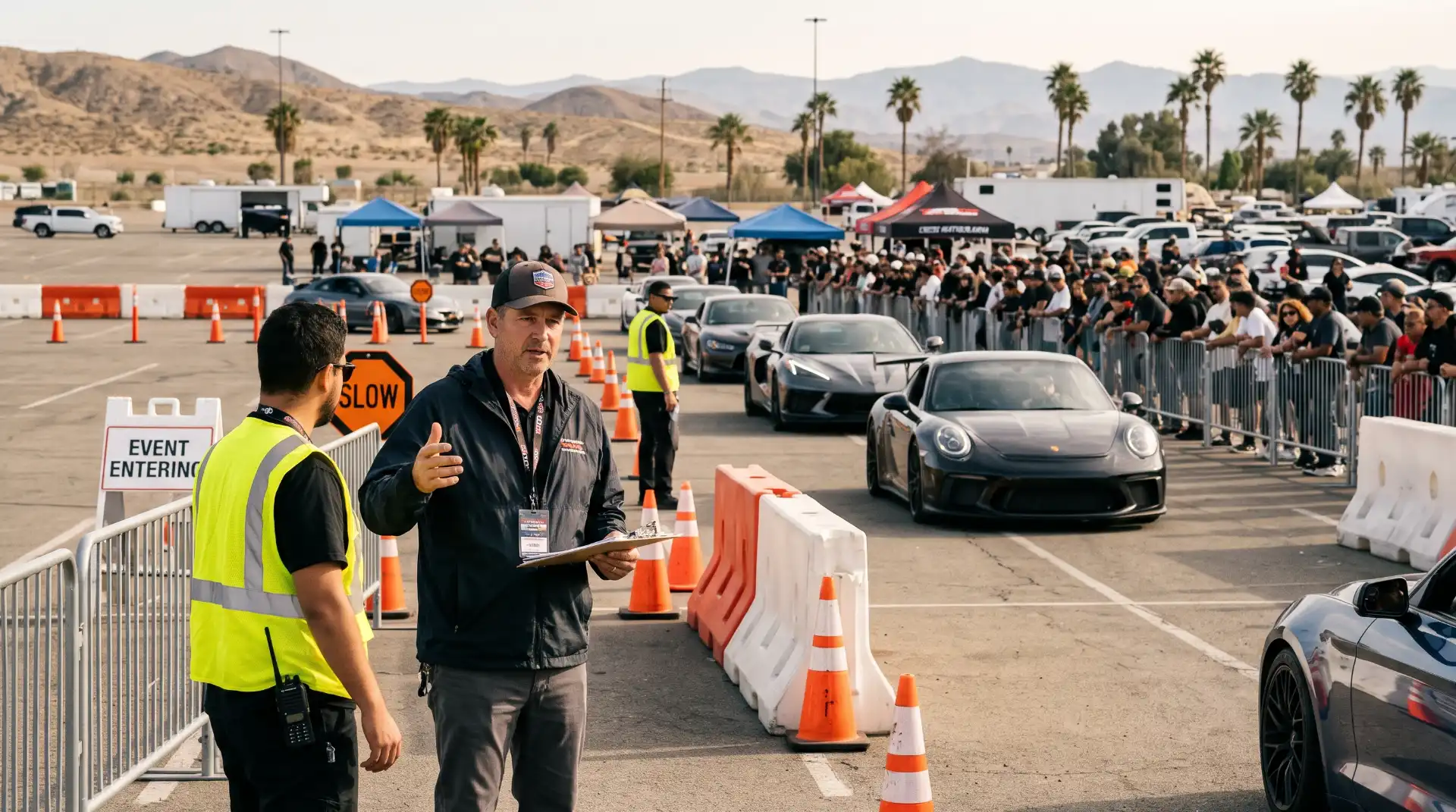
Event organizers may become important defendants when a serious collision occurs during or in connection with an automotive gathering.
Their responsibilities can vary depending on whether they control the venue, coordinate vehicle demonstrations, recruit participants, manage spectators, arrange transportation, or provide safety personnel.
The central question is whether the organizer acted reasonably under the circumstances and whether an unreasonable act or omission contributed to the accident.
Negligent Event Planning and Safety Management
Organizers who arrange automotive events may need to consider foreseeable risks associated with vehicle movement, participant behavior, spectator locations, and surrounding traffic.
For example, an organizer who knows that drivers intend to conduct high-speed demonstrations on a narrow public road may face questions about why the activity was permitted or encouraged.
Relevant issues may include whether the organizer:
- Allowed dangerous driving demonstrations near spectators.
- Failed to establish reasonable vehicle movement restrictions.
- Encouraged participants to perform stunts on public roads.
- Ignored credible warnings about unsafe conditions.
- Failed to coordinate reasonable crowd management.
- Permitted unauthorized racing activities to continue despite known hazards.
These circumstances do not automatically establish liability. The specific duty owed, the organizer’s knowledge, and the causal connection between the alleged negligence and the injury must be examined.
Failure to Address Known Safety Risks
Prior warnings can become particularly important in an event-related accident investigation.
Suppose an organizer receives complaints from residents about dangerous driving near an event location. Local authorities also communicate concerns about speeding, limited visibility, and heavy pedestrian activity.
Despite those warnings, the organizer continues promoting the gathering without implementing reasonable precautions.
If a serious collision subsequently occurs in circumstances connected to the known risks, the injured person may argue that the organizer failed to respond appropriately.
Evidence of prior warnings, internal communications, safety discussions, and event planning documents may help establish what the organizer knew before the accident.
However, receiving a warning does not automatically make an organizer responsible for every later collision. The warning must relate to a foreseeable danger, and the organizer must have had a legally relevant responsibility and ability to address it.
Crowd Control and Spectator Safety
Spectators are particularly vulnerable during street racing events.
Unlike vehicle occupants, people standing near a racing area have little physical protection when a driver loses control.
An event organizer who invites spectators to watch vehicle demonstrations may need to consider where people are positioned and whether reasonable precautions are necessary to separate them from moving vehicles.
For example, a gathering may attract hundreds of people to a parking lot. If participants begin performing donuts or acceleration demonstrations near the crowd, the risk of injury can increase substantially.
An organizer who controls the event location may need to consider barriers, restricted access areas, vehicle movement procedures, warning signs, and appropriate supervision.
Whether these precautions are legally required depends on the nature of the event, the organizer’s control, applicable safety requirements, and the foreseeable risks.
Can an Organizer Be Responsible for an Accident Outside the Venue?
An important question involves accidents that occur on nearby public roads rather than inside the event location.
An organizer may argue that the collision happened outside the property and beyond the organizer’s control.
That argument may be relevant, but the location of the collision does not necessarily resolve the entire liability question.
Suppose an organizer specifically arranges a high-performance vehicle demonstration on a nearby public road. Photographers and passengers are invited to participate, and the driving activity is connected to the promotional event.
If a driver causes a collision during the demonstration, investigators may examine the organizer’s role in arranging, encouraging, or supervising that activity.
The distinction is between merely hosting a gathering and actively participating in conduct that creates a foreseeable danger.
A person who simply rents a venue for a lawful car exhibition may have a very different legal position from an organizer who coordinates dangerous driving activities outside the property.
Can Commercial Sponsors and Automotive Brands Share Liability?
Commercial sponsorships are common in automotive culture. Companies may provide financial support, vehicles, equipment, promotional materials, merchandise, or technical assistance for car shows and driving demonstrations.
However, sponsorship alone does not automatically create legal responsibility for an accident.
A company generally needs to have some legally relevant connection to the conduct that caused the injury.
Sponsorship Versus Operational Control
One of the most important distinctions is whether a sponsor merely provides financial support or actively participates in organizing and controlling the event.
A company that purchases advertising space or provides merchandise may have limited involvement in the actual operation of the gathering.
By comparison, a company that selects drivers, supplies vehicles, establishes demonstration routes, supervises employees, and directs performance activities may have a more substantial connection to the event.
If a collision occurs during an activity arranged or controlled by the sponsor, investigators may examine whether the company failed to use reasonable care.
Relevant evidence could include event contracts, promotional materials, employee communications, safety policies, demonstration schedules, and vehicle assignment records.
Negligent Supervision of Promotional Driving Activities
Automotive manufacturers and dealerships sometimes arrange demonstrations to showcase vehicle acceleration, handling, braking, or other performance characteristics.
These demonstrations can be conducted safely in appropriate environments. Problems arise when performance activities take place in areas unsuitable for high-speed driving.
Consider a hypothetical situation involving a vehicle manufacturer that sends an employee to a promotional car gathering.
The employee is instructed to demonstrate the vehicle’s acceleration to photographers. The demonstration takes place on a narrow public road with ordinary traffic and limited visibility.
If the employee drives at an excessive speed and causes a head-on collision, the injured motorist may investigate whether the employer provided adequate supervision, selected an appropriate location, and established reasonable operating rules.
Depending on the employment relationship and applicable law, the company may face potential claims involving negligent supervision, negligent entrustment, or vicarious liability.
The company’s responsibility would depend on the actual circumstances rather than its mere presence at the event.
Negligent Entrustment of High-Performance Vehicles
Negligent entrustment is another important legal theory.
It generally concerns providing a vehicle to someone when the person providing it knew or should have known that the recipient was likely to use it in a manner creating an unreasonable risk of harm.
For example, a business may provide a powerful sports car to an inexperienced employee for a public-road demonstration despite knowing that the employee has a history of dangerous driving.
If the employee subsequently causes a serious accident, the business’s decision to provide the vehicle may become relevant to a civil claim.
The same general issue can arise when vehicle owners lend cars to people they know are unlicensed, impaired, reckless, or otherwise unfit to drive.
However, negligent entrustment requires evidence supporting the relevant legal elements. Simply owning or supplying a high-performance vehicle does not automatically establish liability.
Advertising That Encourages Dangerous Driving
Promotional materials can also become relevant when evaluating a company’s involvement in an event.
For example, a sponsor may advertise a competition using language that encourages participants to race on public roads, perform dangerous stunts, or demonstrate extreme vehicle speeds outside controlled facilities.
Such evidence may become relevant to questions about the sponsor’s involvement and whether its conduct contributed to a foreseeable risk.
Nevertheless, advertising an automotive event or promoting a vehicle’s performance does not automatically create liability for a subsequent crash.
The investigation must establish a legally sufficient connection between the sponsor’s conduct and the injury.
Can Vehicle Owners Be Responsible When Someone Else Causes the Crash?
Vehicle ownership and driver responsibility are related but separate legal issues.
A person who owns a vehicle is not automatically responsible for every accident involving it. However, vehicle owners may face liability when their own actions contribute to the collision or when applicable vehicle-owner liability laws impose responsibility.
Negligent Entrustment by Private Vehicle Owners
Private vehicle owners sometimes allow friends, relatives, employees, or acquaintances to use their vehicles.
That permission may become legally significant if the owner knows that the person is likely to operate the vehicle dangerously.
For example, an owner may lend a modified sports car to someone who has previously participated in illegal street races, received repeated reckless-driving citations, or demonstrated an inability to operate the vehicle safely.
If that driver subsequently causes a collision during an illegal race, the injured person may investigate whether the owner negligently entrusted the vehicle.
The key issue is what the owner knew or reasonably should have known when allowing the person to drive.
An owner who lends a car to a qualified driver with no known history of dangerous behavior generally presents a different situation.
California’s Vehicle Owner Liability Law
California Vehicle Code Section 17150 addresses certain situations involving vehicle-owner liability.
Under the statute, an owner may be responsible for injuries caused by someone operating the vehicle with the owner’s permission.
However, this form of responsibility is subject to statutory limitations and does not mean that vehicle owners automatically face unlimited liability.
California also has provisions governing the amount of liability that may apply to owners in certain permissive-use situations.
The distinction is important because an owner may face potential responsibility even when the owner was not personally participating in the street race.
For example, a vehicle owner may permit another person to drive a car that later becomes involved in a collision. The injured person may need to examine whether permission existed and how California’s owner-liability statutes apply.
The owner may also face a separate negligent entrustment claim if the facts support it.
Company-Owned Vehicles
Company-owned vehicles can create additional questions.
An employer may provide a vehicle to an employee for business purposes, promotional activities, transportation, or demonstrations.
If the employee causes a collision while performing assigned duties, the employer may face potential vicarious liability under the legal doctrine of respondeat superior.
The analysis generally focuses on the employee’s relationship with the employer and whether the conduct occurred within the scope of employment.
For instance, a company representative who drives a vehicle as part of an authorized marketing demonstration may present a different situation from an employee who independently takes the vehicle for an unauthorized personal race.
The vehicle’s ownership, the employee’s duties, company instructions, and the purpose of the trip may all become relevant.
How Employers May Become Responsible for Employee-Involved Street Racing Accidents
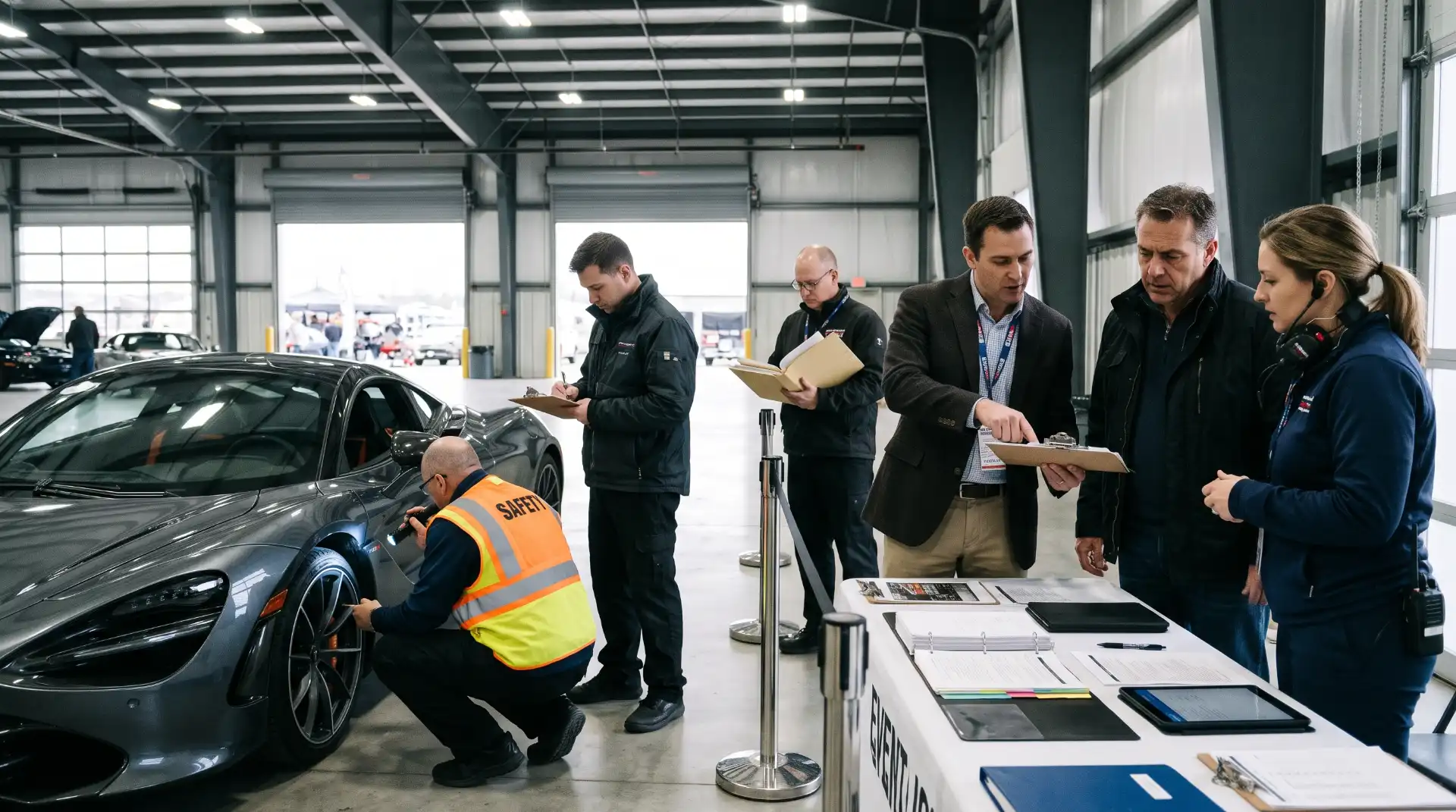
Employers can face legal exposure when employees operate vehicles during company-sponsored events or business activities.
However, an employer is not automatically responsible whenever an employee causes a traffic accident.
Vicarious Liability and the Scope of Employment
Under the doctrine of respondeat superior, an employer may be held responsible for certain negligent acts committed by an employee within the scope of employment.
For example, a dealership employee may be assigned to transport vehicles to an automotive exhibition.
If the employee causes a collision while performing an authorized business task, the employer may face potential vicarious liability.
The situation becomes more complicated if the employee engages in racing or dangerous driving that violates company policy.
An employer may argue that the employee acted outside the scope of employment. The injured person may respond that the driving activity was connected to an assigned demonstration or promotional purpose.
Courts examine the actual circumstances rather than relying exclusively on job titles or written company policies.
Negligent Hiring and Supervision
Employers may also face claims based on their own conduct.
For example, a business that assigns employees to operate high-performance vehicles may need to consider whether those employees possess appropriate qualifications and experience.
If an employer ignores known safety problems, provides inadequate supervision, or fails to establish reasonable operating procedures, those failures may become relevant after a serious collision.
The existence of a company policy prohibiting reckless driving does not necessarily end the investigation.
The question may include whether the company reasonably enforced its policies and responded to known problems.
What Happens When a Spectator or Innocent Motorist Is Injured?
People who are not participating in street racing may have particularly strong reasons to investigate every potential source of responsibility.
A spectator may attend an automotive gathering simply to watch vehicles or photograph the event. A motorist may be driving through an intersection without knowing that a race is taking place.
Neither person necessarily expects to encounter vehicles traveling at dangerous speeds or performing unauthorized stunts.
Injuries to Spectators
Spectators may be injured when a driver loses control, spins out, strikes a barrier, or drives into an area where people have gathered.
These accidents can cause serious trauma, particularly when the vehicle enters a crowd.
Potential claims may involve the driver, event organizer, property owner, or another party whose conduct contributed to the dangerous conditions.
A spectator’s decision to attend an event does not automatically eliminate the right to pursue compensation.
However, questions about assumption of risk, comparative negligence, and the nature of the activity may become important.
An organized racing event at a licensed track presents different legal considerations from an unauthorized street takeover.
Injuries to Drivers Who Were Not Racing
An innocent motorist may be struck by a vehicle participating in an illegal race.
For example, two drivers may begin racing along a public road. One loses control and crosses into an adjacent lane, striking a vehicle carrying a family.
The injured occupants may have claims against the driver who caused the collision. Depending on the evidence, they may also investigate the involvement of organizers, vehicle owners, or other responsible parties.
The fact that the victims were not participating in the race can be important when evaluating their own comparative fault.
Pedestrians and Cyclists
Pedestrians and cyclists face additional risks because they have little physical protection in a collision.
Street racing may occur near intersections, parking facilities, commercial districts, or residential neighborhoods where people are walking and cycling.
A driver who loses control may strike someone on a sidewalk or crosswalk.
Investigators may examine whether the driver violated traffic laws, whether the event created an unreasonable danger, and whether another party contributed to the conditions that allowed the collision to occur.
For injured pedestrians and cyclists, evidence about the location, visibility, vehicle speed, and event organization may become particularly important.
Can Property Owners and Venue Operators Be Held Liable?
The location of an automotive event may create additional legal questions.
A property owner or venue operator may have responsibilities relating to premises safety, access control, and activities conducted on the property.
However, ownership alone does not automatically establish liability for every accident associated with an event.
Unsafe Parking Facilities and Private Event Locations
Some illegal racing activities begin in private parking facilities or commercial lots before moving onto public streets.
A property owner may know that groups regularly gather at a location for dangerous vehicle demonstrations.
If the owner actively permits or facilitates unsafe activities, questions may arise about the owner’s knowledge, control, and ability to take reasonable preventive measures.
For example, an owner who rents a parking facility for a lawful vehicle exhibition may have different responsibilities from an owner who knowingly permits unauthorized racing and spectator gatherings in a dangerous area.
The analysis may also involve whether the owner had authority to control the activity and whether the injury resulted from a dangerous condition or negligent conduct connected to the premises.
Premises Liability and Event Safety
Premises liability generally concerns injuries connected to dangerous property conditions and a person’s legal responsibilities relating to the property.
At an automotive event, potential issues may include inadequate lighting, unsafe access routes, poorly maintained barriers, dangerous pedestrian areas, or inadequate separation between spectators and moving vehicles.
A venue operator may face scrutiny if it knows about a dangerous condition and fails to take reasonable steps to address it.
However, premises liability is not automatic simply because a collision happens on private property.
The injured person generally needs to establish the relevant duty, breach, causation, and damages.
A Recent Bay Area Lawsuit Highlights the Liability Questions
A particularly relevant example emerged in November 2026 involving a serious collision near a Cars & Coffee gathering in San Mateo County.
According to a report published by Road & Track on November 12, 2026, a California woman filed a lawsuit against Tesla, a company representative, and organizers associated with an automotive gathering after an August 30, 2026, head-on collision on State Route 84 near La Honda.
The complaint reportedly alleges that a Tesla representative was demonstrating a company-owned Model Y for event photographers. During the drive, the vehicle allegedly reached speeds exceeding 80 miles per hour on a road with posted speed limits of approximately 35 to 40 miles per hour.
The lawsuit claims the driver lost control on a blind curve, crossed into oncoming traffic, and struck the plaintiff’s Honda CR-V.
The plaintiff reportedly sustained serious injuries, including fractures and a traumatic brain injury.
The lawsuit also alleges that authorities had previously raised concerns about traffic safety in the area and urged event organizers to cancel the gathering.
The plaintiff’s allegations include negligent entrustment and inadequate supervision claims against Tesla, along with negligence claims involving the event organizers and venue.
These allegations have not been proven in court. The filing of a lawsuit does not establish that any named defendant is legally responsible.
Nevertheless, the case illustrates several important issues for people investigating automotive-event accidents.
First, the driver may not be the only person whose conduct deserves examination. The circumstances surrounding the vehicle demonstration, the employer’s involvement, and the organizer’s decisions may all become relevant.
Second, company-owned vehicles can raise questions about negligent entrustment and employee supervision.
Third, warnings about foreseeable traffic hazards may become important evidence when evaluating whether an event organizer acted reasonably.
Finally, the case demonstrates why an ordinary car gathering can become the subject of a complicated injury lawsuit when vehicle demonstrations take place on public roads.
For more details, see the November 2026 Road & Track report.
How California’s Comparative Fault Rules Affect Street Racing Accident Claims
When multiple individuals contribute to a serious collision, determining each party’s percentage of responsibility becomes an important part of the legal process.
California follows a comparative negligence system.
Under this approach, an injured person may generally recover damages even if the person was partly responsible for the accident. The recoverable amount may be reduced according to the plaintiff’s assigned percentage of fault.
When Multiple Drivers Contribute to a Collision
Consider a situation involving two street racers and an ordinary motorist.
Two drivers begin competing at excessive speeds. One changes lanes suddenly, while the other follows closely behind.
An innocent motorist attempts to avoid the racing vehicles but collides with a third vehicle.
An investigation may determine that both racing drivers contributed to the collision through their speed, lane changes, and unsafe driving.
The legal analysis may also examine whether the third motorist acted reasonably under the circumstances.
Responsibility can therefore involve multiple drivers rather than a single person.
When an Injured Person May Share Some Fault
Comparative negligence can also arise when a spectator or event attendee is injured.
For example, a spectator may stand in an area clearly designated as restricted to watch a vehicle demonstration.
If a collision occurs, the defense may argue that the spectator’s conduct contributed to the injury.
However, the defendant’s negligence may still be relevant.
California’s comparative fault framework generally allows a jury to consider the respective responsibility of the parties rather than automatically preventing recovery because an injured person made a mistake.
The exact outcome depends on the facts and applicable law.
Can Spectators Be Prevented From Recovering Compensation Because They Assumed the Risk?
Assumption of risk is another legal issue that may arise when someone is injured at a racing event.
The argument generally concerns whether the injured person voluntarily encountered a known danger and whether the defendant owed a duty to protect against that particular risk.
However, the doctrine is not a universal defense for event organizers or drivers.
Primary Assumption of Risk
Primary assumption of risk can apply in certain activities where the nature of the activity and the relationship between the parties limit the defendant’s duty to protect participants from inherent risks.
For example, people who voluntarily participate in certain competitive sports may understand that some dangers are inherent in the activity.
However, the application of this doctrine depends on the specific activity and the parties’ relationship to it.
An illegal street race on a public road is not automatically treated the same way as a professionally organized racing competition.
An innocent pedestrian who happens to be walking nearby has a very different relationship to the activity from a professional driver who voluntarily participates in a race.
Secondary Assumption of Risk
Secondary assumption of risk generally involves a situation in which a defendant owes a duty of care, but the injured person knowingly encounters a specific danger created by the defendant’s negligence.
In such situations, the issue may be evaluated through comparative fault rather than serving as an automatic complete defense.
For example, a spectator who knowingly stands close to a vehicle demonstration may face arguments concerning personal responsibility.
Nevertheless, a defendant’s conduct, the foreseeability of the danger, and the circumstances of the injury must still be examined.
A warning sign or event waiver does not automatically protect every defendant from liability.
What Evidence Is Important After a Street Racing Accident?
Street racing accidents can be difficult to investigate because several vehicles, participants, spectators, and organizations may be involved.
Evidence may disappear quickly after the collision. Vehicles can be removed, social media content can be deleted, and witnesses may leave the area.
Preserving relevant information is therefore important.
Police Reports and Accident Scene Documentation
Police reports may identify the vehicles involved, describe the initial investigation, document statements, and record possible traffic violations.
For serious collisions, investigators may also prepare diagrams, photographs, measurements, and vehicle inspections.
These materials can help establish where the vehicles were located, how the collision occurred, and whether illegal racing activity was involved.
A police report is not necessarily a final determination of civil liability, but it may provide useful information for a later investigation.
Surveillance Cameras and Smartphone Recordings
Street racing events are frequently recorded by participants and spectators.
Smartphones, dashboard cameras, security systems, and nearby business surveillance cameras may capture important details.
Video footage may help establish:
- Vehicle speeds and movements.
- Whether drivers were competing.
- The location of spectators.
- Whether an organizer directed or encouraged a demonstration.
- The timing of the collision.
- Whether a driver attempted to brake or avoid impact.
Social media recordings can also show what happened before the accident.
For example, event advertisements, livestreams, and promotional videos may help identify who organized the gathering and what activities were planned.
The original recordings and associated metadata may be important when authenticity or editing becomes disputed.
Event Contracts and Communications
When organizers, sponsors, or businesses are involved, documents may provide evidence about their respective roles.
Investigators may seek event agreements, promotional contracts, emails, internal messages, safety plans, vehicle assignment documents, and communications with venue operators.
These records may reveal whether a company supplied the vehicle, selected the driver, arranged the demonstration, or exercised control over the activity.
Prior safety complaints and communications with authorities may also become relevant.
Vehicle Data and Mechanical Inspections
Modern vehicles may store electronic information that helps investigators understand what happened before a collision.
Depending on the vehicle and available systems, relevant information may include speed, braking, acceleration, steering inputs, and other recorded events.
Mechanical inspections can also identify whether a defect or maintenance problem contributed to the accident.
This is particularly important when a vehicle loses control during a high-speed demonstration.
An investigation may need to distinguish between driver error, mechanical failure, road conditions, and other contributing factors.
For additional information about evidence and accident investigations, readers can review our existing guide on how to prove fault in a San Francisco car accident.
How Witnesses Can Help Establish Responsibility
Witnesses can provide important information about the events leading up to a street racing accident.
A person who attended the gathering may know whether the event was advertised as a car exhibition, whether organizers encouraged demonstrations, or whether participants were racing before the collision.
Nearby residents may have information about repeated gatherings, previous dangerous activities, or earlier complaints.
Other motorists may have witnessed the vehicles accelerating, changing lanes, or losing control.
Witness testimony can become especially important when video footage is incomplete or when defendants provide conflicting explanations.
However, witness statements should be evaluated carefully. People may remember events differently, particularly when a collision happens suddenly.
Additional information is available in our article on the role of witnesses in San Francisco auto accident cases.
What Compensation May Be Available After a Serious Street Racing Accident?
People injured by negligent driving or other legally responsible conduct may be entitled to pursue compensation under applicable California law.
The amount and availability of compensation depend on the evidence, the injuries, the responsible parties, and the insurance coverage involved.
Medical Expenses
Medical expenses may include emergency treatment, hospital stays, surgery, medication, rehabilitation, physical therapy, and other necessary care.
Serious street racing collisions can cause traumatic brain injuries, spinal cord injuries, fractures, internal injuries, and permanent disabilities.
Some victims may require continuing treatment for months or years.
Future medical expenses may also become relevant when medical professionals determine that additional care will be necessary.
Lost Income and Reduced Earning Capacity
A serious injury may prevent someone from returning to work immediately.
In some cases, the victim may be unable to perform the same occupation or maintain the same working hours.
Lost wages and other legally recoverable employment-related losses may therefore become part of a personal injury claim.
When an injury permanently affects the person’s ability to earn income, reduced future earning capacity may also be considered.
Pain, Suffering, and Emotional Distress
Physical injuries can create lasting effects beyond medical bills.
Victims may experience chronic pain, anxiety, emotional distress, sleep difficulties, and limitations on everyday activities.
California law allows recovery for qualifying noneconomic damages in appropriate personal injury cases.
The amount depends on the nature and severity of the injuries and the evidence presented.
Property Damage
A collision during a street racing event may destroy or seriously damage an innocent person’s vehicle.
Property damage claims may involve repair expenses, replacement costs, towing, storage, and other recoverable losses.
Vehicle valuation disputes can arise when the insurance company and vehicle owner disagree about the value of a totaled vehicle.
Insurance Complications Involving Street Racing Accidents
Insurance coverage can become a significant obstacle when an accident involves illegal street racing.
A driver who causes a collision may have personal auto insurance, but the insurer may investigate whether a policy exclusion applies.
Some policies contain exclusions involving racing, organized competition, or other specified activities.
The wording of the policy and the actual circumstances of the accident matter.
Commercial Insurance Coverage
When an automotive company, dealership, event organizer, or venue operator becomes involved in a lawsuit, commercial insurance policies may also become relevant.
Possible policies include commercial general liability coverage, business auto insurance, umbrella coverage, and other specialized policies.
However, coverage depends on the policy terms, insured parties, exclusions, and circumstances of the claim.
A sponsor’s insurance policy does not automatically cover every accident connected to an event.
Multiple Insurance Policies
A single collision may involve several potentially responsible parties with different insurance arrangements.
For example, a racing driver may have personal auto coverage, the vehicle owner may have a separate policy, and an event organizer may carry commercial liability insurance.
If an employer supplied the vehicle, company insurance may also become relevant.
Determining which policies apply can require a detailed examination of policy language, ownership, permission, employment relationships, and the purpose of the vehicle’s use.
Uninsured and Underinsured Motorist Coverage
If an at-fault driver has no insurance or insufficient coverage, an injured person’s own uninsured or underinsured motorist coverage may become relevant.
Whether coverage applies depends on the policy and the specific facts of the accident.
Insurance disputes can also arise when a driver flees the scene or cannot be identified.
What Should Victims Do After a Street Racing Accident?
The aftermath of a serious collision can be confusing, especially when several drivers and event participants are involved.
Taking appropriate steps can help protect personal safety and preserve information that may later become important.
Seek Immediate Medical Attention
Medical treatment should be the first priority after a serious collision.
Some injuries may not become immediately apparent. Head injuries, internal trauma, and spinal injuries can produce symptoms that develop or worsen over time.
Emergency medical personnel should evaluate serious injuries, and victims should follow appropriate medical recommendations.
Medical documentation can also help establish the relationship between the collision and the injuries.
Report the Accident
Law enforcement should be notified when a collision involves injuries, significant property damage, suspected illegal racing, or other circumstances requiring an official response.
Victims should provide accurate information about what happened without speculating about details they did not personally observe.
If several vehicles or event participants were involved, identifying all available parties can become particularly important.
Preserve Photographs and Video
When it is safe to do so, photographs may document the vehicles, roadway, traffic signs, debris, skid marks, damaged property, and surrounding conditions.
Videos from witnesses or nearby businesses may also be useful.
Victims should preserve original recordings rather than editing or deleting them.
Identify Witnesses and Event Participants
Witness names and contact information can help investigators reconstruct the collision.
People who attended the event may know who organized it, which vehicles participated, and whether a demonstration or race was scheduled.
Social media accounts and promotional materials may also help identify relevant individuals or businesses.
Avoid Speculating About Fault
After a serious collision, participants may disagree about what happened.
Victims should avoid making unsupported assumptions or publicly accusing individuals of wrongdoing before the facts are established.
Accurate statements, preserved evidence, and professional investigation are more useful than speculation.
Obtain Legal Guidance
When a serious accident involves multiple drivers, event organizers, sponsors, or vehicle owners, determining responsibility may require a detailed legal investigation.
An attorney experienced in California personal injury claims can help evaluate the available evidence, identify potentially responsible parties, review insurance coverage, and explain applicable deadlines.
Victims should be particularly careful about signing settlement agreements before understanding the full extent of their injuries and potential claims.
California Deadlines for Filing Street Racing Accident Lawsuits
Time limits can affect a victim’s ability to pursue compensation.
Under California Code of Civil Procedure Section 335.1, many personal injury lawsuits generally must be filed within two years of the date of injury.
However, different deadlines and exceptions may apply depending on the circumstances.
For example, claims involving government entities may require an administrative claim before a lawsuit can be filed. Certain government claims have much shorter deadlines, commonly six months for claims involving personal injury.
The identity of the defendant can therefore affect the applicable procedure.
If an accident involves a public entity, municipal property, or government-operated event facility, additional legal analysis may be necessary.
Evidence preservation is also time-sensitive. Surveillance recordings, electronic records, event communications, and vehicle data may not remain available indefinitely.
Waiting too long can make it more difficult to identify responsible parties and establish what happened.
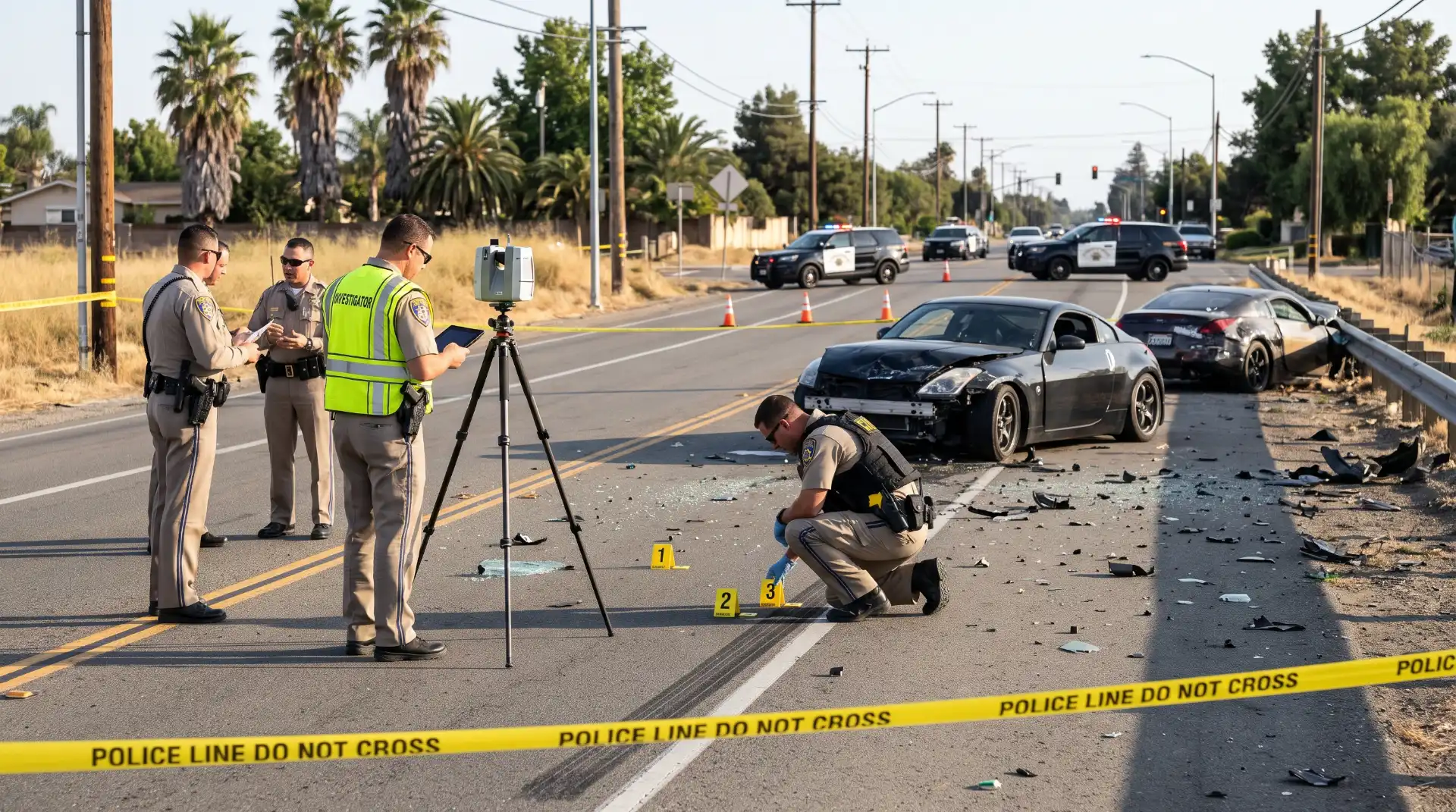
How Street Racing Accident Investigations Differ From Ordinary Car Accident Claims
An ordinary two-vehicle collision may primarily involve investigating the actions of the drivers.
Street racing accidents can require a much broader investigation.
Instead of examining only the vehicles and drivers, investigators may need to reconstruct the organization and operation of the entire event.
They may need to identify who advertised the gathering, who supplied the vehicles, who selected the drivers, who controlled the property, and whether anyone encouraged or facilitated dangerous driving.
The investigation may also involve several insurance companies, corporate records, event contracts, and communications between multiple businesses.
Identifying Every Potentially Responsible Party
A complete investigation should not assume that the driver is the only possible defendant.
Depending on the facts, potentially responsible parties may include:
- The driver who caused the collision.
- Another racing participant who contributed to the crash.
- A person who helped organize or facilitate an illegal speed contest.
- A vehicle owner who negligently entrusted the car.
- An employer responsible for an employee’s conduct.
- A business that negligently supervised a vehicle demonstration.
- An event operator responsible for a dangerous activity.
- A property owner whose negligence contributed to the injury.
Not every party listed will necessarily be legally responsible. Each claim requires evidence supporting the relevant legal theory.
Establishing Causation
One of the most difficult parts of a multi-party accident claim is proving how each defendant contributed to the injury.
For example, an organizer may have arranged an event, but the collision may have resulted from an entirely independent act by a driver.
Alternatively, an organizer may have actively coordinated a dangerous demonstration, selected an unsuitable location, and encouraged the driver to perform at excessive speeds.
These situations present different causation questions.
A plaintiff generally needs to establish more than a general association between a defendant and the event.
Evidence must connect the defendant’s conduct to the injury in a legally sufficient way.
Preserving Corporate and Digital Evidence
Claims involving commercial sponsors or event organizers may require evidence that is not available through ordinary accident-scene photographs.
Documents may include vehicle-use agreements, employment records, promotional contracts, insurance policies, internal communications, safety procedures, and event planning materials.
Digital evidence may also include social media advertisements, livestream recordings, text messages, and photographs shared among event participants.
Preserving these materials can be especially important when defendants dispute their involvement.
Preventing Serious Accidents at Automotive Gatherings
Preventing street racing accidents requires attention from event organizers, vehicle owners, sponsors, drivers, and property operators.
Automotive gatherings can provide opportunities for enthusiasts to share their interests without exposing the public to unnecessary risks.
Choosing Appropriate Event Locations
Vehicle demonstrations should take place in suitable environments rather than ordinary public roads.
High-performance driving activities belong in controlled facilities with appropriate safety arrangements.
Organizers should distinguish between static vehicle displays and activities involving moving vehicles.
Establishing Clear Participant Rules
Events should communicate reasonable expectations concerning vehicle operation, speed, parking, passenger access, and restricted areas.
Participants should understand that dangerous driving and unauthorized demonstrations are not acceptable.
Rules should also address what happens when someone attempts to initiate illegal racing or perform dangerous stunts.
Separating Spectators From Moving Vehicles
Spectator safety should be a central consideration.
Designated viewing areas, barriers, access restrictions, and appropriate supervision can help reduce exposure to moving vehicles.
Event operators should also consider emergency access and procedures for responding to an injury.
Evaluating Drivers and Vehicles
Companies and organizers arranging vehicle demonstrations should consider driver qualifications, vehicle condition, and the suitability of the location.
A high-performance vehicle should not be provided to someone who cannot operate it safely.
Owners should also avoid lending vehicles to individuals whose driving history or behavior creates an unreasonable risk.
Responding to Known Safety Problems
Warnings about dangerous driving, overcrowding, or unsafe demonstrations should not be ignored.
Organizers and venue operators should evaluate complaints and take reasonable steps within their authority to address foreseeable hazards.
California Highway Patrol has also conducted statewide initiatives targeting dangerous sideshows and illegal street racing. Its public safety efforts include enforcement, education, and efforts to reduce crashes associated with reckless driving.
Additional information is available from the California Highway Patrol’s street racing and sideshow enforcement announcement.
Frequently Asked Questions About Street Racing Accident Liability
Can an event organizer be sued if someone causes a crash during a car meet?
Yes, an organizer may potentially face a negligence claim if the organizer owed an applicable duty of care, breached that duty, and the breach substantially contributed to the injury. However, simply organizing or hosting a car meet does not automatically make someone responsible for every accident involving an attendee.
Can a sponsor be responsible for a street racing accident?
A sponsor may face liability if its own conduct contributed to the accident. For example, a company that actively arranged a dangerous vehicle demonstration, supplied a vehicle to an unqualified driver, or negligently supervised an employee may face relevant claims. Providing ordinary financial sponsorship alone does not automatically establish liability.
Can a vehicle owner be sued if someone else was driving the car?
Yes. California law recognizes certain circumstances in which a vehicle owner may be responsible for injuries caused by someone operating the vehicle with permission. Negligent entrustment may also apply when an owner knowingly provides a vehicle to someone likely to operate it dangerously. The applicable statutory limitations and facts must be considered.
What if the street racing accident happened outside the event location?
An accident occurring outside the venue does not automatically eliminate potential responsibility for an organizer or sponsor. If the organizer arranged, encouraged, or controlled a driving activity on a nearby public road, that involvement may become relevant. The injured person must still establish a legally sufficient connection between the defendant’s conduct and the collision.
Can an innocent motorist sue both street racers after a collision?
Potentially, yes. If two or more drivers contributed to the collision, the injured motorist may pursue claims against multiple parties. California’s comparative fault system allows responsibility to be allocated according to the evidence and applicable legal principles.
Does an illegal street racing conviction guarantee compensation for an injured person?
No. A criminal conviction does not automatically guarantee a civil recovery. The injured person generally must still establish liability, causation, and compensable damages. However, evidence of criminal conduct may be relevant to the civil case.
Can spectators sue if they are injured while watching an illegal street race?
Potentially. A spectator may have a claim against a negligent driver or another legally responsible party. The circumstances of attendance, the risks encountered, and applicable assumption-of-risk and comparative-fault principles may affect the outcome.
What if the driver who caused the accident has no insurance?
An injured person may investigate other potentially responsible parties and available insurance coverage. Depending on the circumstances, uninsured or underinsured motorist coverage may also be relevant. Coverage cannot be assumed without reviewing the applicable policy.
How long do victims have to file a California street racing accident lawsuit?
Many California personal injury claims generally have a two-year filing deadline under Code of Civil Procedure Section 335.1. However, exceptions and different procedures may apply, particularly when a government entity is involved. Prompt legal evaluation is important.
Conclusion: Street Racing Accident Liability Can Extend Beyond the Driver
Street racing accidents can create complicated legal disputes because the circumstances surrounding the collision may involve more than one negligent driver.
Although the person operating the vehicle that caused the crash is often a central focus of the investigation, event organizers, commercial sponsors, vehicle owners, employers, and property operators may also become relevant when their conduct contributed to the dangerous situation.
California law addresses illegal speed contests, exhibitions of speed, and sideshow-related activities. Separate civil liability principles may also allow injured people to investigate negligent entrustment, negligent supervision, premises liability, and vicarious responsibility when supported by the evidence.
The November 2026 Bay Area lawsuit involving a vehicle demonstration and an alleged high-speed collision illustrates why these questions deserve attention. The case remains subject to the legal process, and its allegations should not be treated as established findings. Nevertheless, it demonstrates how a collision connected to an automotive gathering can raise questions involving drivers, businesses, vehicle owners, and event organizers.
For victims, identifying every potentially responsible party may be an important part of understanding available compensation options. Police reports, witness statements, vehicle data, event communications, video recordings, and insurance documents can all help establish what happened.
Ultimately, responsibility depends on the specific facts, the applicable California laws, and whether each defendant’s conduct contributed to the injuries. A careful investigation can help injured people understand their legal options after a serious street racing accident.