
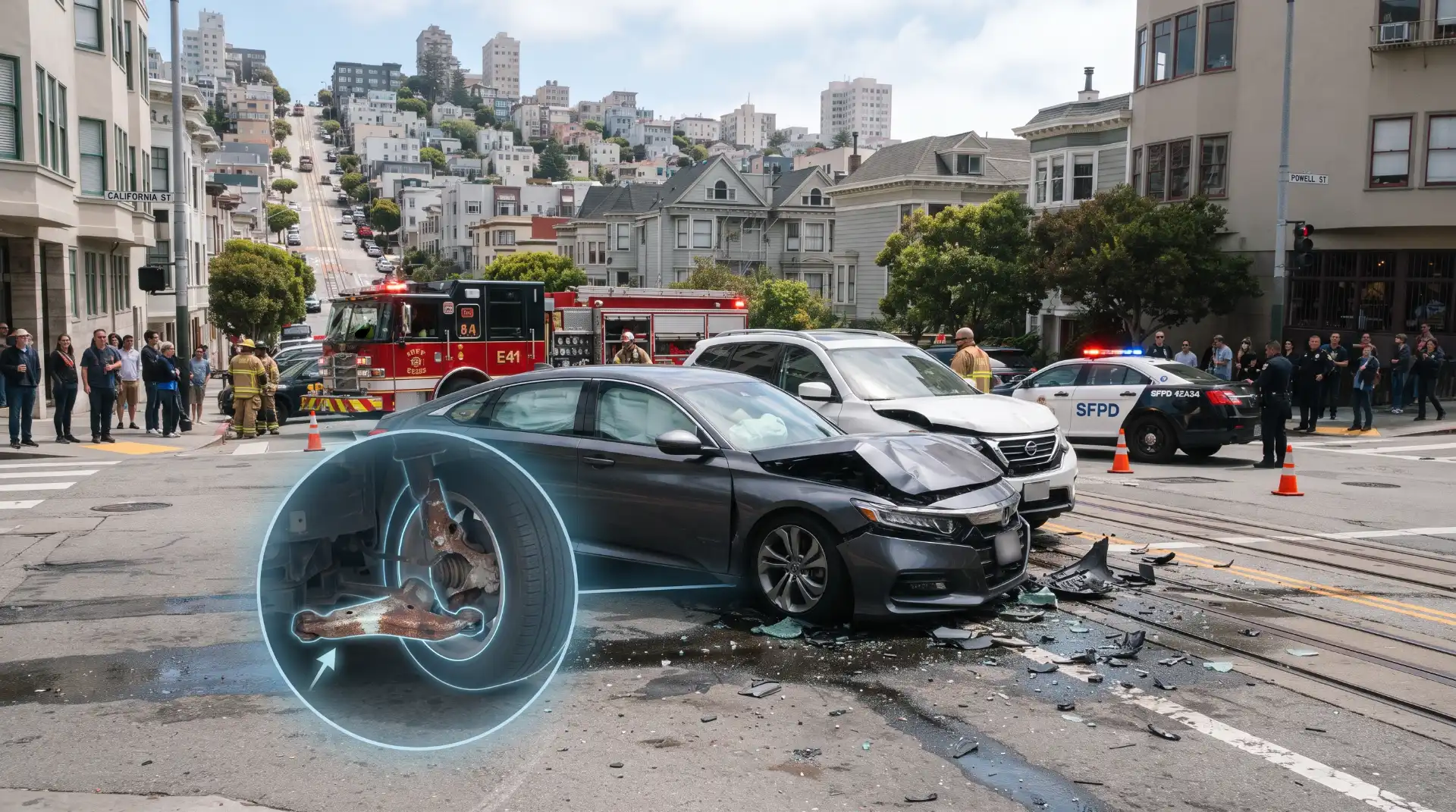
When a car accident happens in San Francisco, the first question is often whether one of the drivers made a mistake. Investigators may examine speeding, distracted driving, unsafe lane changes, following distance, impairment, traffic signals, and other forms of driver behavior. However, not every serious collision is caused by something a driver did or failed to do. Sometimes the vehicle itself may play a significant role.
A brake system can fail unexpectedly. A steering component can fracture. A tire can suffer a dangerous manufacturing problem. An electronic component can malfunction. A defective suspension component can cause a driver to lose control. A seat belt or airbag can fail to provide the protection occupants reasonably expect during a collision.
When a defective vehicle component contributes to a crash, the potential legal claim can become much more complicated than a traditional negligence case involving two motorists. The investigation may need to consider the vehicle manufacturer, a component manufacturer, a distributor, a dealership, a repair facility, an aftermarket-part supplier, or another party involved in producing, selling, maintaining, or modifying the vehicle.
California product liability law recognizes different theories involving defective products, including manufacturing defects, design defects, and inadequate warnings or instructions. Whether a particular accident supports a product liability claim depends on the evidence, the nature of the defect, causation, the injuries involved, and the applicable law.
For San Francisco drivers and passengers who suffer injuries in a collision involving a suspected vehicle defect, understanding how these cases work can help explain why preserving the vehicle and investigating its history may be so important.
What Is a Vehicle Defect?
A vehicle defect is generally a problem involving a vehicle or vehicle component that makes the product unsafe or causes it to perform in a manner that creates an unreasonable risk under the circumstances. A defect can originate during the manufacturing process, result from the design itself, or involve insufficient warnings or instructions about a foreseeable danger.
Not every mechanical failure is necessarily a legal defect. Vehicles are complex machines that experience ordinary wear over time. Brake pads wear down, tires lose tread, batteries fail, belts deteriorate, suspension components eventually require replacement, and other parts need routine maintenance.
The important question is why the component failed and whether the failure was connected to a legally recognized defect.
For example, a driver who ignores worn brake pads for thousands of miles may experience braking problems caused by ordinary maintenance issues. That situation is very different from a properly maintained vehicle whose brake component suddenly fractures because it was manufactured incorrectly.
Likewise, a tire that becomes damaged after striking a large pothole presents different issues from a tire that separates because of a manufacturing defect that existed before the crash.
This distinction is important because simply saying that a part broke does not establish that the manufacturer caused an accident. The evidence needs to show what failed, why it failed, when the failure occurred, and whether the failure contributed to the collision.
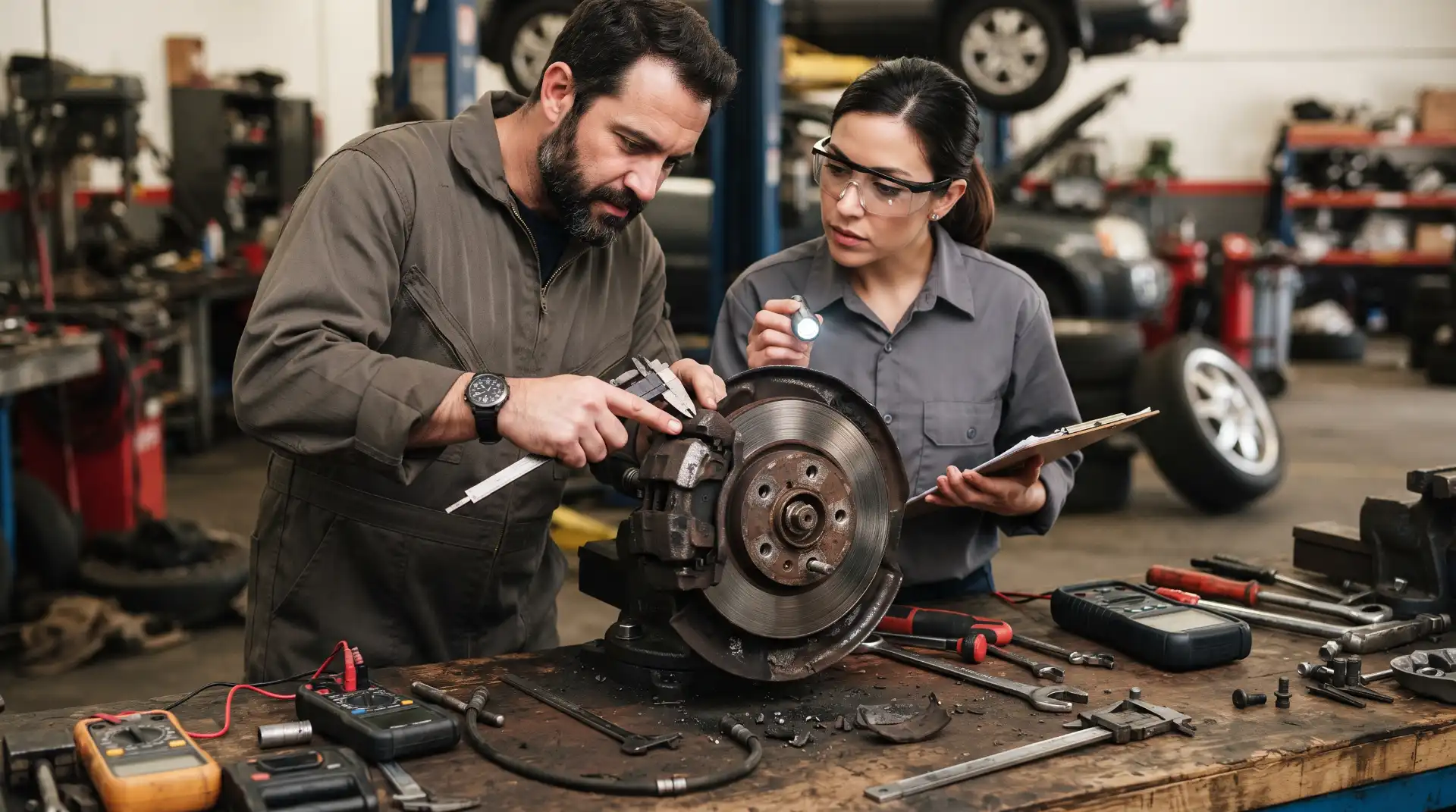
Three Major Types of Vehicle Defects
Manufacturing Defects
A manufacturing defect generally occurs when a particular vehicle or component does not conform to the manufacturer’s intended design because something went wrong during production.
Imagine that an automaker designs a steering component that should be capable of handling normal driving stresses. During manufacturing, however, a particular batch of components is improperly treated, assembled, cast, welded, or otherwise produced. One component contains a structural weakness that was not part of the intended design.
If that component later breaks during ordinary driving and causes the driver to lose control, the manufacturing process may become a central issue in the accident investigation.
Manufacturing defects can potentially involve brakes, steering systems, suspension parts, tires, wheels, electrical components, fuel-system parts, airbags, seat belts, accelerator components, and numerous other systems.
These cases can be difficult because the physical evidence may be damaged during the collision. A component that failed before impact may sustain additional damage when the vehicle strikes another object. Investigators therefore may need to determine which damage occurred before the crash and which damage occurred because of the crash.
Design Defects
A design defect is different because the problem may exist in the basic design of the product rather than in an isolated manufacturing mistake.
In a design-defect investigation, experts may examine whether the component was designed in a way that created an unreasonable safety risk and whether a safer alternative design was feasible under the circumstances.
Vehicle design cases can involve complicated engineering questions. Investigators may examine the materials used, component dimensions, placement, structural strength, interaction with other vehicle systems, foreseeable operating conditions, and potential alternative designs.
For example, a component may be manufactured exactly according to specifications but still have characteristics that create an unreasonable risk of failure under foreseeable conditions. Proving that type of claim can require extensive technical evidence and expert analysis.
Inadequate Warnings or Instructions
A vehicle or component may also create potential liability issues when users are not adequately warned about a foreseeable danger or are not provided with appropriate instructions.
Warnings can address maintenance requirements, operating limitations, installation procedures, known hazards, or other information that may affect safe use.
The absence of a warning does not automatically make a manufacturer responsible for an accident. Investigators may need to examine what danger existed, whether the manufacturer knew or should have known about the risk, whether an appropriate warning could have reduced the risk, and whether the absence of the warning was connected to the injury.
This is why a vehicle defect investigation can involve documents and communications in addition to physical examination of the vehicle.
Which Vehicle Components Can Cause Serious Crashes?
Almost any vehicle system can become relevant if its failure contributes to a collision. Some components, however, are particularly important because a sudden failure can interfere directly with the driver’s ability to control the vehicle.
Brake components are one obvious example. If a braking system unexpectedly loses effectiveness, a driver may be unable to stop before reaching stopped traffic, a pedestrian crossing, another vehicle, a building, or another obstacle.
Steering components can create another serious risk. A steering failure may cause a vehicle to drift into another lane, leave the roadway, cross into opposing traffic, or strike parked vehicles.
Tires can also play a significant role. A tire defect may contribute to tread separation, sudden air loss, a blowout, or loss of vehicle control. Investigators may need to examine the tire’s manufacturing information, age, maintenance history, inflation history, damage patterns, and condition before the collision.
Suspension components can affect stability and handling. A sudden failure may change how a vehicle responds to steering input or braking, particularly during a maneuver.
Modern vehicles also rely heavily on electronic systems. Sensors, electronic control units, cameras, communication systems, and other computerized components may affect vehicle operation and safety functions. When an electronic malfunction is suspected, investigators may need to examine diagnostic records and other available data in addition to the physical components.
Can a Manufacturer Be Liable for a San Francisco Crash?
Potentially, yes, but the mere fact that a vehicle part failed does not automatically establish manufacturer liability.
A product liability investigation generally needs to connect the alleged defect to the injury. That means investigators may need to determine whether a defect actually existed, whether it was present before the collision, whether it caused or substantially contributed to the accident, and whether the accident caused the claimed injuries.
The manufacturer may dispute one or more of these issues.
For example, a manufacturer may argue that a component was not defective and that the failure resulted from improper maintenance. It might argue that the component was damaged during the collision rather than causing it. It may contend that the vehicle was modified after purchase or that the driver operated the vehicle in a manner that caused the failure.
Other parties may also become relevant. A vehicle component may have been produced by a separate supplier. A repair shop may have installed an aftermarket component incorrectly. A previous owner may have modified the vehicle. Another driver may have contributed to the collision.
Consequently, identifying the potentially responsible party often requires an investigation rather than an assumption based on the vehicle’s brand.
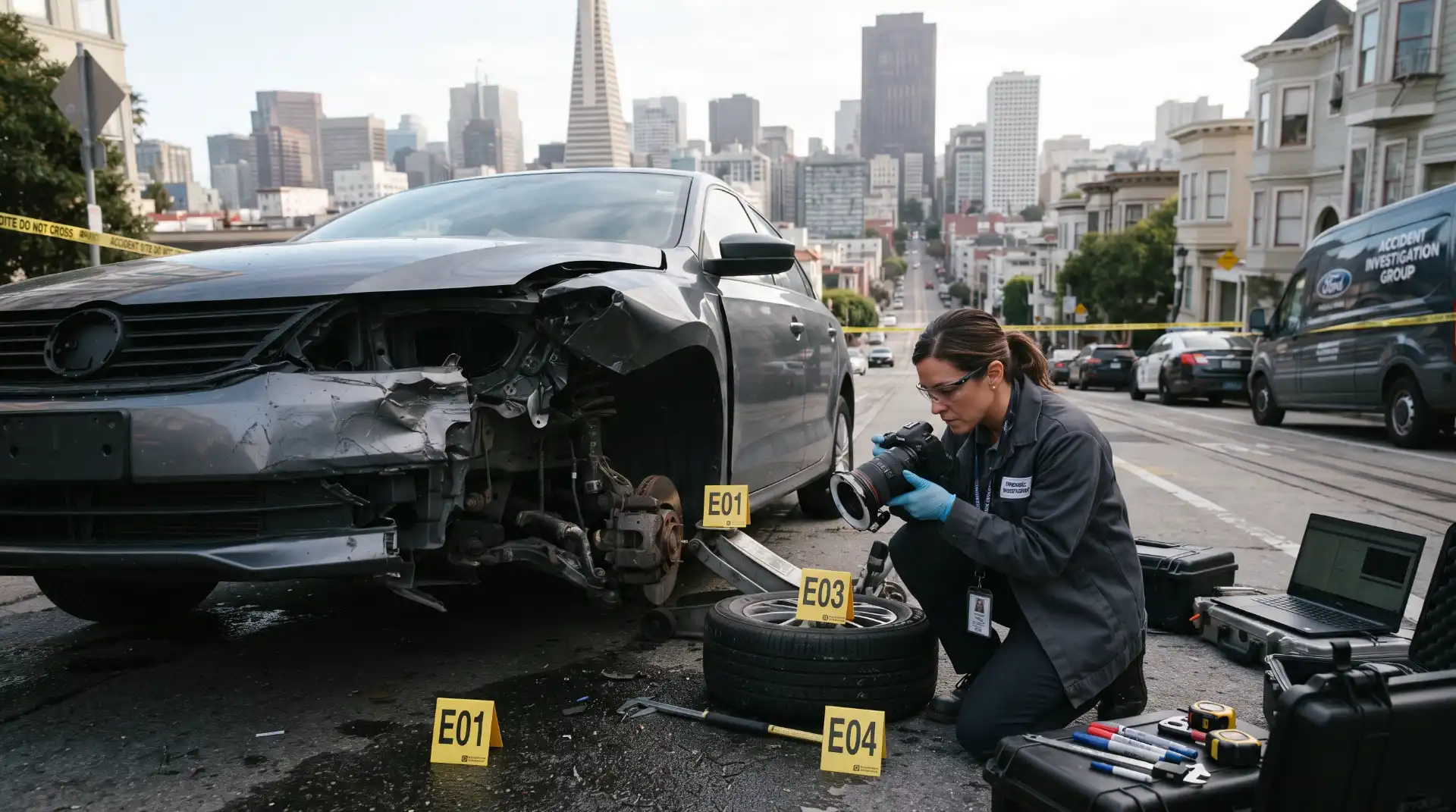
How Recalls Can Help Investigate a Suspected Vehicle Defect
A recall can be an important piece of information after a suspected vehicle defect accident.
The National Highway Traffic Safety Administration provides an online recall database that allows vehicle owners to search for safety recalls using a vehicle identification number and other information. NHTSA also maintains information concerning investigations, consumer complaints, and manufacturer communications.
Check vehicle recalls through the National Highway Traffic Safety Administration.
NHTSA explains that its recall system allows consumers to determine whether a particular vehicle has an unrepaired safety recall. The agency also explains that complaints and other safety information can contribute to investigations of potential defects.
A recall involving the same component that allegedly caused a collision can therefore provide an important investigative lead.
For example, imagine that a driver loses control after a steering component fails. Investigators later discover that the same vehicle model was subject to a recall involving premature failure of that steering component.
The recall would not automatically prove that the specific crash was caused by the defect. The individual vehicle would still need to be examined, and the accident circumstances would need to be evaluated. However, the recall could provide important evidence that the alleged problem was previously identified.
What If There Was No Recall?
The absence of a recall does not necessarily prove that a vehicle was free from defects.
NHTSA explains that consumers can submit complaints about potential safety problems and that the agency reviews complaint information to identify possible safety-defect trends. An investigation can potentially develop when available evidence suggests that a safety-related defect may exist.
This means a driver involved in an accident should not necessarily assume that there is no possible defect simply because the vehicle does not appear in a recall search.
A suspected defect may be relatively new. A manufacturer may not yet have identified the issue. A government investigation may not have been opened. Or the particular failure may involve circumstances that are not yet associated with an established recall.
Other evidence may therefore matter, including maintenance records, repair records, consumer complaints, technical information, warranty claims, photographs, expert inspections, and the condition of the failed component.
What Evidence Can Prove a Vehicle Defect?
Evidence is especially important in vehicle defect cases because the cause of a mechanical failure may not be obvious.
The vehicle itself may be the most important evidence. Investigators may need to examine the failed component, fracture surfaces, electrical systems, tires, brakes, steering components, suspension systems, warning indicators, and other parts that could explain the accident.
Photographs taken immediately after the collision can also help document the condition of the vehicle before repairs alter the evidence.
Maintenance records may show whether the vehicle received regular inspections and whether relevant components had recently been repaired or replaced. Service invoices, dealership records, warranty documents, tire receipts, brake-service records, and inspection paperwork can all provide useful information.
Vehicle identification information is also important. The VIN can help researchers identify recalls and other information associated with the specific vehicle.
Police reports, surveillance footage, dashcam recordings, witness statements, photographs, roadway evidence, and accident-reconstruction analysis can help establish what happened before the component allegedly failed.
Your site’s existing article, How to Prove Fault in a San Francisco Car Accident, provides additional information about police reports, witness evidence, photographs, medical records, and other evidence that can help establish responsibility after a collision.
Why the Damaged Vehicle Should Be Preserved
Vehicle preservation can be particularly important when a defective component may have caused the collision.
After an ordinary crash, vehicle repairs may be handled quickly through an insurance claim. In a suspected defect case, however, replacing or discarding a component before it can be examined may make it much harder to determine what happened.
Consider a driver who claims that a steering component fractured immediately before the collision. If the steering assembly is replaced before an appropriate inspection, investigators may lose the opportunity to examine the original component for fracture patterns, manufacturing evidence, corrosion, fatigue, improper assembly, or other clues.
This does not mean that every damaged vehicle must remain untouched indefinitely. It means that potential evidence should be identified and preserved when there is a reasonable basis to suspect that a mechanical or manufacturing defect contributed to a serious crash.
The same principle can apply to tires, wheels, brake components, suspension parts, electronic components, airbags, and other potentially relevant equipment.
Vehicle Maintenance Records Can Affect Liability
Maintenance history can become an important part of a vehicle defect investigation because manufacturers and insurers may question whether the vehicle was properly maintained.
A driver who can produce service records showing regular inspections and maintenance may be better positioned to explain the condition of the vehicle before the collision.
For example, suppose a vehicle’s steering component fails despite recent documented inspections and relatively low mileage. Investigators may have reason to examine whether the component itself had a defect.
On the other hand, if records show that a component was severely worn, improperly installed, modified, or left unrepaired despite warnings, the opposing side may argue that maintenance or misuse caused the failure.
The purpose of reviewing maintenance records is therefore not simply to prove that the owner took care of the vehicle. The goal is to identify the actual cause of the failure.
Can a Component Manufacturer Be Responsible?
The company whose name appears on the vehicle is not necessarily the only manufacturer involved in a vehicle defect case.
Modern vehicles contain components manufactured by many different companies. Braking systems, tires, airbags, sensors, electronic modules, steering components, suspension components, and other equipment may come from specialized suppliers.
If a component supplied by another company contains a defect, the component manufacturer may become relevant to the investigation.
This can create a complicated chain of responsibility. Investigators may need to determine who designed the part, who manufactured it, who supplied it, who distributed it, and who installed it.
The answer may also depend on whether the component was installed at the factory or added later as an aftermarket part.
What If an Aftermarket Part Failed?
Many vehicles are modified or repaired during their useful lives. Owners replace tires, brakes, wheels, suspension components, lighting equipment, exhaust components, electrical parts, and other equipment.
If an aftermarket component allegedly causes a crash, the investigation may need to consider the manufacturer of the part, the seller, distributor, installer, repair facility, or another party.
Installation can be particularly important.
A component may have been defective when it was manufactured. It may instead have been installed incorrectly. It may have been incompatible with the vehicle. It could have been modified after purchase or damaged through improper use.
Determining which explanation is supported by the evidence is essential before assigning legal responsibility.
What If a Recall Repair Was Never Completed?
A vehicle with an unrepaired recall can present a particularly important issue after a crash.
NHTSA recommends that vehicle owners check for open recalls and have qualifying recall repairs completed. According to NHTSA, recall repairs are generally performed without charge through the manufacturer’s dealership.
If an accident occurs before a known safety defect is repaired, investigators may need to determine whether the recalled problem actually contributed to the collision.
The existence of an unrepaired recall does not automatically establish liability. The recall must still be connected to the accident circumstances.
For example, a vehicle could have an airbag recall, but the crash might have been caused by an unrelated brake failure. The airbag recall would not necessarily explain why the collision occurred.
Conversely, if a recalled brake component fails and causes the driver to lose the ability to stop, the recall may become highly relevant to causation.
Can Electronic Vehicle Data Help?
Modern vehicles may contain electronic systems capable of storing information that can assist with accident reconstruction. Depending on the vehicle, investigators may examine diagnostic trouble codes, event data, warning messages, system information, or other available records.
Electronic information can sometimes help establish what occurred shortly before impact, although the type and availability of information varies considerably between vehicles.
Suppose a driver reports that the vehicle suddenly lost power before entering an intersection. An investigation may need to determine whether the vehicle actually experienced a power-system failure, whether a warning was generated, whether an electronic component malfunctioned, and whether the problem occurred before the collision.
Electronic information should generally be considered alongside physical evidence rather than treated as the only source of truth.
What Role Can Accident Reconstruction Play?
Accident reconstruction can help establish how a collision occurred and whether a suspected component failure is consistent with the physical evidence.
An accident reconstruction specialist may examine vehicle damage, roadway evidence, vehicle positions, tire marks, debris, photographs, video footage, electronic information, and mechanical evidence.
The reconstruction may attempt to establish vehicle speeds, movement patterns, steering inputs, braking behavior, impact sequence, and other factors relevant to causation.
This can be particularly useful when a manufacturer argues that the component failed because of the crash rather than causing the crash.
For example, a manufacturer might argue that a suspension component fractured when the vehicle struck another car. The injured driver might contend that the component fractured first and caused the driver to lose control.
The distinction can be critical.
Physical evidence and reconstruction may help determine which sequence is more consistent with the available evidence.
What If Another Driver Also Caused the Accident?
A vehicle defect does not necessarily mean another driver had no role in the collision.
Consider a situation in which a defective steering component causes a vehicle to drift into another lane, while the other motorist is traveling too fast to stop safely. Both factors may contribute to the final collision.
California’s comparative fault principles can make allocation of responsibility important in cases involving multiple contributing causes.
Your site’s article How to Prove Fault in a San Francisco Car Accident discusses comparative fault and the types of evidence that can be used when responsibility for a collision is disputed.
The existence of a product defect therefore does not automatically eliminate other forms of liability. An investigation may need to evaluate all contributing causes rather than focusing on a single explanation.
How San Francisco’s Streets Can Make Mechanical Failures Especially Dangerous
San Francisco has a distinctive driving environment that can make sudden vehicle-control problems particularly dangerous.
The city’s streets include steep grades, dense traffic, narrow roadways, frequent intersections, transit routes, bicycle infrastructure, pedestrian crossings, parked vehicles, delivery activity, and complicated connections to major highways.
A mechanical problem that might be manageable on a relatively empty road can become much more dangerous when it occurs on a steep urban street surrounded by pedestrians, cyclists, parked vehicles, and moving traffic.
A brake failure approaching a busy intersection can leave a driver with very little time to respond. A steering failure on a narrow roadway can quickly place the vehicle into the path of another road user.
These environmental factors do not automatically create manufacturer liability, but they can affect the sequence of events and severity of a particular collision.
What Should You Do After a Suspected Vehicle Defect Accident?
The first priority after any collision is safety. If someone is seriously injured, emergency medical assistance should be requested immediately. Drivers should also avoid creating additional danger by remaining in active traffic lanes when it is possible and safe to move away from traffic.
Once immediate safety concerns have been addressed, preserving evidence can become important.
Photographs should document vehicle damage, the roadway, traffic controls, debris, tire condition, visible mechanical damage, vehicle positions, and other relevant conditions when it is safe to do so.
If a mechanical failure is suspected, the vehicle should not automatically be discarded, sold, dismantled, or repaired without considering whether potentially important evidence needs to be preserved.
Drivers should also keep maintenance records, repair invoices, dealership communications, warranty documents, recall notices, photographs, dashcam footage, and insurance information.
Medical treatment should also be documented. Injuries after a crash may not always be immediately apparent, and medical records can help establish the nature, severity, treatment, and progression of accident-related injuries.
For a broader post-crash checklist, readers can visit your existing guide, What to Do After a Car Accident in San Francisco: A Step-by-Step Guide.
Why Medical Documentation Matters in Vehicle Defect Claims
A product liability claim is not limited to proving that a vehicle contained a defective component. An injured person must also be able to establish the injuries and losses associated with the collision.
Medical records can document emergency treatment, diagnostic testing, physician evaluations, physical therapy, medication, surgery, rehabilitation, and other care related to the accident.
They may also help establish whether injuries are consistent with the mechanics of the collision.
For example, a high-impact crash involving sudden loss of vehicle control could result in orthopedic injuries, traumatic brain injuries, spinal injuries, fractures, internal injuries, or other serious conditions.
Some injuries may require months or years of treatment. A serious injury may also affect a person’s ability to work or participate in normal activities.
The medical component of the case should therefore be investigated alongside the mechanical and accident evidence.
What Damages Could Be Available?
The damages available in a vehicle defect case depend on the circumstances and the claims that can be established.
Economic losses can include reasonable medical expenses, rehabilitation costs, prescription expenses, lost wages, reduced earning capacity, vehicle damage, and other measurable financial losses associated with the accident.
A serious injury can produce significant future expenses. Someone who requires ongoing physical therapy, surgery, medical equipment, or long-term assistance may face costs well beyond the initial emergency treatment.
Non-economic damages may also be relevant in appropriate California personal injury claims. These can include physical pain, emotional distress, loss of enjoyment of life, and other consequences associated with serious injuries.
The amount potentially recoverable depends on liability, causation, insurance coverage, medical evidence, the nature of the injuries, and other case-specific factors.
What If the Manufacturer Says the Vehicle Was Properly Designed?
Manufacturers may defend vehicle defect claims by arguing that the vehicle or component complied with its intended specifications.
That argument can be particularly relevant in manufacturing-defect cases, where the investigation may need to determine whether the individual component differed from the intended design.
In a design-defect case, the manufacturer may instead argue that the design was reasonably safe or that the alleged alternative design was not feasible or would create different risks.
Other defenses can involve misuse, modification, maintenance, ordinary wear, accident damage, or other causes.
These arguments demonstrate why a vehicle defect case should be based on technical evidence rather than assumptions.
Why Expert Inspection Can Be Important
Mechanical failures are often difficult for non-experts to evaluate.
A damaged component may appear broken without revealing why it broke. A fracture may have resulted from fatigue, impact, corrosion, manufacturing problems, improper installation, excessive stress, or another cause.
An appropriate expert may be able to analyze the component and determine whether the physical evidence is consistent with a pre-impact defect.
Experts may also compare the failed component with manufacturer specifications, industry standards, similar components, recall information, service records, and accident-reconstruction evidence.
In serious cases, this type of technical analysis can become an important part of establishing causation.
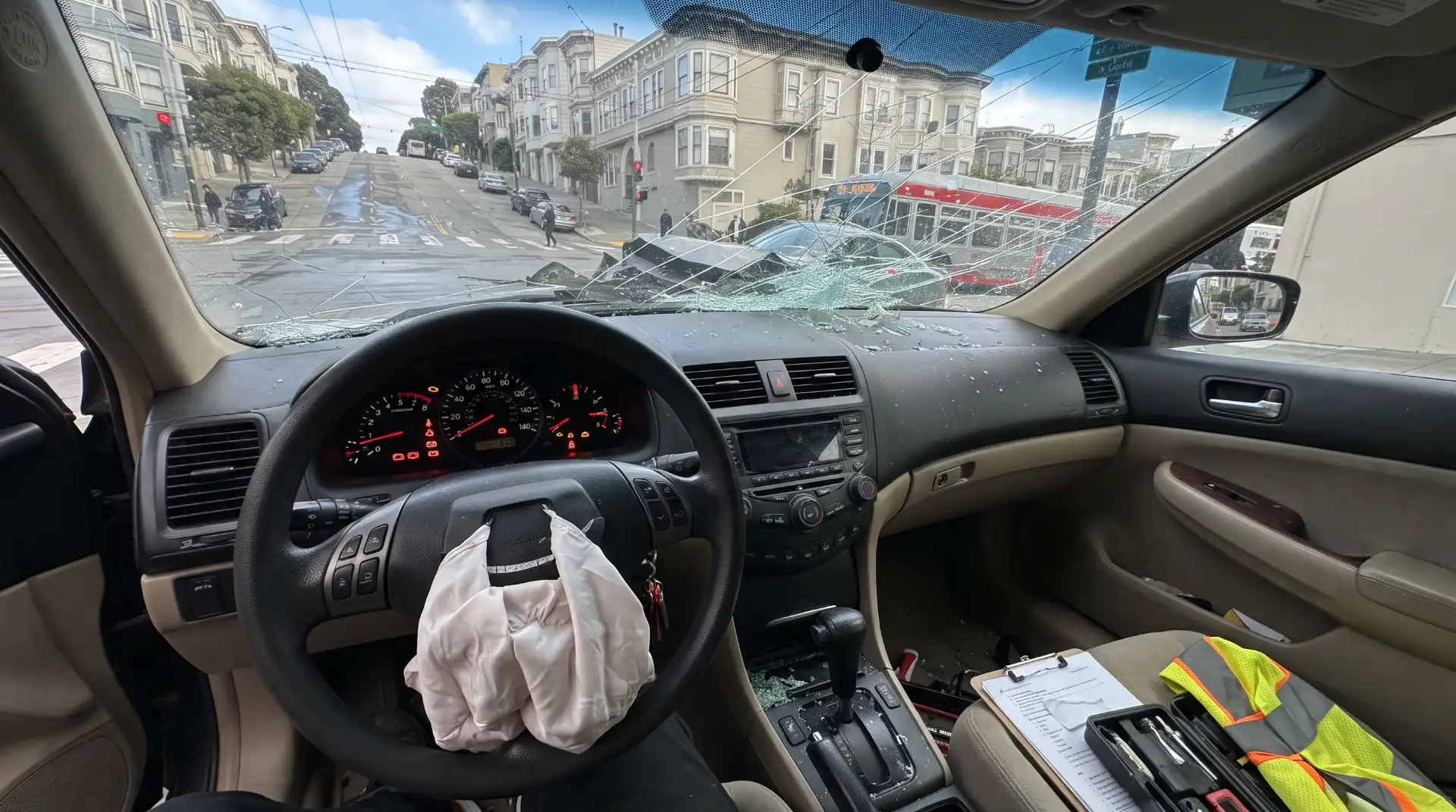
Can a Defective Vehicle Injure Someone Who Does Not Own It?
Yes, a defective vehicle can potentially injure people who have no ownership relationship with the vehicle.
Consider a vehicle whose steering system suddenly fails and causes it to cross into opposing traffic. The occupants of the other vehicle may suffer serious injuries even though they never purchased, operated, or maintained the defective vehicle.
Pedestrians and cyclists could also potentially be injured if a defective component causes a vehicle to leave the roadway or lose control.
This means that product liability investigations are not necessarily limited to the person who purchased the vehicle.
The key issue is whether the alleged defective product caused the injury under the applicable legal standards and circumstances.
What If a Vehicle Is Sold Used?
A used vehicle can still raise defect questions.
Changing ownership does not necessarily change the history of a vehicle’s design or manufacturing problems. A used vehicle may remain subject to a safety recall, and its maintenance and repair history can become relevant after an accident.
Investigators may need to establish when the vehicle was manufactured, when it was purchased, what repairs were performed, whether components were replaced, whether modifications were made, and whether relevant safety information was available.
A used vehicle’s age and mileage can also be important when evaluating whether a particular component failed because of ordinary wear or because of a defect.
What If the Vehicle Was Recently Repaired?
A recent repair can create another potential avenue of investigation.
If a vehicle underwent repairs shortly before the collision, investigators may need to determine whether the repair was performed correctly and whether the component that failed was recently installed or serviced.
For example, if a newly installed brake component fails shortly after installation, the investigation may need to consider whether the component was defective or whether the installation was improper.
Repair records, invoices, parts information, photographs, and communications with the repair facility can help establish what work was performed.
This illustrates why vehicle defect cases can involve several potentially responsible parties rather than only the original vehicle manufacturer.
Why Recall Research Should Go Beyond a Simple Search
A VIN recall search is an important starting point, but it may not answer every question about a suspected defect.
NHTSA maintains information about recalls, investigations, complaints, and manufacturer communications. Its safety-defect investigation resources explain that potential safety problems can come from manufacturers, consumers, law enforcement, media reports, and other sources.
Investigators may therefore need to examine whether the suspected problem appears in complaints, technical communications, investigations, or other records even if there is no current recall associated with the particular vehicle.
Recall research should also be matched against the exact component that allegedly failed.
A recall involving an unrelated safety system may have little relevance to the cause of a particular crash.
The strongest investigation connects the recall or safety information to the physical evidence and circumstances of the accident.
How Insurance Companies May Approach Vehicle Defect Claims
Insurance claims involving vehicle defects can become more complicated than ordinary two-car collisions.
An insurance company may initially investigate the accident as a standard driver-negligence claim. If evidence later indicates that a mechanical failure may have caused the collision, additional parties may need to be considered.
Insurance representatives may ask questions about vehicle maintenance, repairs, modifications, prior accidents, mileage, and the condition of the vehicle before the collision.
Because these questions can affect potential liability, accident victims should be careful about making unsupported conclusions about why a component failed.
It is generally better for the physical evidence and qualified investigation to establish the cause rather than relying on speculation.
Why Preserving Digital and Physical Evidence Matters
Evidence can disappear quickly after a collision.
Security-camera footage may be overwritten. Dashcam recordings can be replaced by newer footage. Vehicle components can be discarded during repairs. Electronic information may become harder to retrieve. Witnesses can forget details.
That makes early evidence preservation particularly important in complicated vehicle defect cases.
Photographs of the vehicle should be preserved in their original form when possible. Relevant videos should also be saved before they are overwritten.
Maintenance and repair documents should be retained rather than discarded after an insurance claim is resolved.
When a vehicle itself may contain critical evidence, its preservation can become one of the most important early considerations in the case.
When Should You Talk With a San Francisco Auto Accident Attorney?
A legal consultation may be particularly useful when a serious collision appears to involve a sudden mechanical failure or a suspected defective component.
Examples can include unexplained brake failure, sudden steering failure, tire separation, unexpected acceleration, defective airbags, seat-belt failures, repeated unexplained mechanical problems, or a component that fails despite appropriate maintenance.
A consultation may also be appropriate when a vehicle is subject to a recall involving the same component suspected of causing the crash.
The purpose of an investigation is not simply to identify a company to sue. It is to determine what caused the accident and whether the available evidence supports a legally recognized claim.
That process may involve examining the vehicle, reviewing maintenance records, researching recalls and complaints, identifying component suppliers, consulting technical experts, reviewing accident evidence, and determining which legal theories may apply.
San Francisco Vehicle Defect Accidents and Manufacturer Liability
San Francisco vehicle defect accidents can involve a significantly different legal analysis from ordinary collisions caused exclusively by driver negligence.
A defective brake, tire, steering component, suspension system, electronic component, airbag, seat belt, or other vehicle part may potentially contribute to a serious crash. When that happens, the investigation may need to look beyond the drivers and examine the vehicle’s design, manufacturing, maintenance, repair history, and safety information.
A manufacturer may potentially face liability when a legally recognized product defect causes injury, but the mere existence of a failed component does not automatically establish responsibility. Investigators must determine why the component failed and whether that failure actually caused or substantially contributed to the collision.
Recall information can provide an important investigative lead. NHTSA provides consumers with tools to search for recalls and safety information using a vehicle’s VIN and other identifiers. NHTSA also accepts complaints about suspected safety defects and conducts investigations into potential safety problems.
For anyone involved in a serious collision, preserving the vehicle, documenting the accident, maintaining repair records, checking recall information, obtaining appropriate medical care, and preserving photographs and other evidence can all help protect important information about what happened.
Ultimately, the critical question is not simply whether a vehicle part broke. The more important questions are what caused the component to fail, whether the failure occurred before the collision, whether the vehicle was properly maintained, whether the component was defective, and whether that defect contributed to the injuries.
When the evidence points toward a defective product, responsibility may extend beyond the driver initially believed to be at fault. The potentially responsible parties could include the vehicle manufacturer, component manufacturer, distributor, repair facility, installer, another motorist, or several parties whose actions contributed to the final collision.
A careful investigation can help separate ordinary vehicle wear from a genuine product defect and can help determine whether the circumstances support a California product liability or personal injury claim.
This article is intended for general informational purposes and does not constitute legal advice. California product liability and personal injury claims are fact-specific, and applicable deadlines and legal requirements can vary. Anyone seriously injured in a vehicle accident should consider consulting a qualified California attorney regarding the specific facts of the case.