
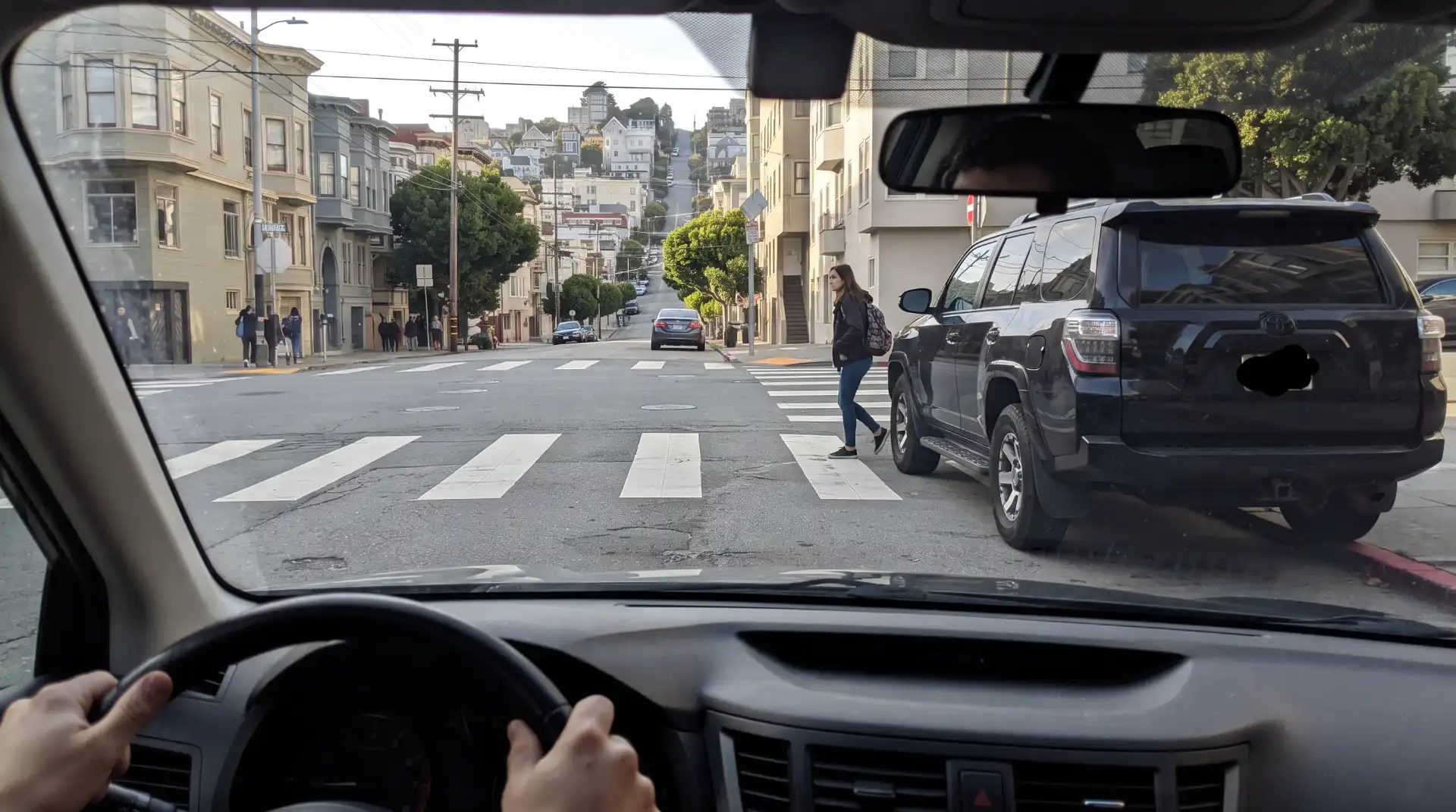
At an urban intersection, a few feet of visibility can make an enormous difference. A driver approaching a crosswalk may have only seconds to notice a pedestrian stepping from the curb, a cyclist entering the intersection, or another vehicle beginning a turn. When a parked SUV, delivery van, construction barrier, or other obstruction blocks that view, those seconds can disappear.
San Francisco is addressing this problem through an increasingly visible street-safety strategy known as daylighting. The idea is straightforward: keep the area immediately before a crosswalk clear so people driving and people crossing the street can see each other sooner.
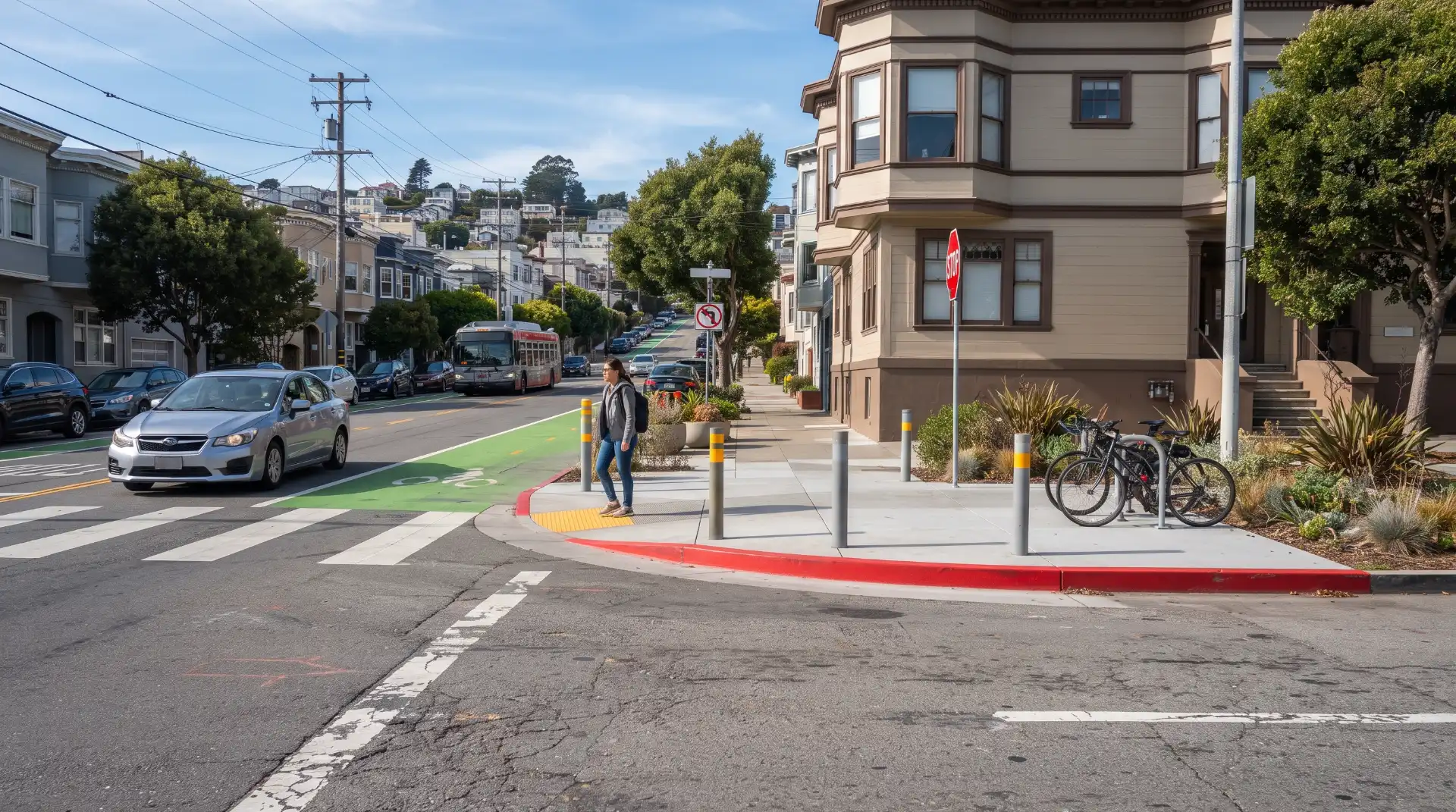
California expanded this concept statewide through Assembly Bill 413. Beginning January 1, 2025, California law generally prohibits stopping, standing, or parking within 20 feet of the vehicle-approach side of a marked or unmarked crosswalk. The distance is generally 15 feet where a curb extension is present. The rule appears in California Vehicle Code §22500(n).
San Francisco has gone further by systematically converting many of these spaces into red-curb daylighting areas and, in 2026, expanding a new Safety Zone Program that can use paint, concrete elements, bicycle parking, turn-safety improvements, planters, and other treatments to keep corners clear.
These changes are primarily about prevention. But they also create important questions after a collision.
If a parked vehicle blocked a driver’s view, who may be responsible? Does illegally parking near a crosswalk automatically make the parked vehicle’s owner liable? Can a driver still be at fault if the pedestrian was hidden until moments before impact? And what happens when several factors combine to cause the same crash?
Understanding those questions requires looking beyond the parking violation itself and examining how visibility affected the collision.
What Is Daylighting at an Intersection?
Daylighting means removing visual obstructions near a crosswalk or intersection so road users have a clearer view of one another.
Imagine a pedestrian waiting to cross beside a large pickup truck parked almost to the corner. From the driver’s seat of an approaching car, the pedestrian may be completely hidden behind the truck. The pedestrian may have the same problem: to see approaching traffic, the person may need to move farther toward the roadway.
Removing the parked truck from the area immediately before the crosswalk creates an open line of sight.
The San Francisco Municipal Transportation Agency explains that daylighting improves intersection safety by keeping parked vehicles away from crosswalk approaches, allowing drivers and pedestrians to see each other more clearly. SFMTA plans to daylight intersections throughout San Francisco as part of its citywide implementation of California’s law.
For more information, readers can visit the authoritative SFMTA Daylighting page.
The principle is simple, but San Francisco’s dense streets make it especially relevant. The city combines closely spaced intersections, hills, parked vehicles, delivery activity, transit vehicles, bicycle traffic and heavy pedestrian movement. A corner that provides adequate visibility when empty can become much more difficult to navigate when a large vehicle occupies the space closest to the crosswalk.
How California’s Daylighting Law Works
California’s daylighting rule is contained in Vehicle Code §22500(n).
In most situations, drivers may not stop, stand or park within 20 feet of the vehicle-approach side of a marked or unmarked crosswalk. Where a curb extension exists, the standard distance is generally 15 feet.
A marked crosswalk is easy to recognize because pavement markings identify the crossing. An unmarked crosswalk can be less obvious, but California law recognizes crosswalks at many intersections even when painted lines are absent.
The rule also matters even when the curb has not yet been painted red.
SFMTA states that California’s statewide restriction applies even where there is no red curb. San Francisco is nevertheless painting many daylighting areas because a clearly marked red curb makes the restriction easier for drivers to recognize and helps preserve the intended visibility.
Drivers who want to review the statutory language can consult California Vehicle Code §22500 through the California Legislature.
The law also permits some local variation. A local authority can establish a different distance when statutory requirements are satisfied and the area is appropriately marked.
For someone investigating a collision, this means the correct daylighting distance should be determined based on the actual intersection rather than assuming every corner uses exactly the same configuration.
Why Blocked Sightlines Can Cause Serious Intersection Crashes
Visibility affects almost every stage of driving.
Before turning right, a motorist must identify pedestrians and cyclists approaching or entering the crossing. Before proceeding from a stop sign, a driver must evaluate traffic traveling along the intersecting street. A pedestrian preparing to cross needs enough visibility to judge whether approaching vehicles are slowing.
An obstruction can delay that information.
Suppose a driver approaches an intersection at a reasonable speed but a large delivery van is parked very close to the crosswalk. A pedestrian begins crossing from behind the van. Neither person sees the other until the pedestrian has moved into the travel lane.
The resulting collision may happen within seconds.
That does not automatically determine who is legally responsible. Investigators must still consider speed, attention, right-of-way, driver reaction, pedestrian behavior and other circumstances.
But the obstructed sightline can become an important part of explaining why the danger was not detected earlier.
Similar problems can occur with cyclists. A driver turning across a bicycle’s path may not see the cyclist until the vehicle begins entering the intersection. A cyclist may also have difficulty seeing a vehicle approaching from the side.
Even two motorists can experience the problem where parked vehicles limit the view across an intersection.
Does a Blocked View Excuse a Driver From Responsibility?
Usually, a blocked view is not the end of the analysis.
Drivers must use reasonable care under the conditions they encounter. When visibility is limited, that may require slowing down, carefully observing the roadway and being prepared for pedestrians or other traffic that could emerge from behind the obstruction.
California Vehicle Code §21950 requires motorists approaching pedestrians within marked or unmarked crosswalks to exercise due care and take appropriate action to protect pedestrian safety.
Therefore, a driver generally cannot assume that because a parked vehicle blocked the corner, responsibility automatically shifts to someone else.
Investigators may ask whether the driver recognized that visibility was limited. They may examine whether the vehicle slowed before reaching the crosswalk, whether the driver was distracted, whether the vehicle was traveling too fast for the conditions, and whether additional time existed to react.
This becomes particularly important on streets with hills, closely parked vehicles or heavy pedestrian activity.
A driver who cannot see around an obstruction may need to approach more cautiously rather than proceeding as though the intersection is clear.
Can an Illegally Parked Vehicle Affect Crash Liability?
Potentially, but a parking violation alone does not automatically establish responsibility for another person’s collision.
The important question is whether the illegally parked vehicle actually contributed to the crash.
Consider a car parked within a daylighting area immediately beside a crosswalk. If photographs and video show that the vehicle completely blocked the driver’s view of a pedestrian until moments before impact, the parking violation may become relevant to the causation analysis.
Investigators could examine the parked vehicle’s size, exact location, distance from the crosswalk and relationship to the driver’s sightline.
Now consider a different situation. A vehicle may be illegally parked near the same intersection, but the collision happens because an approaching motorist runs a red light from another direction. If the parked vehicle did not interfere with anyone’s ability to see or react, the parking violation may have little connection to the crash itself.
This distinction matters.
Traffic violations can provide useful evidence, but civil liability generally requires more than showing that someone technically violated a rule. The evidence must connect the conduct to the accident and resulting harm.
More Than One Person May Share Fault
Blocked-sightline crashes often involve several overlapping factors.
A driver may approach too quickly. A vehicle may be illegally parked close to the crosswalk. A pedestrian may move into traffic without enough time for an approaching motorist to react. Another vehicle may obscure the traffic signal. A delivery truck may be temporarily stopped where visibility is poor.
California uses comparative fault principles, meaning responsibility can potentially be divided when multiple parties contribute to a collision.
The percentage assigned to each person depends on the evidence and the specific circumstances.
For example, investigators might determine that a driver should have slowed because the intersection was visibly obstructed, while also examining whether another person’s conduct contributed to creating the hazard.
The presence of several possible contributing causes makes strong evidence especially important.
Readers interested in this issue can also review the site’s existing guide, How to Prove Fault in a San Francisco Car Accident.
San Francisco’s New Safety Zone Program
San Francisco’s approach to daylighting continued evolving in 2026.
On June 17, 2026, SFMTA announced its Safety Zone Program, designed to build upon state-mandated daylighting. Instead of treating every cleared corner as merely an empty no-parking area, the city can reinforce selected locations with physical and visual treatments.
According to SFMTA, possible Safety Zone features include painted areas, turn-safety treatments, bicycle corrals and concrete elements. The city’s Community Corners initiative can also allow eligible neighborhood organizations to add murals and planters under program requirements.
SFMTA reported in June 2026 that approximately 65 percent of state-mandated daylighting areas had already been installed across the city and that more than 2,300 intersections near schools had been completed. The agency also said it would prioritize enhanced Safety Zones at locations such as the High Injury Network, intersections with pedestrian-collision histories and areas near schools and senior centers.
These improvements serve an important purpose beyond parking regulation.
A painted curb may tell drivers not to park, but physical treatments can make it harder for a vehicle to occupy the space in the first place. That helps protect the open sightline the daylighting rule is intended to create.
How Investigators Determine Whether Visibility Caused a Crash
Determining whether a blocked sightline contributed to a collision often requires reconstructing what each road user could actually see.
A photograph taken from the sidewalk may not answer that question.
The driver’s eye position inside the vehicle may be several feet lower than the camera angle used by someone standing nearby. A pedestrian may also experience a very different line of sight than a person photographing the intersection from across the street.
For this reason, useful accident-scene documentation often includes photographs taken from approximately the driver’s viewpoint.
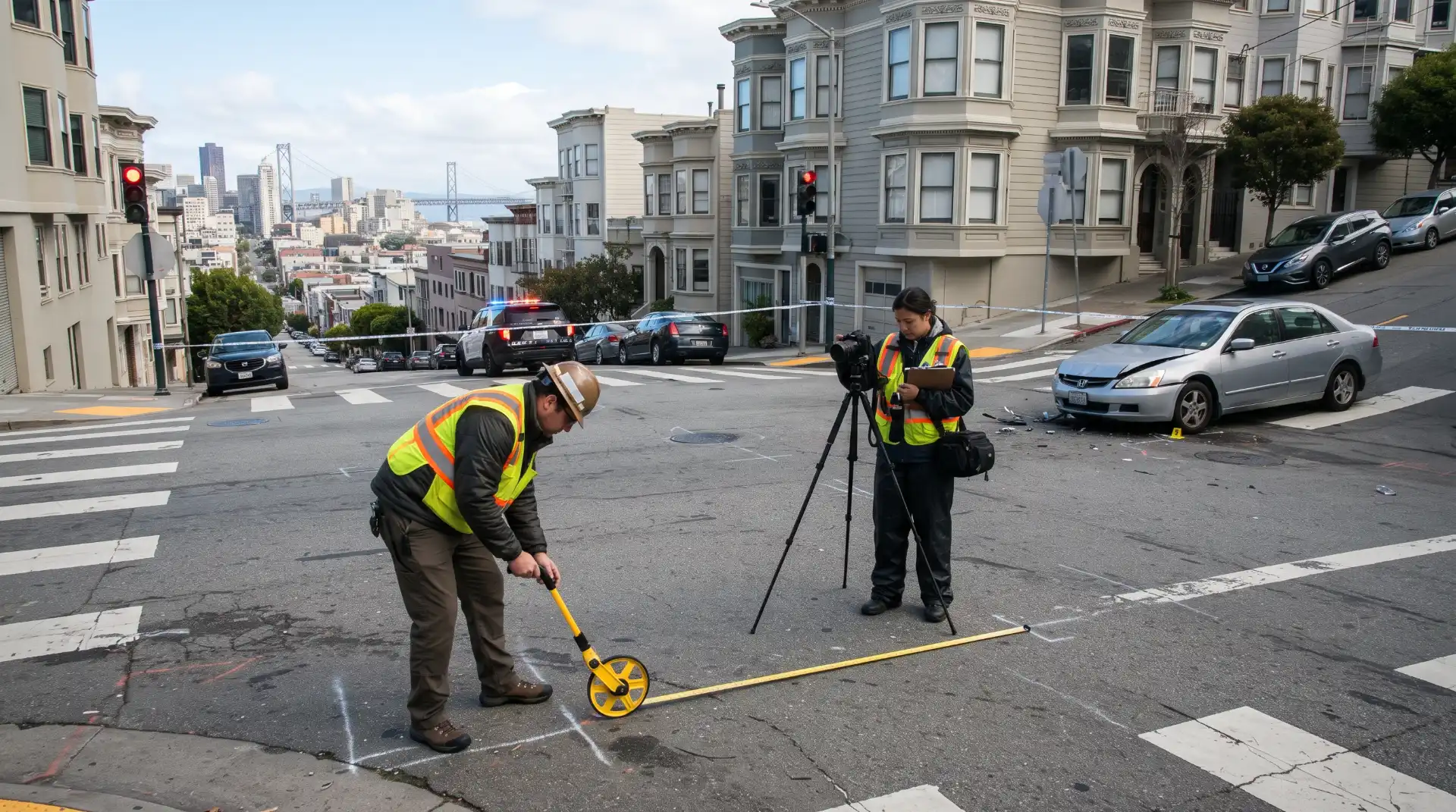
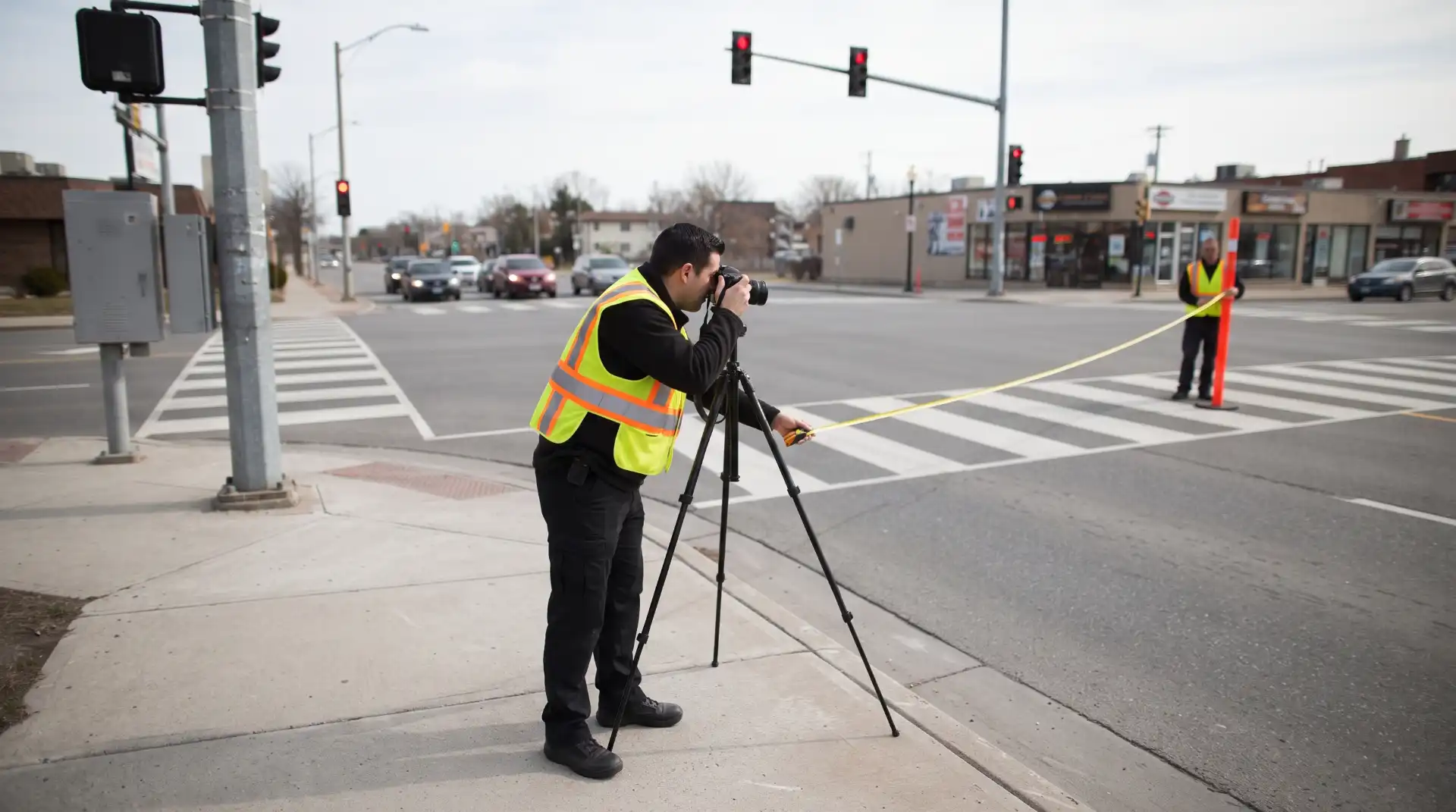
Investigators may measure the distance between the obstruction and the crosswalk, the height and width of the parked vehicle, the driver’s approach angle and the point where the pedestrian or cyclist would first have become visible.
They may also evaluate the roadway grade.
This is especially relevant in San Francisco. A hill can change how soon one road user becomes visible to another. The angle of a parked vehicle, a curb extension or a sloped intersection can further alter sight distance.
Accident reconstruction professionals may use these measurements to estimate perception time, reaction time and the amount of distance available for braking.
Photographs Taken Immediately After the Crash Can Be Critical
Sightline evidence can disappear quickly.
The SUV blocking the corner may leave before police arrive. A delivery truck might move within minutes. Construction equipment could be repositioned. Temporary signs may be removed. A loading vehicle could depart before anyone realizes its position mattered.
That makes early photographs valuable.
Someone documenting the scene should, when it is safe to do so, capture both close and wide views. Photos showing the exact position of parked vehicles relative to the crosswalk may later help establish whether visibility was restricted.
Photographs looking toward the intersection from the direction each road user traveled can be particularly helpful.
The site’s Step-by-Step Guide After a San Francisco Car Accident contains additional information about documenting an accident scene and preserving evidence.
Video May Show More Than the Collision Itself
San Francisco intersections may be surrounded by businesses, apartment buildings, parking structures, private security cameras, dashcams and transit vehicles.
Video can be valuable even if it does not capture the moment of impact.
For example, footage from several minutes earlier may show a delivery van arriving and parking near the crosswalk. Another camera might establish how long the obstruction remained there. Video could also show a driver’s approach speed or whether a pedestrian hesitated before entering the roadway.
These details can help reconstruct the visibility conditions before the crash.
Because surveillance systems may overwrite older recordings, potentially relevant footage should be identified as soon as reasonably possible.
Traffic Controls and Street Design Also Matter
A blocked sightline is sometimes only one part of a larger intersection-safety problem.
Investigators may need to evaluate stop signs, traffic signals, crosswalk placement, curb extensions, bicycle lanes, parking configuration, street lighting and turn geometry.
Suppose a crosswalk sits beside a large curb extension that already moves pedestrians farther into the driver’s field of view. The visibility analysis could be different than at a traditional corner.
Similarly, a protected bicycle lane may position cyclists differently from ordinary mixed traffic.
The goal is to understand the intersection as it actually existed when the collision occurred.
SFMTA’s continuing daylighting work means those conditions can also change over time. Photographs taken months later may show a newly painted red curb, planter or concrete element that was not present on the accident date.
For that reason, contemporary evidence is generally more useful than assuming today’s layout matches the earlier configuration.
What About Construction, Vegetation or Other Obstructions?
Daylighting law focuses heavily on parked vehicles, but blocked sightlines can have many other causes.
Construction fencing may limit visibility. Temporary traffic-control equipment can obstruct a corner. Trees or vegetation may interfere with a driver’s view. A parklet or other street feature may affect what road users can see.
Each situation requires its own analysis.
The important questions remain similar: What blocked the view? Who controlled or created the obstruction? Was it foreseeable that the condition could interfere with visibility? Did the obstruction actually contribute to the collision?
When a government entity or public roadway condition becomes part of the case, different legal rules and claim procedures can apply. Public-entity claims are therefore different from ordinary disputes between private motorists and may involve shorter procedural deadlines.
Why Pedestrians Are Central to Daylighting
Although daylighting can benefit motorists and cyclists, pedestrian visibility is one of its primary purposes.
California law requires drivers to yield to pedestrians crossing within marked or unmarked crosswalks and to use due care when approaching them.
Visibility helps make compliance possible.
When corners are clear, motorists can see pedestrians sooner. Pedestrians can also see approaching traffic without moving farther into the street merely to look around a parked vehicle.
This is particularly important for children, older pedestrians and people using mobility devices, whose height or movement speed may make visibility challenges more significant.
San Francisco specifically prioritized daylighting around schools before expanding the work citywide. SFMTA reported that its school daylighting effort focused on intersections within approximately 600 feet of public schools.
A Red Curb Does Not Replace Careful Driving
One risk of roadway safety improvements is assuming that infrastructure removes all responsibility from road users.
It does not.
A daylighted intersection can improve visibility, but drivers must still watch for pedestrians, cyclists and approaching traffic. Pedestrians should still observe traffic conditions. Cyclists must remain alert to turning vehicles.
Likewise, a blocked daylighting zone does not mean a collision is inevitable.
The central legal question after a crash remains whether each involved person acted reasonably under the circumstances and whether their conduct contributed to what happened.
Daylighting simply changes one important part of those circumstances: what people could reasonably see.
What to Document After a Blocked-Sightline Crash
After obtaining necessary medical assistance and addressing immediate safety concerns, documenting the visibility conditions can be particularly valuable in this type of accident.
Useful evidence may include photographs from the driver’s direction of travel, the position of any parked vehicle or obstruction, the crosswalk, curb markings and surrounding traffic controls.
If possible, photograph the entire intersection before vehicles or temporary obstructions move.
Witnesses may also provide valuable information. Someone standing at a bus stop or nearby business may have seen how long a truck was parked near the corner or whether the driver slowed before entering the intersection.
Police reports, nearby video, dashcam recordings and electronic vehicle information may later help create a more complete picture.
Why Daylighting Evidence Could Become More Important in 2026
San Francisco is changing thousands of corners as it continues its citywide daylighting program.
SFMTA states that its goal is to daylight all remaining city intersections by the end of 2026. The Safety Zone initiative introduced in June adds another layer by reinforcing selected locations where collision data or surrounding conditions indicate a greater safety need.
As these changes become more familiar, drivers may also become more aware that the area immediately before a crosswalk is intended to remain open.
That could make visibility conditions easier to identify and document after a collision.
An investigator may be able to compare the actual scene against the intended daylighting configuration and determine whether a vehicle or other object occupied space that should have remained clear.
Still, the existence of a daylighting violation should not be treated as automatic proof of crash liability.
Fault depends on the complete sequence of events.
How Blocked Sightlines Ultimately Affect Crash Fault
Daylighting is based on a simple transportation principle: people are safer when they can see one another before their paths intersect.
When that visibility disappears, the possibility of a crash can increase.
From a liability perspective, however, the analysis is rarely as simple as identifying the object that blocked the view.
Investigators need to determine how the obstruction affected each person’s ability to perceive the danger, whether the approaching driver adjusted for restricted visibility, whether the pedestrian or cyclist had an opportunity to see traffic and whether any traffic law violations contributed to the collision.
A parked vehicle may be relevant. So may speed, distraction, right-of-way, intersection design, signal timing or roadway conditions.
California’s comparative-fault system allows these different factors to be considered together rather than forcing every accident into an all-or-nothing determination.
For readers who want a broader explanation of California collision liability, see San Francisco Auto Accidents: Understanding Your Legal Rights.
Final Thoughts
California’s daylighting law and San Francisco’s expanding Safety Zone Program are changing how city intersections look and function.
Keeping the approach to a crosswalk open can provide drivers, pedestrians and cyclists with the additional visibility they need to recognize potential conflicts earlier.
When that space becomes obstructed and a collision occurs, the blocked sightline may become important evidence in determining fault.
The strongest investigation does not focus on one parking violation alone. It reconstructs the entire scene: where everyone was positioned, what each person could see, how fast the vehicles were moving, what traffic controls were present and whether additional conduct contributed to the crash.
As San Francisco continues daylighting intersections throughout 2026, understanding the relationship between visibility and accident liability will become increasingly useful for anyone navigating the city’s streets.