
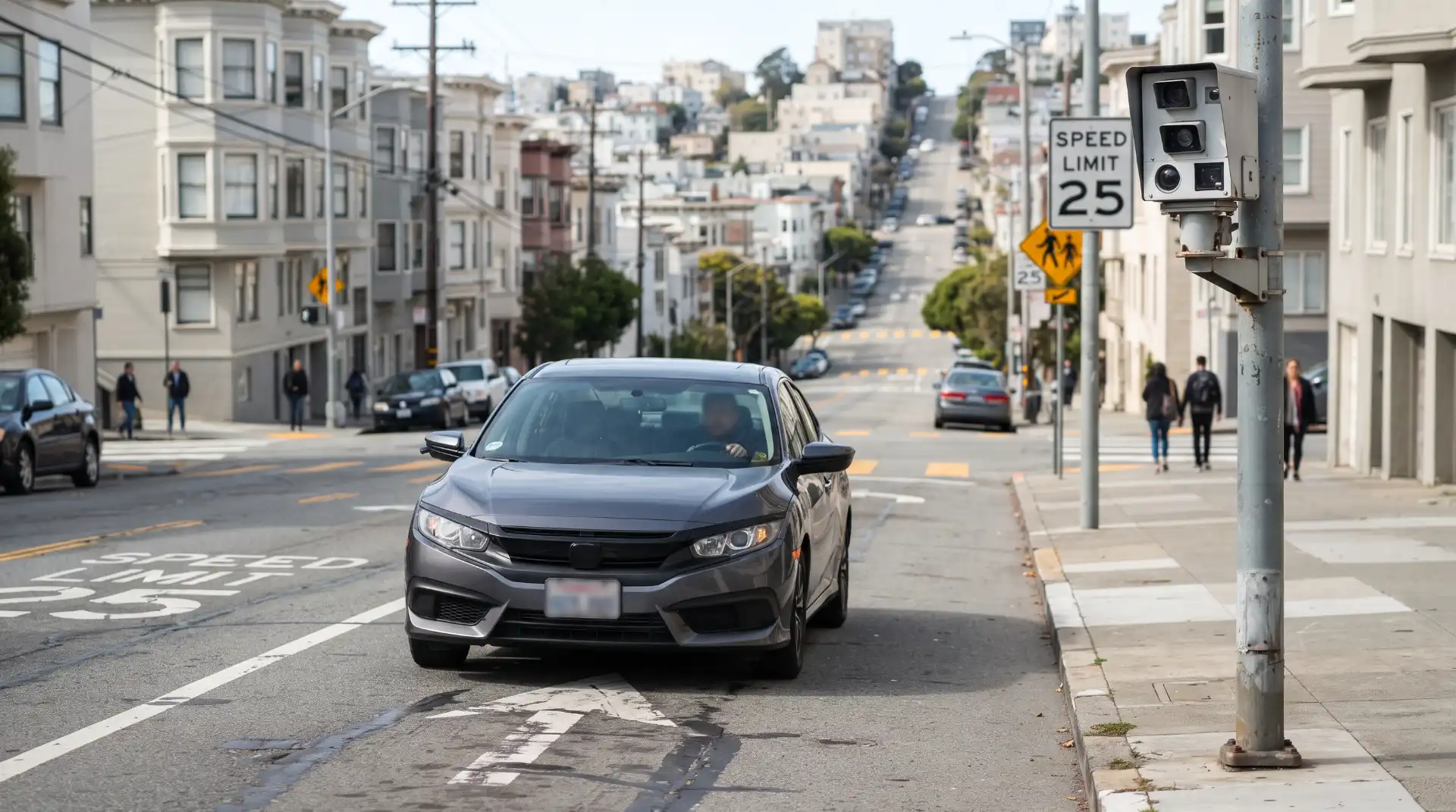
San Francisco drivers are becoming increasingly familiar with automated speed safety cameras. These cameras are now an established part of the city’s traffic-enforcement system, operating at designated locations throughout San Francisco and issuing civil speeding violations to qualifying vehicles. For motorists, the program creates a new reason to pay close attention to posted speed limits, but it also raises an important question for people involved in collisions: Can a speed camera ticket affect a San Francisco car accident claim?
The short answer is that a speed camera ticket and car accident liability are related issues, but they are not automatically the same thing. A driver receiving an automated speeding citation does not automatically become responsible for a later collision. At the same time, evidence showing that a driver was traveling at an excessive or unsafe speed can become important when investigators, insurance companies, attorneys, or courts examine how a particular crash occurred.
This distinction is especially important in San Francisco because the city combines dense traffic, pedestrians, bicyclists, public transportation, steep streets, busy intersections, narrow roadways, and heavily traveled corridors. A driver who is traveling too quickly may have less time to react when traffic suddenly stops, a pedestrian enters a crosswalk, a cyclist moves into an intersection, or another vehicle makes an unexpected maneuver.
What Are San Francisco Speed Safety Cameras?
San Francisco speed safety cameras are automated enforcement devices designed to identify vehicles traveling above specified speed thresholds at designated locations. Unlike a traditional speeding citation issued by a police officer who personally observes a driver, an automated speed safety camera uses equipment to document the vehicle and alleged speeding violation.
The San Francisco Municipal Transportation Agency, commonly known as SFMTA, administers the city’s speed safety camera program. The program was established under California’s automated speed enforcement legislation and is intended to address excessive speeding on streets where traffic safety concerns have been identified.
The program includes 33 camera locations across San Francisco. Drivers who want to check the current locations, enforcement rules, and penalty information can review the SFMTA Speed Safety Cameras information page, which provides the city’s current official information about the program.
The cameras are part of a broader effort to reduce dangerous speeding. SFMTA has reported significant reductions in the amount of excessive speeding recorded at camera locations since automated enforcement began. That information is useful for understanding the purpose of the program, although a reduction in speeding at camera locations does not mean that every San Francisco collision is caused by speeding.
When Did San Francisco Start Issuing Speed Camera Tickets?
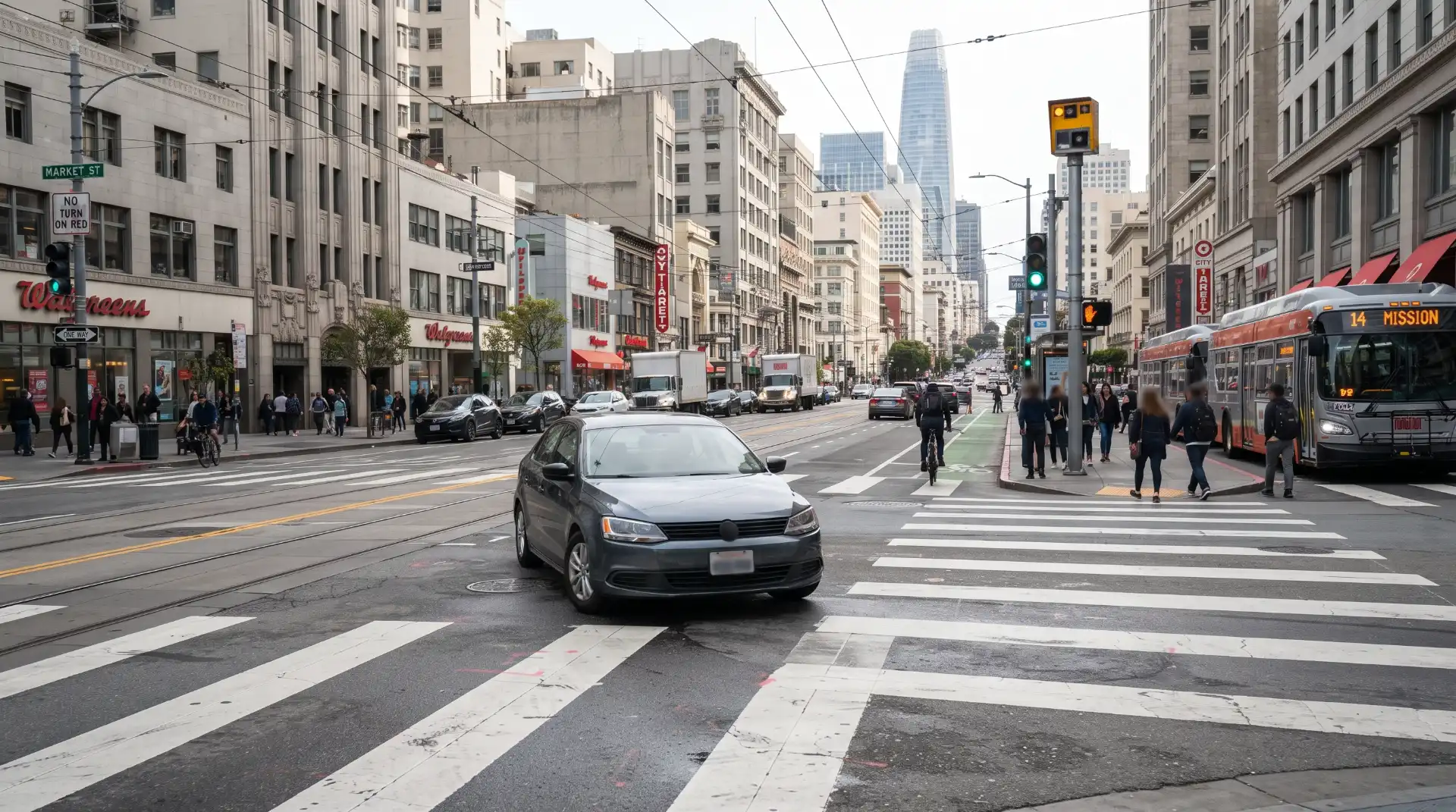
San Francisco’s speed safety camera program began operating in stages. Cameras were initially used for warnings before the city transitioned to actual civil penalties. The SFMTA began issuing speed camera violations at the city’s designated locations in August 2025.
The transition gave drivers an opportunity to become familiar with the new enforcement system. After the warning period ended, qualifying speeding events could result in civil penalties.
This timing matters because older information online may describe San Francisco’s speed cameras as a planned or upcoming program. The system is now operational, and motorists traveling through designated enforcement areas should pay attention to posted speed limits and roadway conditions.
How Much Is a San Francisco Speed Camera Ticket?
The amount of a San Francisco automated speeding penalty depends on how far above the posted speed limit the vehicle was traveling. The current SFMTA information identifies different civil penalty amounts depending on the recorded speed.
A vehicle recorded traveling 11 to 15 mph over the posted limit can result in an original civil penalty of $50. Traveling 16 to 25 mph over the limit can result in a $100 penalty, while traveling 26 mph or more over the posted limit can result in a $200 penalty. A vehicle recorded traveling at 100 mph or more can result in a $500 penalty.
These amounts are separate from the potential financial consequences of causing a collision. A speed camera citation is a civil traffic penalty. A personal injury claim following a crash involves different questions, including whether a driver’s conduct contributed to the accident and whether another person suffered compensable damages.
Do Speed Camera Tickets Put Points on Your California Driver’s License?
One important feature of San Francisco’s automated speed safety camera program is that these violations are treated as civil penalties rather than ordinary moving violations that result in driver-license points.
Drivers should nevertheless understand that the absence of license points does not mean that speeding can never become relevant in another legal matter. A car accident investigation involves different questions. If evidence indicates that excessive speed contributed to a collision, the driver’s speed may become an important part of the investigation.
Does a Speed Camera Ticket Automatically Make a Driver Liable for an Accident?
No. Receiving a speed camera ticket does not automatically establish liability for a car accident.
Consider a driver who receives an automated speeding notice on a San Francisco street in the morning and is involved in an unrelated collision several hours later. The earlier camera citation would not automatically prove that the driver caused the later accident.
The situation can be different when speeding occurs immediately before or during a collision. If a vehicle is documented traveling at an excessive speed shortly before striking another vehicle, investigators may examine whether that speed affected the driver’s ability to stop, react, yield, maintain control, or avoid the collision.
The key issue is the relationship between the alleged speeding and the accident. A traffic violation and the cause of a collision are not necessarily the same question.
For example, imagine that one driver is traveling above the posted speed limit while another driver suddenly turns across the roadway without yielding. Investigators may need to determine whether the speeding driver could have avoided the crash by traveling at a lower speed, whether the other driver’s maneuver independently created the collision, and whether both drivers’ actions contributed to the outcome.
Why Speed Matters in San Francisco Car Accidents
Speed can affect a driver’s ability to respond to hazards in several ways. As vehicle speed increases, the distance traveled during the driver’s reaction time also increases. A faster vehicle may then require additional distance to slow or stop.
This can become particularly important in San Francisco because many streets involve frequent changes in traffic conditions. A driver may move from a relatively open roadway into an area with parked vehicles, pedestrians, cyclists, buses, delivery vehicles, and frequent intersection activity within a short distance.
A driver traveling too fast for those conditions may have less opportunity to respond to something unexpected.
For example, a vehicle traveling through a commercial corridor may encounter a pedestrian entering a crosswalk, a Muni vehicle stopping, a cyclist approaching an intersection, or traffic suddenly backing up. If the driver’s speed leaves insufficient time or distance to respond, the risk of a collision can increase.
Speed can also affect the severity of a collision. When vehicles collide at higher speeds, the forces involved can be greater, potentially increasing vehicle damage and the seriousness of injuries.
San Francisco’s Basic Speed Law Is Important
Drivers should also understand that California traffic law is not limited to posted speed limits.
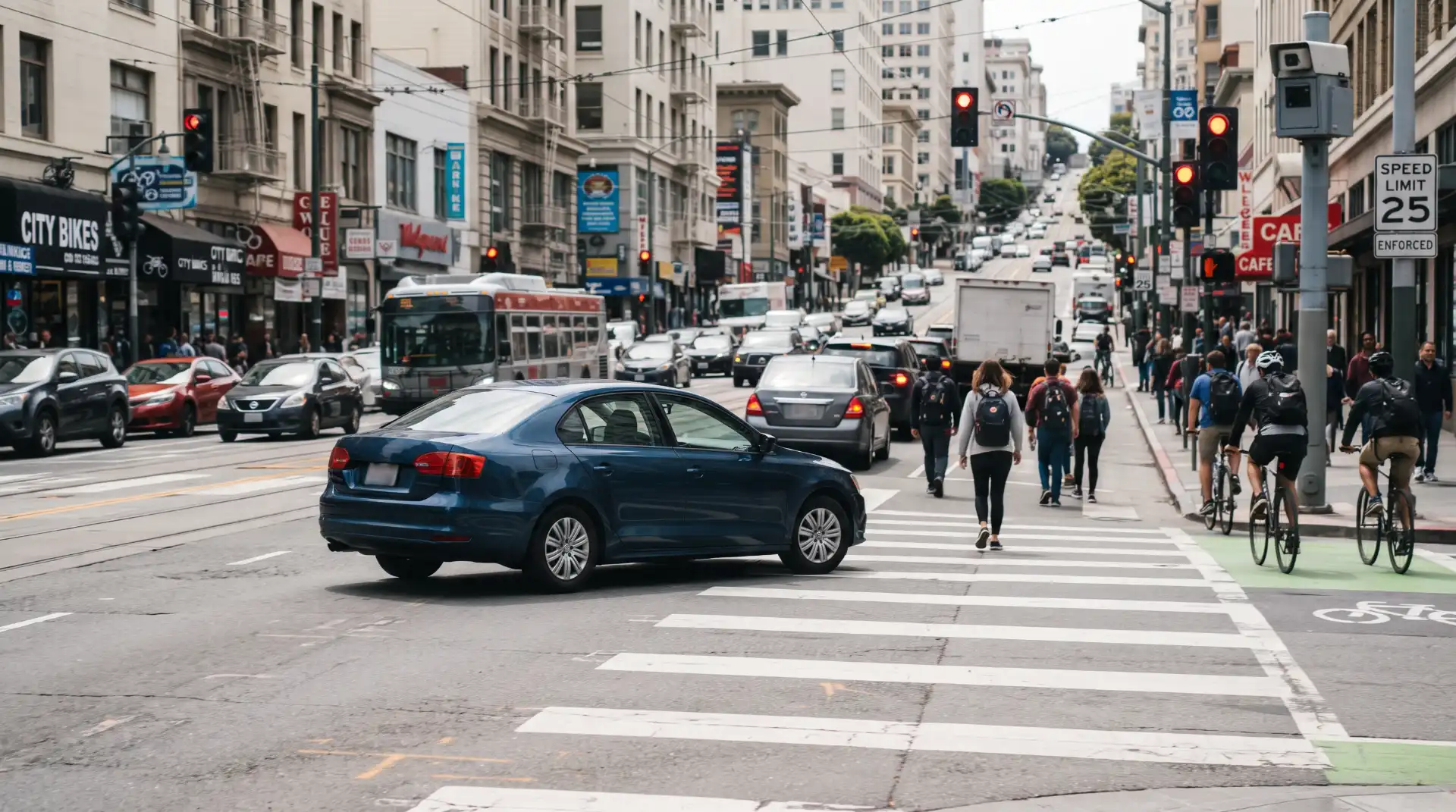
California’s Basic Speed Law requires drivers to travel at a speed that is reasonable or prudent under the circumstances. Factors can include traffic, weather, visibility, roadway conditions, and the presence of pedestrians and other road users.
This means that a driver cannot always assume that traveling exactly at the posted speed limit is automatically appropriate.
Imagine a street with a posted limit of 30 mph. If traffic is suddenly congested, visibility is poor, pedestrians are crossing nearby, or the roadway is affected by unusual conditions, a driver may need to reduce speed even though the posted limit remains 30 mph.
The Basic Speed Law can therefore become relevant in accident investigations where the question is not simply whether a driver exceeded a posted number but whether the driver’s speed was reasonable for the circumstances.
Speed Camera Tickets and Rear-End Collisions
Rear-end collisions are common in busy urban traffic. They can occur when one driver follows another vehicle too closely, fails to recognize stopped traffic, becomes distracted, or is unable to stop in time.
Speed can become an important part of that analysis. A driver traveling too quickly may have less time to recognize that traffic ahead has stopped. If the driver also follows too closely, the combination can make a collision more likely.
San Francisco traffic congestion can make these situations particularly challenging. Vehicles may stop suddenly near intersections, pedestrian crossings, construction areas, and public transportation stops.
For additional information about how evidence can be used when determining responsibility, readers can review How to Prove Fault in a San Francisco Car Accident. That article discusses evidence such as police reports, witnesses, traffic-camera footage, dashcam recordings, photographs, medical records, and accident reconstruction evidence.
When a collision involves allegations of speeding, these types of evidence can become especially useful because they may help establish vehicle positions, traffic conditions, and the sequence of events immediately before the crash.
Speeding at San Francisco Intersections
Intersections deserve particular attention when examining speeding-related crashes.
A driver approaching an intersection may need to respond to multiple sources of information at once. Traffic signals can change, pedestrians may enter crosswalks, cyclists may cross through the intersection, and other vehicles may turn or change lanes.
When a vehicle is traveling too quickly, the driver may have less time to process these changes and take appropriate action.
Visibility is another important consideration. San Francisco has implemented street-safety measures intended to improve visibility around crosswalks and intersections. Parked vehicles, large trucks, delivery vehicles, vegetation, construction equipment, and other obstructions can affect what drivers and pedestrians see.
This issue is particularly relevant when speed and visibility overlap. The site’s article Daylighting and Safety Zones: How Blocked Sightlines Affect Crash Fault explains how blocked sightlines can affect the circumstances surrounding an intersection collision and why visibility may become part of a crash investigation.
When speed and visibility problems occur together, the investigation may need to consider both. A driver might argue that a pedestrian or vehicle appeared suddenly, while other evidence could show that the driver was traveling too fast for the available sight distance.
Can Speed Camera Evidence Be Relevant to a Car Accident?
Potentially, but the answer depends on the circumstances.
Speed safety cameras are primarily designed to enforce speeding laws rather than reconstruct automobile accidents. Their records should therefore not automatically be treated as a complete record of everything that happened during a collision.
Nevertheless, automated enforcement information may become relevant when the timing and location of a speeding event overlap with an accident investigation.
For example, if a vehicle was recorded traveling at an excessive speed immediately before a collision in the same general area, investigators may examine whether the information helps establish the vehicle’s movement before the crash.
Other evidence may still be necessary. Accident investigations can involve dashcam footage, traffic-camera footage, witness statements, photographs, vehicle damage, roadway evidence, electronic vehicle information, police reports, and other available records.
Readers who want to understand the importance of preserving this type of evidence can also review What to Do After a Car Accident in San Francisco: A Step-by-Step Guide. The guide explains why photographs, witness information, police documentation, and prompt reporting can be important after a collision.
The important point is that no single piece of evidence necessarily tells the entire story. A camera record showing speeding may establish one fact, while video or witness evidence may establish another. Investigators may need to compare all available information to understand how the collision happened.
What If a Driver Was Speeding but Another Driver Caused the Crash?
This is one of the most important questions in speeding-related accident claims.
A driver can violate a traffic rule without necessarily causing a particular accident.
For example, suppose Driver A is traveling above the posted speed limit. Driver B then turns left across Driver A’s path without yielding. The investigation may need to determine whether Driver A’s speed contributed to the collision and whether Driver B’s failure to yield was another contributing factor.
The answer could depend on evidence about distances, speeds, traffic signals, reaction times, vehicle positions, visibility, and other circumstances.
California uses comparative-fault principles when multiple parties contribute to an accident. This means that an investigation may consider the conduct of more than one person rather than assuming that a single traffic violation explains the entire collision.
How Insurance Companies May Consider Speed
Insurance companies may examine speeding when evaluating a claim because speed can be relevant to whether a driver acted reasonably and whether that conduct contributed to the accident.
An insurer may review the police report, photographs, witness statements, vehicle damage, available video, traffic conditions, citations, and other evidence.
A speed camera citation may become part of that broader evidence picture, but its existence does not automatically establish the percentage of fault assigned to a driver.
For example, an insurer might investigate a collision where one driver was allegedly speeding while another driver changed lanes improperly. The insurer may need to consider evidence regarding both actions rather than focusing exclusively on the speeding allegation.
W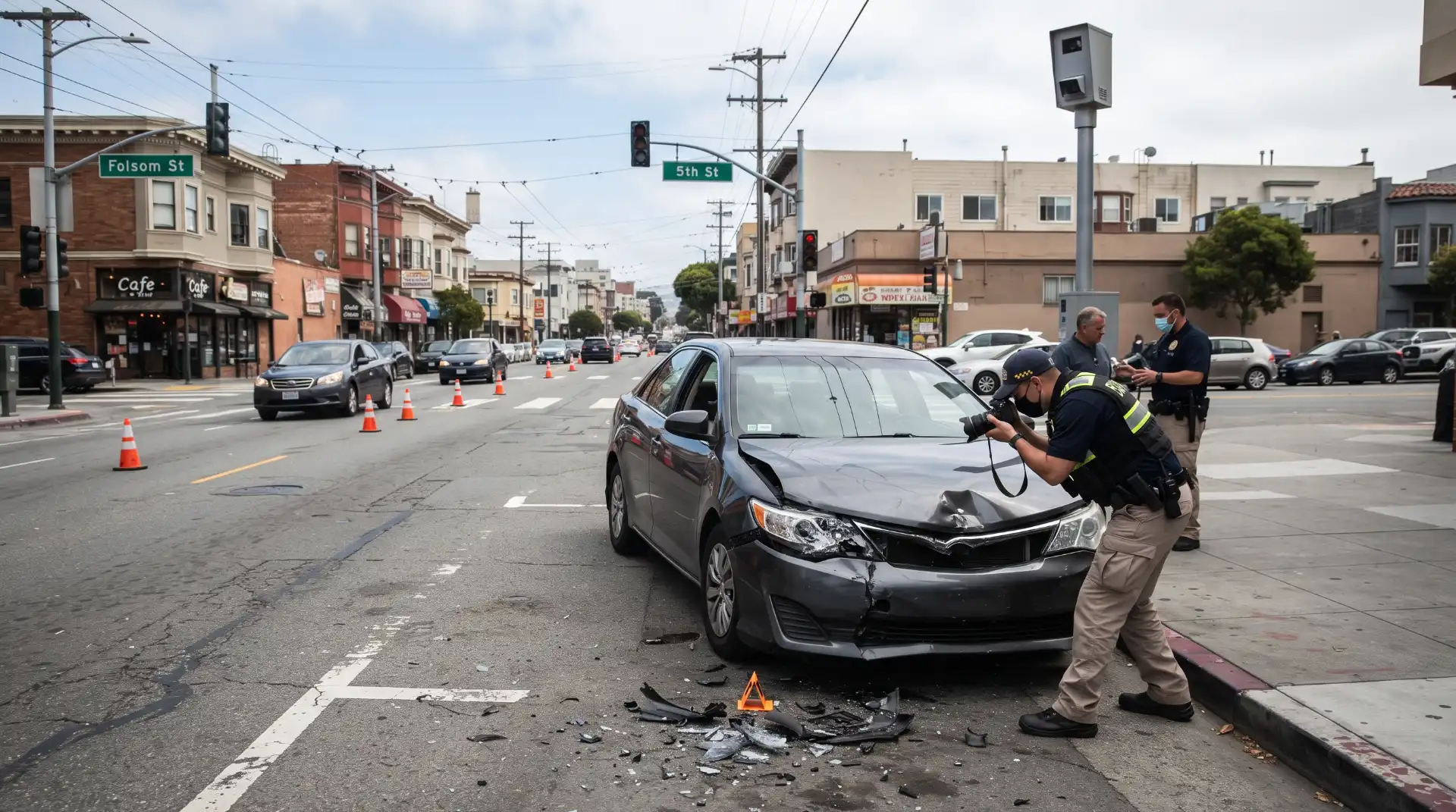 hat Evidence Can Show How Fast a Vehicle Was Traveling?
Determining vehicle speed after an accident can be challenging, particularly when no camera or witness directly records the vehicle’s speed immediately before impact.
Investigators may examine several forms of evidence. Dashcam video can show how quickly a vehicle approaches an intersection or another vehicle. Traffic surveillance footage may provide another perspective. Witnesses may describe how fast a vehicle appeared to be traveling, although visual estimates of speed are not always precise.
Physical evidence can also matter. Skid marks, vehicle damage, debris patterns, vehicle positions, and roadway measurements may provide information that helps reconstruct the collision.
Some modern vehicles also contain electronic information that may be useful in understanding events surrounding a crash, depending on the vehicle and circumstances.
When several sources of evidence are available, investigators may compare them to determine whether they tell a consistent story.
What Drivers Should Do After a San Francisco Car Accident
Anyone involved in a San Francisco collision should first focus on safety and medical needs. If someone is seriously injured, emergency assistance should be requested immediately.
When it is safe and appropriate, drivers should document the accident scene. Photographs can be particularly useful because roadway conditions can change quickly.
Instead of photographing only the damaged vehicles, consider documenting the surrounding roadway, lane markings, traffic signals, crosswalks, road signs, visible skid marks, debris, nearby vehicles, and any conditions that may have affected visibility.
If witnesses are present, obtaining their contact information can also be useful. Independent witnesses may have observed the vehicles before the collision and may be able to provide information about traffic conditions or vehicle movement.
Drivers should also exchange required information and report the accident when appropriate. Medical evaluation should not be delayed simply because an injury does not initially appear severe.
For a more detailed explanation of these immediate steps, read What to Do After a Car Accident in San Francisco: A Step-by-Step Guide.
Why Preserving Evidence Quickly Matters
Evidence can disappear quickly after a San Francisco accident.
A nearby vehicle may leave the area. A delivery truck may move. Construction equipment may be relocated. Traffic conditions may return to normal. A business or traffic camera may eventually overwrite older footage.
These issues can become especially important when a collision involves a dispute about speed.
Suppose one driver claims that another vehicle was traveling at an excessive speed. A nearby surveillance camera might have captured the approaching vehicles. If that footage is not preserved, an important source of evidence could eventually become unavailable.
The same principle applies to roadway conditions. If a driver’s view was blocked by a parked vehicle, construction equipment, or another obstruction, photographs taken shortly after the crash may help document what the roadway looked like at the time.
Preserving photographs, video, medical records, vehicle repair documentation, witness information, and other relevant records can help create a more complete record of the accident.
Do Speed Camera Tickets Prove Negligence?
A speed camera ticket may document an alleged speeding violation, but the ticket alone does not necessarily establish every element of negligence in a personal injury case.
A negligence analysis generally involves questions about the driver’s conduct, whether a duty was breached, whether that conduct caused the accident, and whether the accident resulted in legally recognized damages.
For example, if a driver receives a speed camera ticket weeks before an unrelated crash, that citation does not necessarily establish that the driver was negligent in the later collision.
However, evidence that a driver was speeding at or immediately before the time of an accident may be more directly relevant to the collision investigation.
The distinction between a citation and proof of causation is therefore important. A ticket can be one piece of information, but the broader circumstances surrounding the accident still matter.
San Francisco Speed Cameras and Pedestrian Safety
Speed is particularly important when vehicles share the road with pedestrians and bicyclists.
San Francisco’s camera locations include areas with schools, parks, pedestrian activity, and busy commercial corridors. SFMTA has reported substantial reductions in speeding at camera locations since the program began.
These statistics describe speeding behavior at monitored locations and should not be interpreted as proving that every type of San Francisco collision has decreased because of the program.
Drivers still need to watch for pedestrians, cyclists, buses, motorcycles, and other vehicles. Speed should be adjusted to the actual conditions on the road rather than treated as a number that can be followed without considering the surroundings.
Why San Francisco Drivers Should Pay Attention to Posted Speed Limits
The introduction of automated enforcement makes it more important for San Francisco drivers to pay attention to posted speed limits.
Drivers should not assume that they will receive a warning before a violation results in a civil penalty. The warning phase of the city’s program has already ended.
Drivers should also avoid relying on the location of cameras as a guide for when to slow down. The absence of a camera does not mean that speeding is safe or lawful under all circumstances.
California’s Basic Speed Law continues to require motorists to operate at a reasonable and prudent speed based on the circumstances.
This is especially important in neighborhoods with heavy pedestrian activity, school zones, crowded intersections, steep streets, poor visibility, construction, or changing traffic patterns.
How Speed Can Affect the Severity of a Collision
Speed is not only relevant to whether a crash occurs. It can also affect what happens when vehicles collide.
A higher-speed impact can involve greater forces and may result in more extensive vehicle damage. Occupants can also experience significant forces during a collision, particularly when a vehicle strikes another object at a substantial speed.
This is one reason speed-related investigations can matter in serious injury cases.
An investigation may need to examine whether a driver’s speed contributed to the initial collision, whether it affected the driver’s ability to avoid the accident, and whether the speed influenced the severity of the resulting impact.
Each accident is different, and conclusions should be based on the evidence available for that specific collision.
Common Mistakes Drivers Make After a Speed-Related Accident
One common mistake is assuming that the driver who received a ticket is automatically responsible for the entire collision.
Another mistake is assuming that a driver who was below the posted speed limit cannot be responsible for a speed-related problem. California’s Basic Speed Law requires drivers to consider conditions beyond the posted number.
Drivers should also avoid deleting or discarding potentially relevant photographs, video, messages, vehicle records, or other evidence.
Another problem can arise when drivers make statements about fault before all of the facts are known. An accident scene can be confusing, particularly when multiple vehicles, pedestrians, cyclists, traffic signals, or road conditions are involved.
A more useful approach is to document what can be observed, obtain appropriate medical attention, preserve evidence, and allow the accident investigation to establish the sequence of events.
Frequently Asked Questions About San Francisco Speed Camera Tickets
Do San Francisco speed camera tickets add points to a driver’s license?
Automated speed safety camera violations under the California pilot program are civil penalties and are not used for driver-license point assessment, suspension, or revocation in the manner described by the DMV for ordinary negligent-operator violations.
How much is a San Francisco speed camera ticket?
The current SFMTA penalty schedule identifies different civil penalties based on how far above the posted speed limit a vehicle is traveling. Drivers should check the current official SFMTA information when responding to a notice.
Does a speed camera ticket automatically prove I caused an accident?
No. A speed camera ticket does not automatically establish that a driver caused a particular collision. The investigation must consider the circumstances of the accident and whether the driver’s speed contributed to the crash.
Can speeding affect a San Francisco personal injury claim?
Potentially. If evidence shows that excessive or unsafe speed contributed to a collision, speeding may become relevant when evaluating negligence, causation, and responsibility for damages.
Can someone be driving too fast even when they are below the speed limit?
Yes. California’s Basic Speed Law requires drivers to operate at a reasonable and prudent speed for the circumstances. Weather, traffic, visibility, pedestrians, bicyclists, and roadway conditions can all affect what speed is appropriate.
Are San Francisco speed camera tickets criminal charges?
No. The SFMTA describes the automated speed-camera violations as civil penalties.
How many speed cameras are operating in San Francisco?
The SFMTA’s current program includes 33 speed safety camera locations throughout San Francisco.
Can speed camera information be relevant after a car accident?
It can potentially be relevant depending on the circumstances, particularly if the timing and location of an automated speeding event relate closely to the collision. However, camera information is only one potential source of evidence and does not automatically determine liability.
Final Thoughts for San Francisco Drivers
San Francisco’s speed safety camera program has changed the traffic-enforcement environment for drivers throughout the city. With 33 camera locations currently operating, motorists should expect automated enforcement on designated corridors and should pay close attention to posted speed limits.
At the same time, a speed camera ticket should not be confused with a finding that a driver caused a particular car accident. A speeding citation documents an alleged violation, while accident liability requires examining the circumstances of the actual collision.
When a crash occurs, investigators may need to determine vehicle speeds, traffic conditions, roadway visibility, traffic signals, vehicle positions, driver actions, and the relationship between those factors and the collision.
Speed can be important because it can affect reaction time, stopping distance, vehicle control, and the severity of an impact. But speeding may be only one part of a much larger accident investigation.
For San Francisco drivers involved in a collision, preserving evidence can be especially important. Photographs, dashcam footage, traffic video, witness information, police reports, vehicle records, medical documentation, and roadway evidence may all help establish what happened.
For additional information about proving responsibility after a collision, visit How to Prove Fault in a San Francisco Car Accident. For immediate post-crash guidance, read What to Do After a Car Accident in San Francisco: A Step-by-Step Guide. Drivers dealing with visibility issues at intersections can also learn more from Daylighting and Safety Zones: How Blocked Sightlines Affect Crash Fault.
For current information about San Francisco’s automated speed enforcement program, camera locations, and applicable penalties, readers can also visit the official SFMTA Speed Safety Cameras page.
Drivers should remember that safe driving requires more than simply watching for speed cameras. Following posted limits, adjusting speed for conditions, watching carefully for pedestrians and cyclists, maintaining an appropriate following distance, and remaining alert can all help reduce the risk of a serious San Francisco collision.