
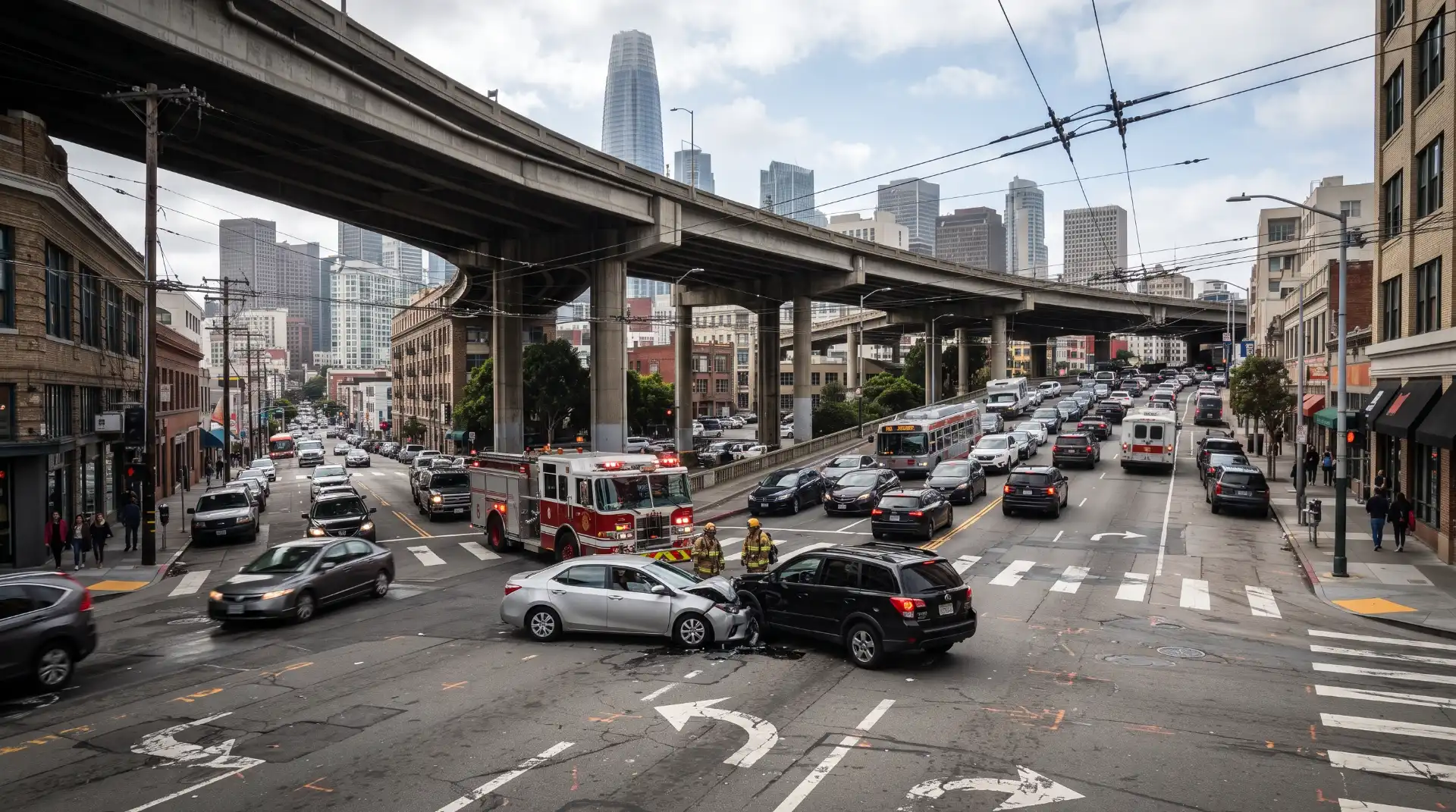
South of Market, commonly known as SoMa, is one of the busiest and most complicated driving environments in San Francisco. The neighborhood sits near major freeway connections, downtown streets, transit corridors, commercial districts, residential buildings, convention facilities, and entertainment venues. Drivers entering or leaving Interstate 80 and U.S. 101 may move within seconds from freeway-speed traffic into dense city intersections filled with pedestrians, cyclists, buses, delivery vehicles, rideshare cars, and turning traffic.
That combination makes freeway ramp accidents in SoMa different from many ordinary car crashes. A collision near an on-ramp or off-ramp may involve sudden lane changes, merging conflicts, backed-up traffic, unfamiliar drivers, confusing roadway geometry, or disputes over traffic signals and right of way. Some crashes also raise questions about roadway maintenance, construction, visibility, or the way freeway infrastructure connects with local streets.
Determining liability after one of these crashes can therefore require much more than simply identifying which vehicle struck the other. Investigators may need to examine lane positions, traffic flow, signal timing, vehicle speeds, driver behavior, roadway design, surveillance video, app data, commercial vehicle records, and even which public agency controlled a particular road segment.
For people injured in these crashes, understanding how California liability law applies can be important when dealing with insurers, evaluating fault, and preserving evidence. The following guide explains why SoMa freeway ramp accidents happen, who may be responsible, and what factors can affect a personal injury claim.
Why SoMa Freeway Ramps Create Complex Driving Conditions
SoMa is not built like a suburban highway interchange. Freeway ramps in and around the neighborhood connect directly into a dense urban street grid. Drivers leaving the freeway may immediately encounter signalized intersections, turning lanes, crosswalks, bus routes, bicycles, curbside activity, and vehicles entering or leaving parking facilities.
One of the biggest challenges is the rapid change in driving environment. A motorist may be traveling at freeway speeds and then need to slow quickly for stopped traffic at the end of an off-ramp. At the same time, local traffic may be crossing or turning through the ramp intersection. Drivers who are unfamiliar with San Francisco may also depend heavily on navigation systems and make last-second lane changes after realizing they are in the wrong lane.
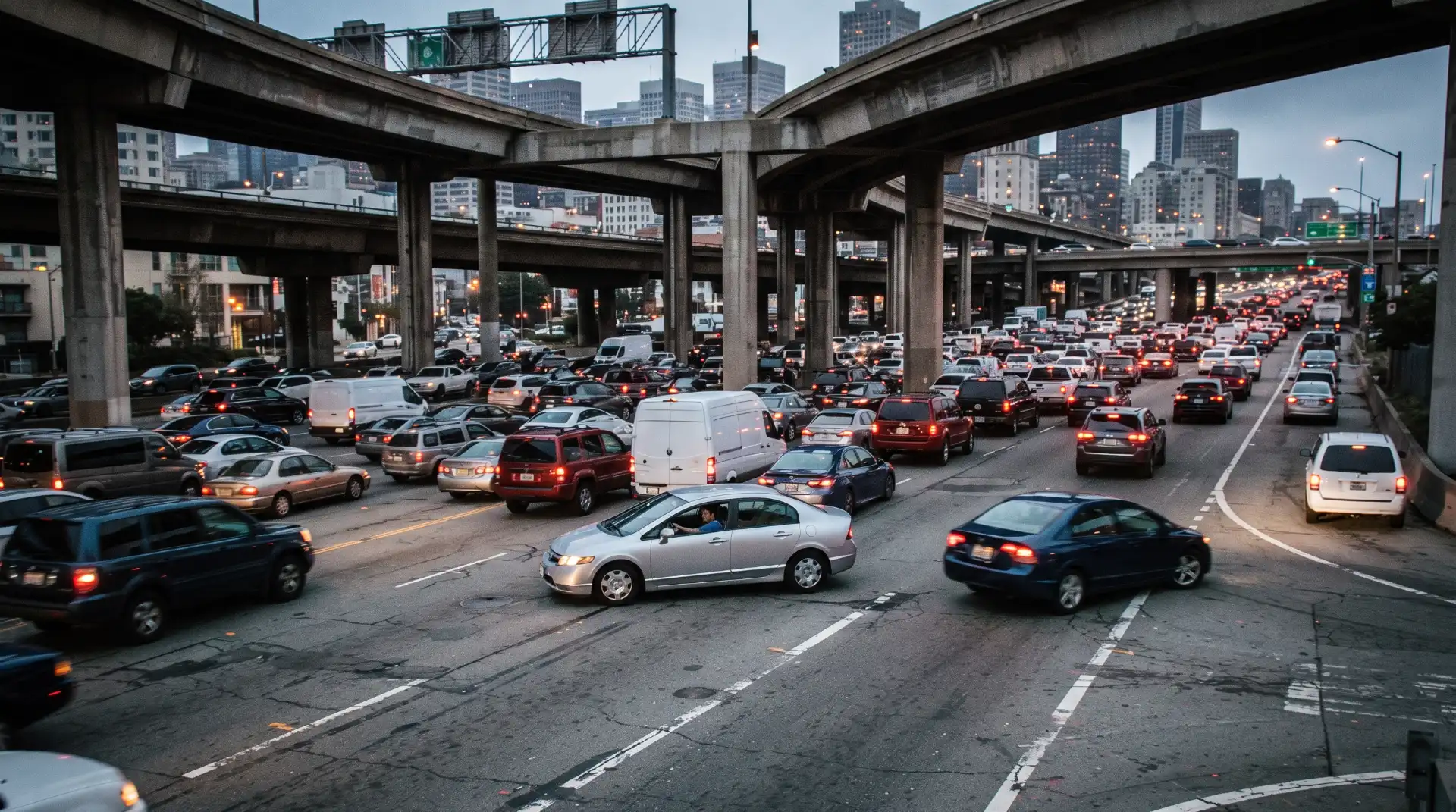
Traffic congestion adds another layer of risk. During peak travel periods, vehicles can queue onto ramps, block intersections, or stop abruptly. A driver watching for a merge opportunity may fail to notice that the vehicle ahead has stopped. Another motorist may become impatient and try to move around backed-up traffic, creating a sideswipe or angle collision.
SoMa also has significant pedestrian and bicycle traffic. This means drivers exiting freeway ramps cannot focus only on other cars. They must also watch for people crossing at intersections, cyclists traveling alongside traffic, buses entering or leaving stops, and delivery vehicles temporarily obstructing visibility.
These factors can make liability disputes more complicated because more than one action may contribute to the collision.
Major Freeway Connections in and Around SoMa
SoMa is closely connected to Interstate 80 and U.S. 101. These routes carry drivers toward the Bay Bridge, the Peninsula, downtown San Francisco, and other parts of the Bay Area.
The Eastbound I-80 4th Street off-ramp is one example of freeway infrastructure serving the neighborhood. Caltrans has continued rehabilitation work on Central and Bayshore freeway viaducts, including work affecting the 4th Street off-ramp. These projects reflect the age, traffic load, and importance of the freeway structures running through this part of San Francisco.
Freeway entrances and exits near Harrison Street, Bryant Street, 4th Street, 5th Street, 7th Street, and other SoMa corridors can place drivers into busy surface-street environments almost immediately after leaving the highway.
Not every intersection near a freeway ramp is inherently dangerous, and crash history alone does not prove that a roadway is defective. However, San Francisco uses its High Injury Network to identify corridors where severe and fatal traffic injuries are concentrated. The system helps transportation agencies focus safety improvements on areas where serious crashes have historically occurred.
For drivers, the practical point is that SoMa contains many locations where freeway traffic, downtown congestion, and multimodal transportation overlap. That overlap can increase the number of potential conflicts at a single intersection.
Common Causes of Freeway Ramp Accidents in SoMa
Although every collision is different, several patterns frequently appear in ramp-related crashes.
Unsafe Lane Changes
Lane changes are one of the most common sources of conflict near freeway ramps. Drivers may realize too late that they need to move left or right to reach the correct ramp or surface street. Instead of continuing safely and rerouting, they may cut across multiple lanes.
A driver who changes lanes without checking mirrors, blind spots, or surrounding traffic may collide with a vehicle already occupying the lane. If the maneuver causes another motorist to brake suddenly or swerve, additional vehicles may also become involved.
Rear-End Collisions
Traffic often slows suddenly at the bottom of an off-ramp. Congestion, red lights, pedestrian crossings, turning vehicles, or blocked intersections can all create abrupt stops.
A motorist who follows too closely may not have enough room to react. Distracted drivers are especially vulnerable to this type of crash because they may not notice a traffic queue until it is too late.
Although the rear driver is often blamed in these situations, liability is not always automatic. Investigators may still consider whether another vehicle cut into the lane, stopped unexpectedly without reason, or created an emergency situation.
Failure to Yield
Merging areas require drivers to coordinate with one another. A motorist entering a traffic stream must yield when required and avoid forcing another vehicle out of its lane.
At the same time, drivers already on the roadway must operate reasonably and should not accelerate aggressively simply to prevent another vehicle from merging.
When two vehicles collide in a merge area, insurers may disagree over which driver had the better opportunity to avoid the crash.
Speeding or Driving Too Fast for Conditions
A driver does not need to exceed the posted speed limit to be traveling too fast for existing conditions. Heavy traffic, reduced visibility, construction, wet pavement, or an approaching queue may require slower speeds.
This issue is especially important for drivers transitioning from freeway travel to city streets. A motorist accustomed to higher freeway speeds may underestimate how quickly traffic can stop at a ramp terminal.
Distracted Driving
Navigation systems, rideshare apps, delivery instructions, text messages, and phone calls can all divert a driver’s attention.
Ramp environments require constant scanning. A few seconds of distraction can cause a driver to miss a red light, a stopped car, a pedestrian, or a vehicle entering from another lane.
Blocked Visibility
Large trucks, buses, parked vehicles, construction barriers, and temporary equipment may reduce visibility near intersections.
San Francisco has increasingly emphasized daylighting and safety zones to improve sightlines around intersections. Readers interested in that issue can review Daylighting and Safety Zones: How Blocked Sightlines Affect Crash Fault.
Construction and Lane Reconfigurations
Freeway rehabilitation or nearby construction may lead to temporary lane shifts, closures, detours, narrowed travel lanes, or unfamiliar traffic patterns.
Construction does not automatically create liability. Drivers still have a duty to pay attention and adjust to visible conditions. However, poorly marked work zones, confusing temporary signage, or dangerous traffic control could become relevant when investigating how a crash occurred.
How Negligence Determines Liability
Most California car accident claims are based on negligence. In general, the injured person must show that another party failed to act with reasonable care and that this failure caused the injuries.
In a freeway ramp accident, negligence may include speeding, failing to yield, following too closely, making an unsafe lane change, running a red light, driving while distracted, or failing to adjust to traffic conditions.
The physical point of impact alone does not always establish fault. For example, one driver may strike the side of another vehicle because that second vehicle suddenly entered the lane. Investigators therefore look at the events leading up to the collision, not just the final impact.
Evidence such as lane markings, traffic signals, surveillance video, witness accounts, vehicle damage, and electronic data can help reconstruct those events.
California’s Comparative Fault Rule
Not every crash has only one responsible driver. California follows a pure comparative fault system, which allows responsibility to be divided among multiple parties.
Suppose a driver suddenly merges from a freeway exit lane without enough space. Another driver approaching from behind is also speeding and looking at a phone. Both actions may have contributed to the collision.
In that situation, fault could potentially be divided between the two motorists. If an injured person is found partly responsible, the amount of compensation may be reduced according to that percentage of fault.
This is important because insurance companies often use comparative fault arguments to reduce claim value. They may argue that an injured driver could have reacted sooner, changed lanes differently, slowed earlier, or avoided the crash.
Strong evidence can help challenge unsupported fault allegations.
When an Employer May Share Liability
SoMa has constant commercial vehicle activity. Delivery trucks, couriers, contractors, service vehicles, rideshare drivers, and company cars travel through the neighborhood throughout the day.
If a driver causes a crash while acting within the scope of employment, the employer may sometimes be legally responsible for the employee’s negligence.
This matters because a commercial insurance policy may provide different coverage than a typical personal auto policy.
Investigators may examine whether the driver was making deliveries, traveling between work locations, transporting equipment, or performing another job-related task when the accident happened.
Employment status can be disputed, especially in app-based or contractor arrangements, so the facts of each case matter.
Rideshare and App-Based Drivers Near SoMa Freeway Ramps
Rideshare activity is common in SoMa because of hotels, offices, nightlife, events, convention facilities, and transportation hubs.
An Uber or Lyft driver may stop suddenly near the curb, cross multiple lanes to reach a passenger, look at the app for directions, or make an unexpected turn after receiving a ride request.
When a rideshare vehicle causes a crash, insurance coverage may depend on what the driver was doing at that exact moment. Coverage can differ depending on whether the driver was offline, logged into the app and waiting, traveling to pick up a passenger, or transporting a passenger.
Digital app records can become important evidence because they may establish the driver’s status and trip timeline.
Similar coverage questions may arise with peer-to-peer vehicle sharing. Readers can learn more in Turo and Peer-to-Peer Car Sharing Accidents in San Francisco.
Could Caltrans or the City Be Liable?
Some freeway ramp accidents involve allegations that the roadway itself contributed to the crash. Possible issues may include a malfunctioning traffic signal, missing signage, damaged pavement, poor visibility, confusing traffic control, or another hazardous condition.
When public property is involved, California Government Code section 835 may become relevant. Under that law, a public entity can potentially be liable when a dangerous condition of its property causes an injury and the required legal elements are established.
Generally, the injured person must show that the property was in a dangerous condition, the condition caused the injury, and the condition created a reasonably foreseeable risk of the type of injury that occurred. The claimant must also establish that the dangerous condition was created by a public employee’s negligent or wrongful act or that the public entity had actual or constructive notice of the condition with enough time to address it.
These are fact-intensive claims.
A crash occurring near a freeway ramp does not automatically make Caltrans responsible. Likewise, a collision on a San Francisco street does not automatically create city liability.
The investigation must determine which agency controlled the particular feature involved and whether the legal requirements for a dangerous-condition claim can actually be established.
Roadway Ownership Can Be Complicated
One reason SoMa ramp cases can become complicated is that responsibility for the roadway may change within a short distance.
The freeway and ramp may be part of the state highway system and fall under Caltrans. Nearby surface streets, traffic signals, crosswalks, curbs, or intersections may fall under the City and County of San Francisco.
If a collision occurs where those systems connect, investigators may need to identify who designed, maintained, operated, or controlled the specific condition at issue.
Public agencies may also raise defenses, including arguments involving design immunity, lack of notice, or lack of causation.
For that reason, a claim based on roadway conditions usually requires more detailed investigation than simply stating that an intersection appeared unsafe.
The Government Claim Deadline Can Be Much Shorter
California generally gives injured people two years to file many personal injury lawsuits under Code of Civil Procedure section 335.1.
However, claims against public entities have different procedural requirements. Government Code section 911.2 generally requires a claim involving injury to a person or personal property to be presented within six months after the cause of action accrues.
This means someone who suspects a dangerous roadway condition contributed to a crash should not assume that the ordinary two-year personal injury deadline is the only deadline that matters.
The shorter government claim period is one reason it is important to identify potential public-entity involvement early.
Important Evidence After a SoMa Freeway Ramp Accident
Evidence is especially important in ramp crashes because fault may depend on what happened in just a few seconds.
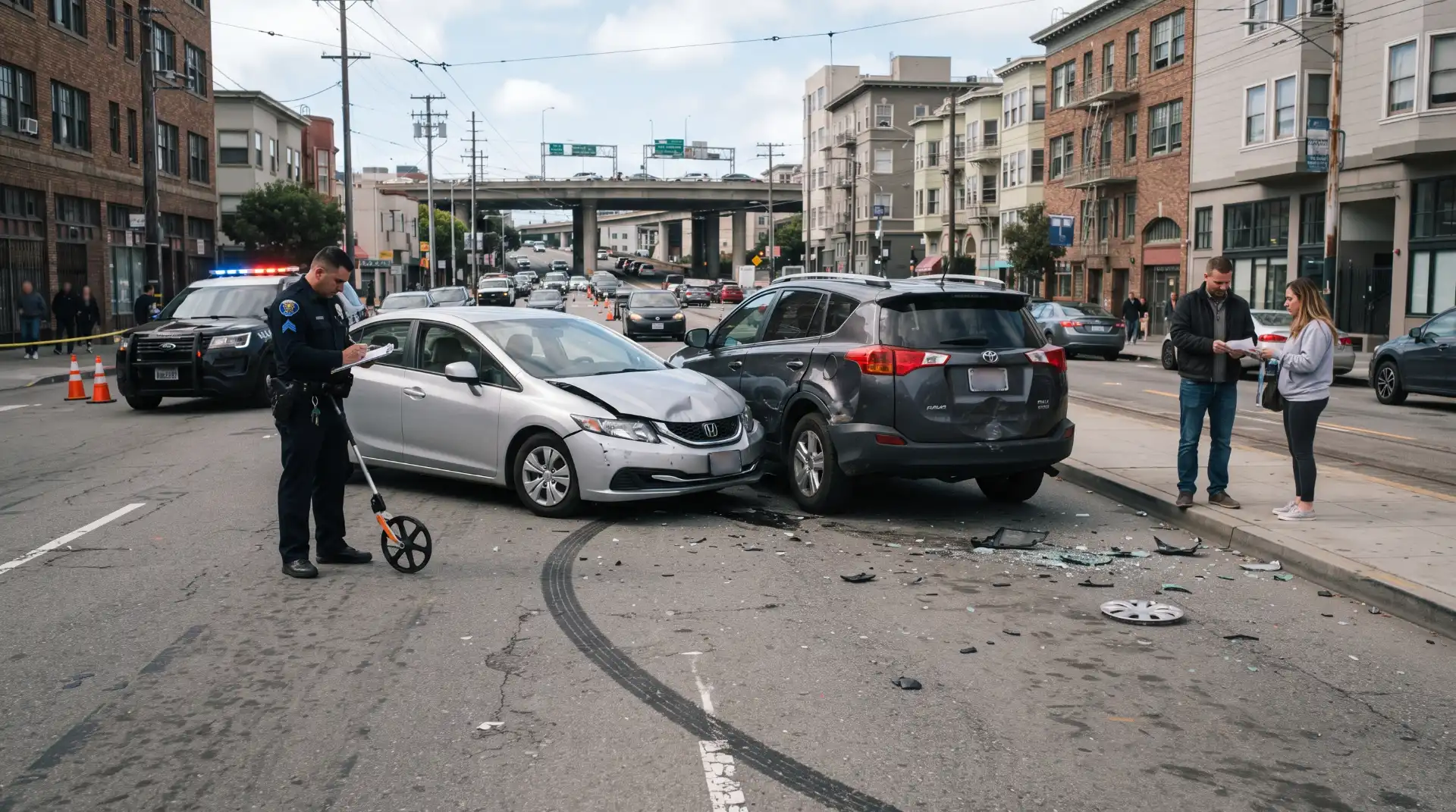
Photos should capture more than just vehicle damage. Wide-angle images can show where the ramp enters the intersection, which lanes were involved, how traffic signals were positioned, whether sightlines were blocked, and where debris or skid marks appeared.
Photos of road signs, pavement markings, lane arrows, construction barriers, cones, signals, and nearby crosswalks can also help establish the layout.
Video evidence can be even more useful. SoMa contains many commercial buildings, parking garages, transit vehicles, and businesses with exterior cameras. A nearby camera may show a lane change, signal phase, pedestrian movement, or the moments immediately before impact.
Dash-camera footage may also establish which driver entered a lane, whether traffic had stopped, or whether someone ran a light.
Witness statements can provide another independent source of evidence. A person walking nearby, waiting at a bus stop, or driving behind the vehicles may have seen which motorist made the unsafe move.
Vehicle and Digital Data
Modern vehicles may contain electronic information that becomes relevant after a serious crash. Event data recorders can sometimes provide information about speed, braking, throttle use, seat belts, and other vehicle activity shortly before impact.
Navigation history may help establish the driver’s planned route. Rideshare or delivery apps may show whether the driver was working and what instructions appeared on the device.
Cell-phone records may become relevant in cases involving suspected distraction, although access to those records generally requires appropriate legal procedures.
Commercial vehicles may generate additional records such as GPS data, dispatch records, delivery logs, telematics, or driver communications.
Police Reports and Accident Documentation
A police report can help identify drivers, witnesses, insurance information, road conditions, and sometimes the investigating officer’s observations.
Police reports do not always determine civil liability, but they are often an important starting point.
California drivers may also have a separate obligation to report the crash to the Department of Motor Vehicles. According to the California DMV, an SR-1 must generally be submitted within 10 days when someone is injured or killed or when property damage exceeds $1,000.
The SR-1 requirement applies separately from reports made to police, the California Highway Patrol, or an insurance company.
Readers looking for broader guidance can also visit What to Do After a Car Accident in San Francisco: A Step-by-Step Guide.
How Insurance Companies Evaluate Ramp Accidents
Insurance companies commonly examine the location of impact, statements from the drivers, police reports, photographs, witness information, and applicable traffic laws.
In disputed merge accidents, each insurer may initially blame the other driver.
One carrier may argue that the driver entering the lane failed to yield. The other may claim that the through driver was speeding, distracted, or intentionally refused to allow space.
Insurance adjusters may also look for inconsistencies between a driver’s statement and the physical evidence.
For example, someone may claim that the other car appeared suddenly, while video shows the vehicle traveling beside them for several seconds.
In serious cases, accident reconstruction may be used to analyze vehicle speeds, angles, braking, and roadway geometry.
Why Early Settlement Offers Can Be Risky
Some insurers make settlement offers soon after a collision, particularly when liability appears clear.
That may sound helpful, but an early offer can come before the injured person understands the full extent of the injuries.
Soft-tissue injuries, back injuries, concussion symptoms, shoulder injuries, and nerve problems may develop or become more serious over time.
If a settlement is accepted and a release is signed, the injured person usually cannot return later and request additional compensation simply because medical problems became worse.
For that reason, evaluating the full medical picture is often important before resolving a serious injury claim.
Common Injuries in SoMa Ramp Collisions
Ramp crashes can produce a wide variety of injuries.
Rear-end impacts often cause neck and back injuries. Side-impact crashes can cause shoulder, hip, rib, or head injuries. Sudden rotation of the vehicle can also produce spinal trauma or concussions.
Drivers and passengers may suffer knee injuries when their legs strike the dashboard or interior. Airbags and seat belts can prevent more serious harm but may still cause bruising, abrasions, or chest injuries during a forceful collision.
Secondary impacts can make the crash more severe. A vehicle struck near a ramp intersection may be pushed into another car, curb, barrier, traffic pole, cyclist, or pedestrian area.
When symptoms appear after a collision, prompt medical evaluation can help identify injuries and create documentation connecting the condition to the crash.
Damages Available After a Freeway Ramp Accident
The value of a California injury claim depends on the specific losses caused by the collision.
Recoverable damages may include emergency treatment, hospitalization, diagnostic testing, physical therapy, medication, follow-up appointments, surgery, and future medical care.
Lost income may also be recoverable when injuries prevent someone from working. If the injuries permanently affect the person’s ability to earn income, reduced earning capacity may become part of the claim.
Property damage may include vehicle repairs, replacement value in a total-loss situation, towing, storage, and related transportation costs.
Non-economic damages can include physical pain, emotional distress, inconvenience, and loss of enjoyment of normal activities.
The seriousness and duration of the injuries usually play a major role in determining the value of these damages.
What If a Disabled Vehicle Contributed to the Crash?
Freeway ramps can become especially dangerous when a vehicle breaks down or stops in an unexpected location.
A disabled vehicle may block part of a lane, force traffic to merge suddenly, or create a hazard that approaching drivers do not see in time.
Liability can depend on where the vehicle was stopped, whether the driver could move it, whether hazard lights were activated, and how approaching motorists responded.
For a deeper explanation, readers can review Car Accidents Involving Disabled Vehicles on California Highways.
What If a Muni Bus or Transit Vehicle Is Involved?
SoMa carries significant public transportation traffic. A crash near a freeway ramp may involve a bus turning through an intersection, stopping for passengers, or interacting with congested traffic.
Transit crashes can raise additional legal issues, particularly when a public agency is involved.
Public-entity claim deadlines may apply, and investigation may involve onboard cameras, driver records, transit schedules, or agency incident reports.
Readers can learn more through Muni Bus and Transit Accidents in San Francisco.
Steps to Take After a SoMa Freeway Ramp Crash
Safety should come first after any collision. If the vehicles can be moved safely and the situation requires it, drivers should avoid remaining in an exposed traffic lane where another collision could occur.
Emergency services should be contacted when someone is injured or the crash creates a traffic hazard.
If conditions are safe, photographs of the scene can be valuable. Try to document the vehicles, lane positions, roadway layout, traffic lights, signs, nearby construction, and visible injuries.
Drivers should exchange identification and insurance information and obtain contact details for witnesses when possible.
Medical evaluation should not be delayed simply because the injuries initially seem minor. Adrenaline can temporarily mask symptoms, particularly after a sudden high-stress event.
Insurance companies should also be notified as required by the policy, but injured people should be cautious about giving speculative statements about fault before all facts are known.
How Long Do You Have to File a Claim?
Under California Code of Civil Procedure section 335.1, many lawsuits for personal injuries caused by negligence must be filed within two years.
However, shorter deadlines can apply in certain situations.
If the claim may involve Caltrans, the City and County of San Francisco, or another public entity, the government claim rules may require action within six months.
Other circumstances can also affect deadlines, so the specific facts of the case should always be considered.
Readers who want an overview of the broader claims process can visit How to File a Personal Injury Claim After a San Francisco Car Accident.
Why Location Matters in a SoMa Ramp Case
The precise location of the collision can affect which traffic rules apply, which agency controls the roadway, where evidence may be located, and what witnesses or cameras may exist nearby.
A crash that occurs on an elevated freeway ramp may involve different evidence than a collision that occurs after the driver reaches the surface street.
Likewise, a collision at the intersection immediately below a freeway structure may involve both local street conditions and traffic flowing from the freeway.
Accurate location documentation can therefore become critical.
Photos, GPS data, police reports, vehicle location information, and nearby surveillance footage can help establish exactly where the crash occurred.
Why SoMa Freeway Ramp Liability Cases Can Become Complicated
Freeway ramp accidents in SoMa bring together many of the most difficult issues found in San Francisco auto accident claims.
There may be disputes about which driver had the right of way. Multiple vehicles may share fault. A delivery company or rideshare platform may be connected to one of the drivers. A roadway condition may raise questions about public-entity responsibility. Video may contradict the initial police report. Insurance companies may disagree about coverage.
For those reasons, these cases are often built through careful investigation rather than assumptions.
The strongest liability analysis usually considers the complete traffic environment, the movements of every involved vehicle, the available physical evidence, and the applicable California laws.
Final Thoughts
Freeway ramp accidents in SoMa can happen in seconds, but determining responsibility may take much longer. The neighborhood’s combination of freeway traffic, busy intersections, commercial vehicles, public transit, pedestrians, cyclists, construction activity, and narrow decision-making windows makes these crashes especially complex.
In some cases, one driver’s negligence is clearly responsible. In others, several motorists may share fault. Commercial employers, rideshare-related insurers, vehicle owners, or public entities may also become part of the investigation depending on the circumstances.
Evidence is often the key to resolving these disputes. Scene photographs, surveillance footage, witness statements, police reports, vehicle data, app records, medical documentation, and roadway records can all help establish what happened and who should be held responsible.
Because different deadlines may apply, especially when public property or a government entity may be involved, injured people should avoid assuming that every California accident claim follows the same timeline.
Understanding the location, preserving evidence, documenting injuries, and identifying all potentially responsible parties can help create a clearer picture of liability after a serious SoMa freeway ramp accident.
Frequently Asked Questions About SoMa Freeway Ramp Accidents
Who is usually at fault in a freeway ramp accident?
There is no automatic rule that makes either the merging driver or the driver already in traffic responsible. Fault depends on how the crash occurred. A driver may be liable for making an unsafe lane change, failing to yield, speeding, following too closely, or driving while distracted.
Can two drivers both be responsible?
Yes. California’s comparative fault system allows responsibility to be divided among multiple people. If both drivers made mistakes that contributed to the collision, each may receive a percentage of fault.
Can Caltrans be liable for a freeway ramp crash?
Potentially, but only when the legal requirements for public-entity liability are satisfied. The fact that a crash happened on or near a state highway does not automatically make Caltrans liable. Evidence must connect a qualifying dangerous condition to the injury and satisfy California’s public-entity liability rules.
Can the City of San Francisco be responsible for an unsafe intersection?
A public-entity claim may be possible if a dangerous condition of city-controlled property contributed to the crash and the requirements of Government Code section 835 are met. These claims are highly fact-specific.
How quickly must a government claim be filed?
California Government Code section 911.2 generally requires claims involving personal injury against a public entity to be presented within six months after accrual. This is significantly shorter than the general two-year personal injury lawsuit deadline.
What evidence is most useful in a ramp accident?
Useful evidence may include photographs, video, witness statements, police reports, roadway markings, traffic signal information, vehicle data, app records, medical records, and documentation of the exact location of the crash.
Should I report the accident to the DMV?
The California DMV generally requires an SR-1 report within 10 days if anyone was injured or killed or if property damage exceeds $1,000. The DMV report is separate from a police or insurance report.
What happens if a delivery driver caused the crash?
If the driver was performing job duties at the time, the employer may potentially share responsibility depending on the employment relationship and circumstances. Commercial insurance coverage may also apply.
What if an Uber or Lyft driver caused the accident?
Liability for the driver’s conduct is analyzed under ordinary negligence rules, but insurance coverage can depend on the driver’s status in the app at the time of the collision.
Can I recover compensation if I was partly responsible?
Potentially, yes. California follows pure comparative fault. An injured person’s compensation may be reduced by their percentage of responsibility rather than automatically eliminated because they shared some fault.